Reviewed and updated: 21 July 2026.
The 60-second verdict
A discovery-call recording can accelerate a client proposal only when the draft preserves the buyer’s real problem, constraints and decision criteria without inventing scope, pricing or promises. AI should organise evidence from the conversation, not negotiate on behalf of the seller.
Decision focus: use the method below only where it produces a recoverable source, a verifiable output and a clear next action. If one of those fails, change the workflow rather than trusting a polished summary.
Quick verdict: capture an authorised discovery call, verify the client’s wording and commercial facts, build the proposal from a controlled evidence matrix and require accountable review of scope, claims, pricing and commitments before sending.
Evidence basis and limits
- Decision factors covered: Define the proposal evidence; Create an evidence matrix; Separate client statements from seller interpretation.
- Evidence rule: Claims are weighted by consequence: capture failure, changed meaning, access and recovery matter more than polished wording.
- Boundary: Examples and workflow recommendations must be tested with representative recordings, the intended users and the actual approval process before rollout.
Define the proposal evidence
Extract and verify:
- Client situation
- Problem or opportunity
- Desired outcomes
- Current process
- Constraints
- Stakeholders
- Decision criteria
- Timing
- Budget information
- Risks
- Questions or unknowns
- Agreed next step
Do not fill gaps with assumptions merely because a proposal template requests them.
Create an evidence matrix
| Proposal section | Source evidence | Status |
|---|---|---|
| Current challenge | Client wording and examples | Verified or clarify |
| Desired outcome | Success definition | Confirmed or inferred |
| Scope | Requirements discussed | Included, excluded or open |
| Timing | Dates and dependencies | Confirmed or provisional |
| Commercial terms | Approved pricing source | Authorised |
| Claims | Evidence and approved wording | Substantiated |
Separate client statements from seller interpretation
Label:
- What the client said
- What the seller observed
- What remains to be verified
- What the proposed solution could address
- What has not yet been agreed
This prevents AI from turning a sales hypothesis into a client fact.
Use a controlled proposal structure
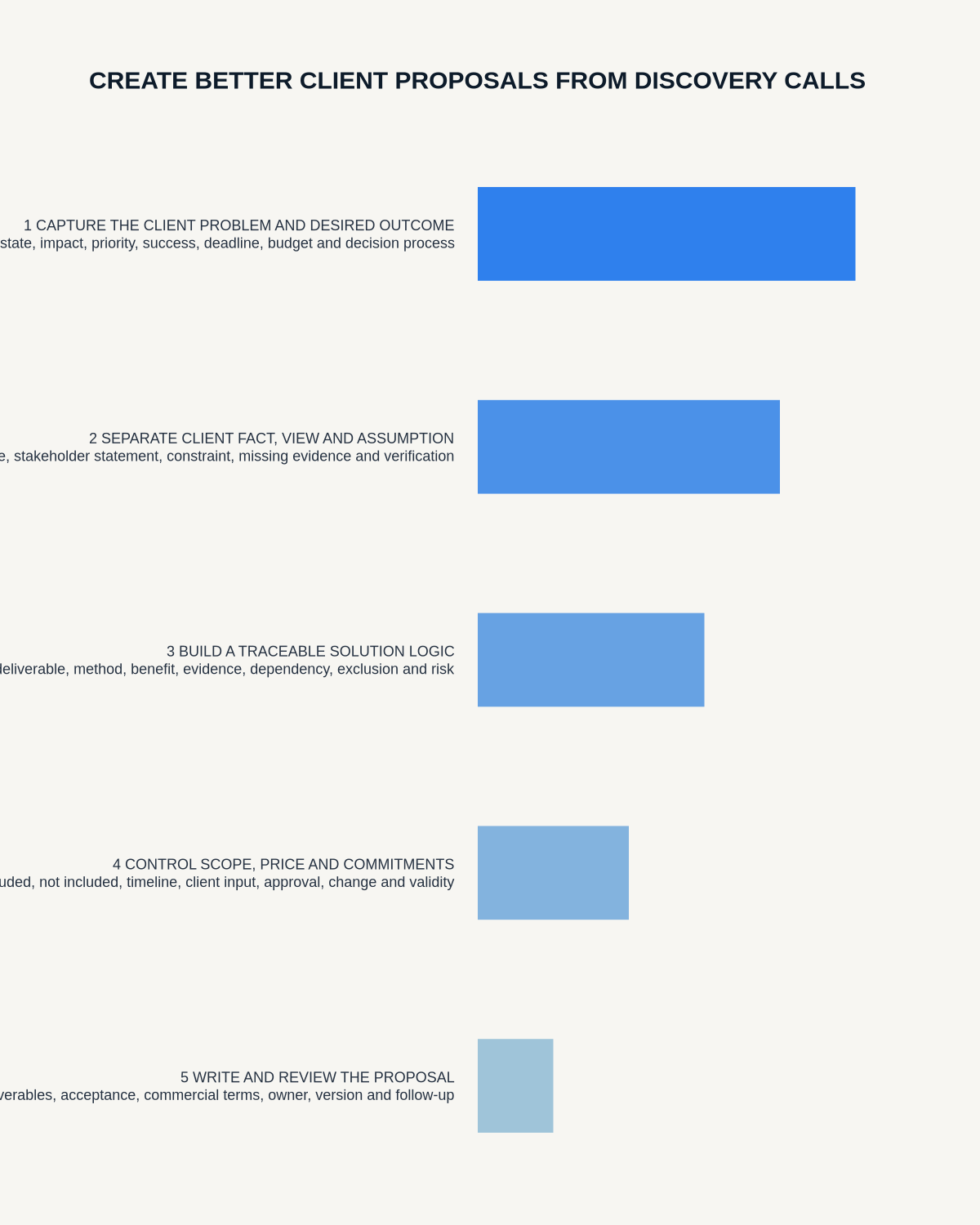
- Executive understanding
- Client objectives
- Current situation and constraints
- Proposed approach
- Scope and deliverables
- Roles and responsibilities
- Timeline and dependencies
- Assumptions and exclusions
- Commercial terms
- Risks and governance
- Next step and validity period
Verify consequential details
Check:
- Client and company names
- Dates and deadlines
- Quantities and volumes
- Technical requirements
- Decision-makers
- Budget references
- Pricing and taxes
- Service levels
- Legal or regulatory claims
- Delivery promises
- Exclusions
Do not let AI invent commercial commitments
High-risk failures include:
- Adding work that was never discussed
- Removing an exclusion
- Creating an unsupported saving or performance claim
- Presenting a target date as guaranteed
- Using an obsolete price
- Changing payment terms
- Promising integration or compliance without verification
- Turning a possible option into the recommended scope
Workflow from call to approved proposal
- Record the authorised discovery call.
- Generate the transcript and summary.
- Correct names, figures and technical terms.
- Build the evidence matrix.
- List open questions and assumptions.
- Draft the proposal using approved templates.
- Validate scope with delivery specialists.
- Validate pricing and terms.
- Check claims and legal wording.
- Obtain accountable approval.
- Send the controlled version.
- Store the source, draft and final under the relevant policy.
Preserve source traceability
For important claims or requirements, retain the meeting reference and timestamp so the reviewer can check context. Do not quote isolated wording without the surrounding question and qualification.
Use client confirmation deliberately
Where the discovery remains incomplete, send a concise understanding statement or clarification list before finalising the proposal. This can reduce scope disputes and reveal assumptions early.
Measure proposal quality
- Time from call to first draft
- Correction time
- Number of unsupported claims removed
- Scope clarifications required
- Pricing or term errors
- Client correction requests
- Proposal turnaround time
- Acceptance and implementation variance
Protect client information
Restrict access to the recording, transcript, pricing and proposal. Avoid moving raw discovery transcripts into uncontrolled generative-AI tools or personal accounts. Apply the organisation’s approved supplier, retention and deletion process.
Where NERALVO Halo fits
Check whether NERALVO Halo fits this workflow can capture suitable discovery meetings and supported calls to 64GB local storage, then synchronise recordings to DOWAY. DOWAY can create transcripts, summaries, speaker-separated notes and templates.
Use those outputs to create a verified evidence matrix before drafting. One year of DOWAY Max is included with the current Halo package. CALL compatibility varies by phone, operating system and call route and should be tested.
Workflow choice matrix for How to Create Better Client Proposals from Discovery Call Recordings
Choose the method that protects the source and reduces downstream correction. The table makes the non-hardware options explicit.
| Condition | Preferred route | Why |
|---|---|---|
| High-risk or mixed work | Governed hybrid | Separate capture, review, approval and retention rather than trusting one tool. |
| Recording is refused, prohibited or unnecessary | Manual notes / no recording | Respecting the boundary is the correct workflow, not a product failure. |
| In-person, mobile or unreliable-connectivity work | Dedicated recorder | Independent capture and a recoverable local source are usually more resilient. |
| Repeatable remote work with approved integrations | Cloud software | Automation and central collaboration may outweigh device independence. |
Frequently asked questions
Can AI write the whole proposal?
It can prepare a draft, but scope, pricing, claims, legal wording and commitments require accountable human approval.
Should the client transcript be attached?
Usually not. Use a concise verified proposal and retain source material under the appropriate access and retention controls.
What if the client did not state a budget?
Do not invent one. Mark it as an open question or use approved pricing options with clear assumptions.
What is the most important control?
Every material proposal statement should be supported by client evidence or an approved internal source.
Final checklist
- Client purpose and problem verified
- Desired outcome confirmed
- Evidence matrix completed
- Assumptions and unknowns labelled
- Scope and exclusions checked
- Pricing and terms approved
- Claims substantiated
- Dates and dependencies verified
- Source references available
- Delivery, legal and commercial review completed
- Controlled final version stored
A strong AI-assisted proposal is faster because the evidence is organised—not because the system is allowed to invent the deal.
Related AI voice recorder guides
Workflow map
Visual map for How to Create Better Client Proposals from Discovery Call Recordings
- Define the decisionState the question, required output and acceptance rule.
- Capture the sourceUse the approved route and preserve context, identity and limitations.
- Verify material detailsReplay or check names, numbers, negatives, decisions and actions.
- Move into the real recordAssign an owner, retain evidence and apply the deletion rule.
On this page
Related guides
See whether Halo fits this workflow
Review the NERALVO Halo specifications, included services, delivery information and current offer only after completing the guide.
Found an error or an out-of-date claim? Email support@neralvo.com with the article address and a supporting source.