Reviewed and updated: 21 July 2026.
The 60-second verdict
A sales-call summary should improve the next conversation. It should preserve the customer’s problem, buying criteria, objections, stakeholders, commitments and open questions without turning exploratory discussion into a deal that does not exist.
Decision focus: use the method below only where it produces a recoverable source, a verifiable output and a clear next action. If one of those fails, change the workflow rather than trusting a polished summary.
Quick verdict: verify customer wording, commercial facts and action ownership against the source, then create a concise CRM note that helps the next seller continue accurately rather than rereading a full transcript.
Evidence basis and limits
- Decision factors covered: Define the CRM outcome before recording; Separate customer evidence from seller interpretation; Use a structured call-close.
- Evidence rule: Claims are weighted by consequence: capture failure, changed meaning, access and recovery matter more than polished wording.
- Boundary: Examples and workflow recommendations must be tested with representative recordings, the intended users and the actual approval process before rollout.
Define the CRM outcome before recording
A useful sales summary may need:
- Customer and account
- Call purpose
- Current situation
- Problem or opportunity
- Business impact
- Desired outcome
- Buying criteria
- Stakeholders and decision process
- Budget or commercial context where provided
- Timing
- Objections and risks
- Competitors or alternatives
- Agreed next step
- Owner and date
Do not store the whole conversation when the next seller needs a short operational record.
Separate customer evidence from seller interpretation
| Layer | Example | Treatment |
|---|---|---|
| Customer statement | “Manual notes take two hours each week.” | Preserve as reported evidence |
| Observed signal | Customer asked about security and rollout | Record neutrally |
| Seller interpretation | Security may be a decision criterion | Label as hypothesis |
| Confirmed commitment | Customer will send the user list by Friday | Verify owner and date |
| Unknown | Final budget holder | Keep open; do not infer |
Use a structured call-close
Before ending, read back:
- What the customer is trying to achieve
- The main constraint or objection
- What each side has agreed to do
- The next meeting or decision point
- Anything still unconfirmed
This improves both customer clarity and later AI extraction.
Verify the details that affect the deal
Replay and check:
- Customer and company names
- Dates and deadlines
- Prices, budgets and quantities
- Technical requirements
- Current systems
- Decision-maker and stakeholders
- Contract or procurement conditions
- Competitor references
- Promises made by the seller
- Agreed next action
A fluent transcript can still change the one figure or condition that matters.
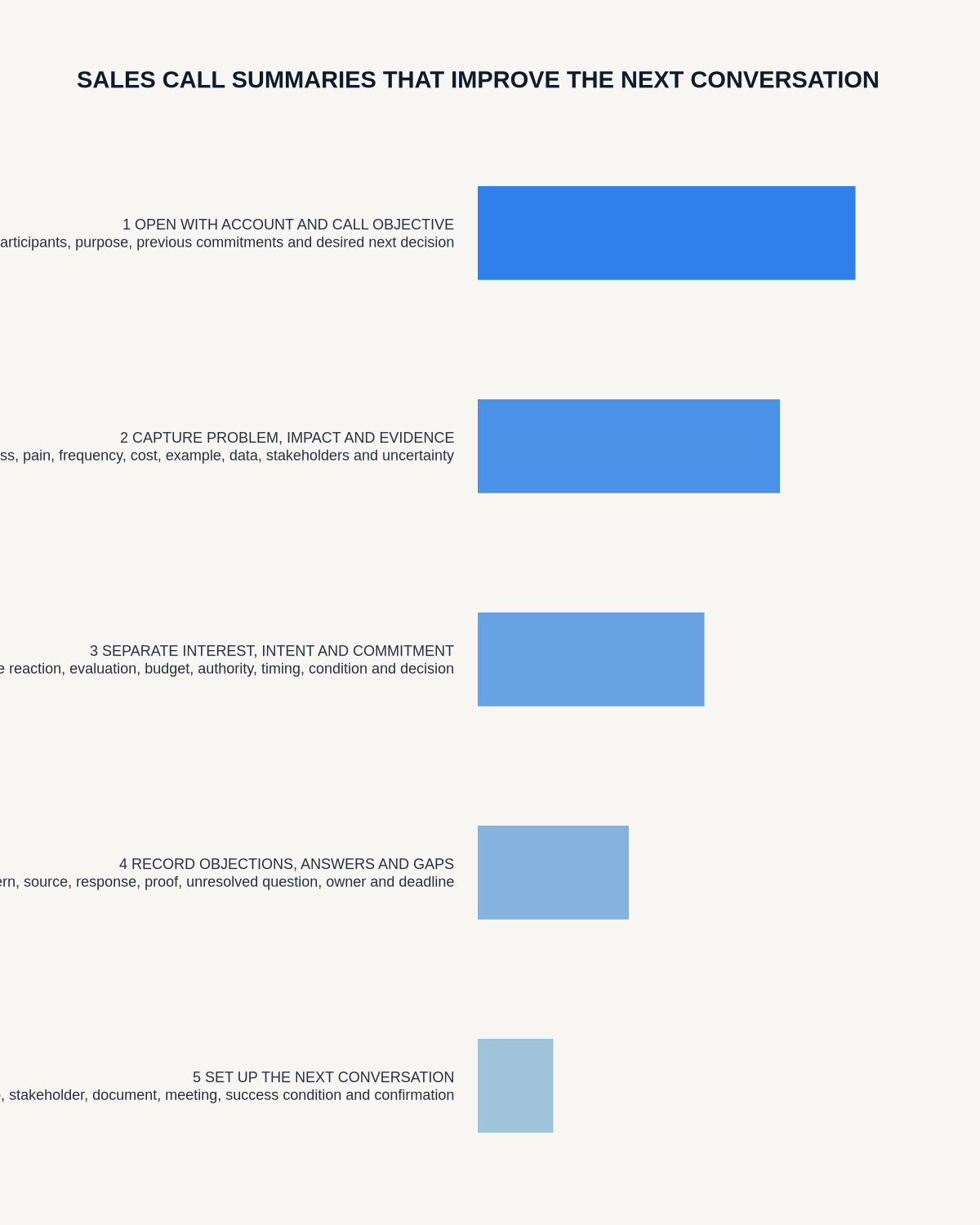
Use a concise CRM template
- Call purpose
- Customer situation
- Problem and impact
- Desired outcome
- Requirements and buying criteria
- Stakeholders and process
- Objections and risks
- Commercial context
- Agreed next step
- Open questions
Keep the note short enough that another seller can understand it before the next call.
Do not allow AI to inflate the opportunity
Common failures include:
- Turning interest into intent to buy
- Inventing a budget
- Changing a tentative date into a deadline
- Converting a feature question into a requirement
- Removing an objection
- Presenting a seller promise as customer agreement
- Assigning decision authority to the wrong person
- Adding a next step that was never confirmed
Workflow from call to next conversation
- Record the authorised call.
- Confirm both sides are complete.
- Generate the transcript and draft summary.
- Correct commercial and technical details.
- Separate evidence from interpretation.
- Create the concise CRM note.
- Assign actions and next date.
- Send any approved follow-up.
- Prepare a next-call agenda from the open questions.
- Apply retention and deletion rules.
Create a next-call brief
Before the next conversation, the summary should answer:
- What matters most to the customer?
- What evidence supports that?
- What was promised?
- What remains unknown?
- Who needs to join?
- What decision or progress is expected?
- Which objection must be addressed?
Measure summary quality
- Critical details verified
- Customer corrections after follow-up
- Open questions carried forward
- Actions completed on time
- Duplicate CRM notes avoided
- Time from call end to usable CRM entry
- Next seller’s ability to continue without replaying the call
Protect customer information
Restrict access to audio, transcripts and commercial data. Exclude payment credentials, passwords and unrelated personal information. Use approved accounts, sharing, retention and deletion processes.
Where NERALVO Halo fits
Check whether NERALVO Halo fits this workflow can capture suitable sales meetings and supported calls to 64GB local storage, then synchronise recordings to DOWAY for transcripts, summaries and templates. One year of DOWAY Max is included with the current package.
CALL compatibility varies by phone, operating system and call route. Verify both sides before relying on the summary.
Workflow choice matrix for How to Create Sales Call Summaries That Improve the Next Conversation
Choose the method that protects the source and reduces downstream correction. The table makes the non-hardware options explicit.
| Condition | Preferred route | Why |
|---|---|---|
| High-risk or mixed work | Governed hybrid | Separate capture, review, approval and retention rather than trusting one tool. |
| Recording is refused, prohibited or unnecessary | Manual notes / no recording | Respecting the boundary is the correct workflow, not a product failure. |
| In-person, mobile or unreliable-connectivity work | Dedicated recorder | Independent capture and a recoverable local source are usually more resilient. |
| Repeatable remote work with approved integrations | Cloud software | Automation and central collaboration may outweigh device independence. |
Frequently asked questions
Should the full transcript go into the CRM?
Usually no. Use a concise verified note and retain the source only where justified.
Can AI determine deal stage?
It can suggest a stage, but the seller should confirm it against the organisation’s criteria and evidence.
Can sentiment identify buying intent?
Do not rely on emotion or tone inference. Use explicit customer statements and behaviour.
What is the most important summary field?
The agreed next step, owner and timing—supported by accurate customer context.
Final checklist
- Both sides captured
- Customer problem and impact verified
- Buying criteria and stakeholders recorded
- Commercial facts checked
- Evidence separated from seller interpretation
- Objections retained
- Next action confirmed
- CRM note concise and approved
- Next-call brief prepared
- Retention applied
A strong AI-assisted sales-call summary improves continuity by preserving the customer’s reality—not by making the opportunity sound better.
Related AI voice recorder guides
Workflow map
Visual map for How to Create Sales Call Summaries That Improve the Next Conversation
- Define the decisionState the question, required output and acceptance rule.
- Capture the sourceUse the approved route and preserve context, identity and limitations.
- Verify material detailsReplay or check names, numbers, negatives, decisions and actions.
- Move into the real recordAssign an owner, retain evidence and apply the deletion rule.
On this page
Related guides
See whether Halo fits this workflow
Review the NERALVO Halo specifications, included services, delivery information and current offer only after completing the guide.
Found an error or an out-of-date claim? Email support@neralvo.com with the article address and a supporting source.