
The 60-second verdict
Quick answer: fundraisers can use an AI voice recorder to preserve donor interests, questions, restrictions and agreed follow-up, but interest, intent, communication permission, story permission, pledge and received gift must remain separate.
Best fit: Fundraisers who need recoverable audio and human-verified notes in an authorised workflow. Use another method when: recording is prohibited, a participant declines or the approved process requires manual notes.
Evidence basis and limits
- Decision factors covered: Why donor notes are vulnerable to optimism; The relationship → interest → intent → permission → commitment → stewardship workflow; Use precise engagement states.
- Evidence rule: A claim earns weight only when the source, date, configuration and limitation are clear enough for a reader to check.
- Boundary: Examples and workflow recommendations must be tested with representative recordings, the intended users and the actual approval process before rollout.
Assess Halo against the fundraisers workflow matrix can support approved donor meetings and private post-call notes. It cannot create consent, accept a restricted gift or process payment.
Why donor notes are vulnerable to optimism
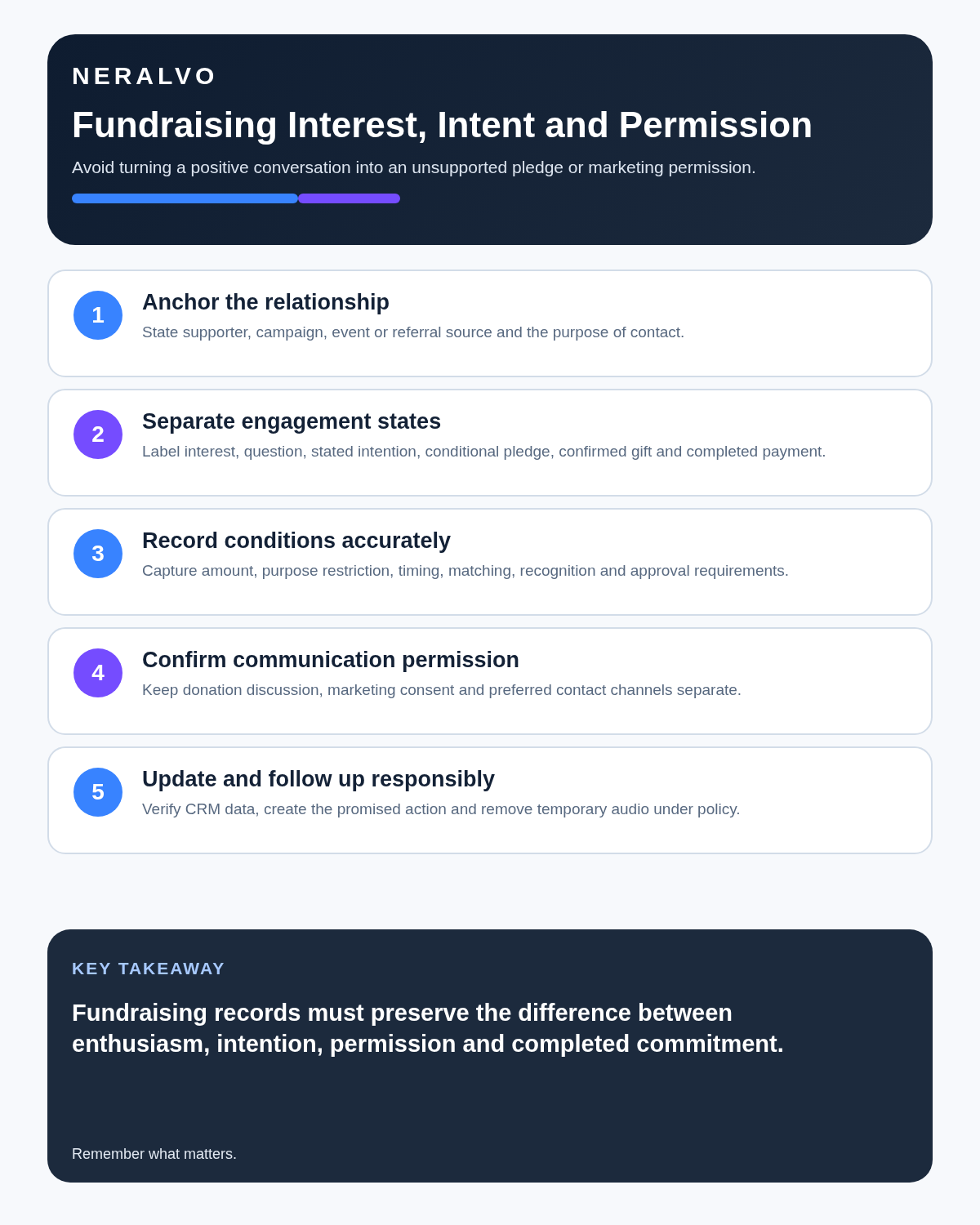
A warm conversation can be misread as a likely gift. An AI summary may turn “I would like to learn more” into “donor intends to support the project.” That distorts forecasting and can damage trust.
The relationship → interest → intent → permission → commitment → stewardship workflow
| Stage | Question | Record |
|---|---|---|
| Relationship | Who is the person and what is the legitimate context? | Verified CRM identity |
| Interest | Which cause, outcome or activity matters to them? | Attributed preference |
| Intent | What are they considering? | Qualified next step |
| Permission | How may the charity contact and use information? | Communication and story status |
| Commitment | What gift or action is actually confirmed? | Formal record |
| Stewardship | What reporting and relationship promise follows? | Owned plan |
Use precise engagement states
- Introduced.
- Interested in a named area.
- Requested information.
- Considering support.
- Discussed an indicative amount.
- Pledged through the authorised process.
- Gift received and reconciled.
- Declined or no further contact.
Do not assign a probability from enthusiasm alone.
Preserve donor motivation without over-collecting
Capture the cause, outcome, questions, concerns and communication preference needed for responsible follow-up. Avoid unnecessary family, health, wealth and personal-history detail. A memorable story is not automatically necessary CRM data.
Record gift conditions carefully
For a potential restricted or conditional gift, capture the donor’s wording, purpose, intended beneficiary, timing, reporting expectation, naming or anonymity preference and unresolved conditions. Route the proposal for appropriate legal, finance and programme review before acceptance.
Separate a pledge from payment
| Status | Meaning |
|---|---|
| Discussion | No commitment |
| Indicative intention | Possible future support |
| Formal pledge | Recorded commitment under the approved process |
| Payment scheduled | Agreed date or instalments |
| Received | Funds reconciled by finance |
| Acknowledged | Receipt and thanks completed |
Control communication permission
Record the channel, purpose, date and source of permission or objection. Do not infer permission for future campaigns from attendance at an event or one-to-one conversation.
Keep story permission separate
| Use | Permission to confirm |
|---|---|
| Internal service learning | Who may access the account |
| Anonymous report quotation | Whether contextual detail could identify the person |
| Named website story | Name, wording, image and publication channels |
| Fundraising appeal | Audience, edits, duration and reuse |
| Sharing with funder or partner | Recipient and further publication rights |
Interview permission, publication permission and marketing reuse are separate decisions.
Run a dignity check before publication
- Would the contributor recognise themselves in the final wording?
- Does the edit preserve agency rather than presenting only crisis?
- Could details identify them despite an anonymous label?
- Are quotations checked against the audio?
- Is participation genuinely separate from access to services?
- Can communications staff see restrictions and expiry dates?
Current UK fundraising standards
The current UK Code of Fundraising Practice took effect on 1 November 2025. Fundraising Regulator data-privacy guidance was updated in June 2026. Use the current Code of Fundraising Practice and data-privacy guidance when designing donor-recording and follow-up processes.
Build an accountable follow-up
- Information promised.
- Owner and deadline.
- Approval required.
- Next contact method and time.
- Gift, event or programme dependency.
- CRM field to update.
- Stewardship or reporting commitment.
Use a meeting-to-CRM workflow
- Decide whether direct recording is needed or a private follow-up note is sufficient.
- Explain recording, communication and story-use boundaries.
- Generate and correct the transcript.
- Assign the correct donor-status label.
- Separate gift discussion from publication permission.
- Update only relevant CRM fields.
- Confirm restrictions and material points in writing.
- Route accepted gifts through finance and formal gift records.
- Delete source audio when its purpose ends.
Protect financial and personal data
Never record card details, bank information, passwords or unnecessary financial circumstances. Use approved payment routes and restricted accounts. Apply minimum retention to raw audio and working transcripts.
How NERALVO Halo fits fundraising
NERALVO Halo includes NOTE mode, supported CALL mode, 64GB local storage, up to 35 hours of recording and Bluetooth sync with DOWAY. CALL mode is not universal, so test the exact phone, case and route. DOWAY provides transcripts, summaries, speaker-separated notes, templates, translations, mind maps and exports, with one year of DOWAY Max included.
Cloud software, a dedicated recorder or manual notes?
For Fundraisers, the right answer changes with the setting. This matrix deliberately gives each method a situation where it can be the strongest choice.
| Situation | Best starting point | Reason |
|---|---|---|
| scheduled remote meetings | Cloud meeting software | Auto-join and central collaboration can remove routine admin. |
| in-person or mobile work | Dedicated recorder | Dedicated hardware suits movement, variable rooms and offline source capture. |
| recording is refused or prohibited | Manual notes or an approved alternative | A clear alternative respects policy and participant choice. |
| mixed online and offline work | Governed hybrid | One governed process prevents gaps between desk and field work. |
Frequently asked questions
Does donor enthusiasm count as a pledge?
No. Use the charity’s formal commitment and finance process.
Can a conversation create marketing permission?
Only where the required information and choice are clear and the permission is properly recorded.
Does interview consent allow a named fundraising story?
No. Confirm the publication, audience, wording, image, duration and reuse separately.
Should sensitive donor motivations be stored?
Only the minimum relevant information needed for a legitimate purpose.
Final fundraising checklist
- Donor and relationship context verified.
- Interest separated from intent and commitment.
- Communication permission recorded accurately.
- Story and quotation permission recorded separately.
- Gift restrictions and conditions routed for review.
- Payment information kept out of recordings.
- Follow-up owned and dated.
- Finance and CRM records reconciled.
- Stewardship and publication promises tracked.
Bottom line: responsible fundraising records the donor’s actual choices and protects the difference between a meaningful conversation, a permitted story and a confirmed gift.
Related guides
On this page
Related guides
See whether Halo fits this workflow
Review the NERALVO Halo specifications, included services, delivery information and current offer only after completing the guide.
Found an error or an out-of-date claim? Email support@neralvo.com with the article address and a supporting source.