The 60-second verdict
Quick answer: before using an AI voice recorder, check the purpose, authority, participants, data route, supplier, security, accuracy, sharing, retention, deletion and failure response. The 30 questions below provide a practical evidence-based privacy review.
Use this guide when: the recording purpose, authority, participants, access and retention can be defined. Pause when: any of those controls is unclear.
Evidence basis and limits
- Decision factors covered: 1. Purpose and necessity; 2. Authority and people; 3. Data and sensitivity.
- Evidence rule: A claim earns weight only when the source, date, configuration and limitation are clear enough for a reader to check.
- Boundary: This is practical information, not legal advice. Verify current ICO guidance, sector rules, contracts and organisational policy for the real use case.

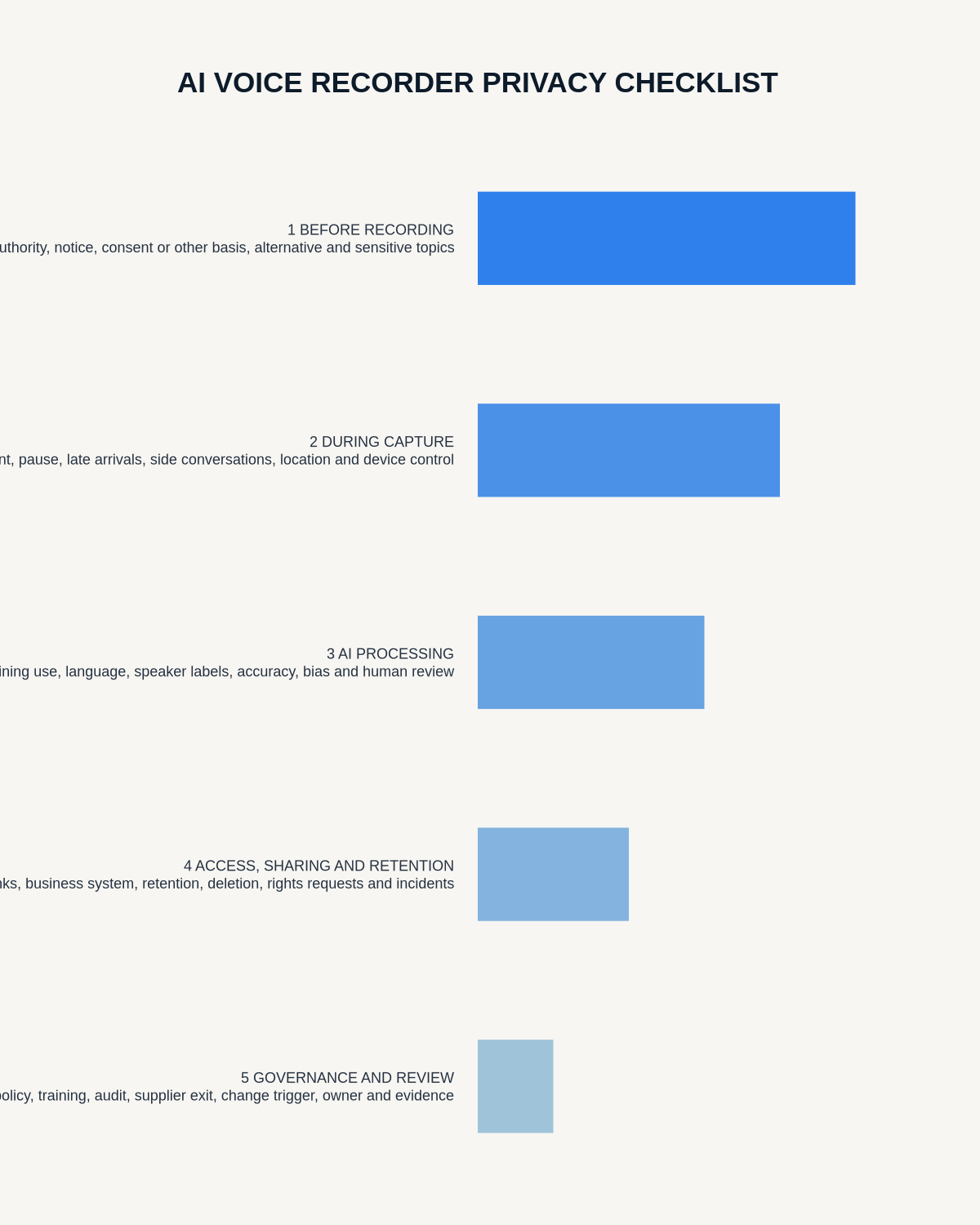
This 30-question checklist helps organisations test an AI voice-recording workflow before deployment. It is designed to expose unclear purpose, excessive collection, weak supplier controls and missing deletion processes.
Answer each question yes, partly or no. A “no” on purpose, authority, participant information, sensitive data, security or deletion should stop deployment until the control is resolved. Check current ICO guidance and obtain professional advice for high-risk uses.
1. Purpose and necessity
- Can we describe the recording purpose in one precise sentence?
- Is recording necessary, rather than merely convenient?
- Have we considered a less intrusive alternative such as agreed written notes?
- Will the recording be used only for the stated purpose?
- Have we identified the final authoritative record the audio will support?
2. Authority and people
- Has the correct organisational owner approved the use case?
- Have we assessed the appropriate lawful and policy basis?
- Will every participant receive clear information before recording?
- Can late joiners, remote participants and bystanders be handled properly?
- Is there a fair alternative when someone declines or objects?
3. Data and sensitivity
- Can we limit capture to the relevant part of the conversation?
- Will passwords, payment details and security answers be excluded?
- Could the meeting include health, employment, legal, financial or criminal-offence information?
- Have additional conditions and safeguards been assessed for sensitive data?
- Has the need for a data-protection impact assessment been recorded?
4. Device, app and supplier
- Do we know every location where audio, transcripts and exports are stored?
- Is the device protected against loss, unauthorised access and accidental sharing?
- Is the processing account an approved business account rather than a personal one?
- Have supplier contracts, security, subprocessors and data locations been reviewed?
- Have we tested whether deletion removes local, cloud and exported copies as expected?
5. Accuracy, access and sharing
- Is a named person responsible for checking names, dates, figures and speaker labels?
- Are proposals, reports, objections and final decisions kept distinct?
- Can people access only the audio or output needed for their role?
- Are public links, uncontrolled attachments and unnecessary downloads prevented?
- Can the organisation handle access, correction, objection, restriction, erasure and complaint requests where applicable?
6. Retention, deletion and accountability
- Are separate retention periods defined for raw audio, working transcript and final record?
- Is the event that starts each retention period clear?
- Is one owner responsible for deletion and evidence of completion?
- Are backups, legal holds and exported copies included in the process?
- Will the workflow be reviewed after incidents, complaints, supplier changes or new uses?
How to score the checklist
| Result | Meaning |
|---|---|
| Green | All material questions are answered yes and evidence exists. |
| Amber | Some controls are partial; restrict the pilot and assign owners before wider use. |
| Red | A core purpose, authority, transparency, sensitive-data, security or deletion control is missing. |
A checklist score is not legal approval. Keep the evidence behind each answer, including policy, supplier review, DPIA decision, participant wording, retention schedule and test results.
Record the evidence behind every answer
| Field | What to record |
|---|---|
| Answer | Yes, partly or no |
| Evidence | Policy, contract, test result, system setting or approved wording |
| Owner | Named role responsible for the control |
| Action | Required remediation or monitoring step |
| Due date | When the gap will be resolved |
| Residual risk | What remains after the control is applied |
How NERALVO Halo fits the assessment
Check Halo specifications before applying this guidance provides NOTE recording, supported CALL capture, 64GB local storage, up to 35 hours of recording and Bluetooth sync with DOWAY. DOWAY can create transcripts and structured outputs, with one year of DOWAY Max included from activation.
Evaluate the complete Halo-to-DOWAY workflow, not only the physical recorder. Device, account, processing, export and deletion controls all form part of the privacy assessment.
Workflow choice matrix for AI Voice Recorder Privacy Checklist
Apply the strongest control before choosing a device. The table makes the non-hardware options explicit.
| Condition | Preferred route | Why |
|---|---|---|
| High-risk or mixed work | Governed hybrid | Separate capture, review, approval and retention rather than trusting one tool. |
| Recording is refused, prohibited or unnecessary | Manual notes / no recording | Respecting the boundary is the correct workflow, not a product failure. |
| In-person, mobile or unreliable-connectivity work | Dedicated recorder | Independent capture and a recoverable local source are usually more resilient. |
| Repeatable remote work with approved integrations | Cloud software | Automation and central collaboration may outweigh device independence. |
Frequently asked questions
Is completing the checklist enough for legal compliance?
No. It supports assessment but does not replace legal advice, a DPIA or sector-specific governance.
Should the checklist be repeated?
Review it after supplier changes, new features, incidents, policy updates or expansion into sensitive use cases.
Can personal voice notes use a shorter check?
Use a proportionate version, especially if work or third-party information may be captured.
Official ICO guidance
Final privacy decision
Approve the workflow only when the purpose is necessary, participants are treated fairly, the data route is understood, critical details are reviewed and deletion can be completed reliably.
Related guides
On this page
Related guides
Check permission, retention and access before choosing hardware
Once the policy requirements in this guide are satisfied, compare Halo’s specifications, local storage, included services and current offer against your approved workflow.
Found an error or an out-of-date claim? Email support@neralvo.com with the article address and a supporting source.