The 60-second verdict
Quick answer: use an AI voice recorder in grievance meetings only where the process permits it, participants are treated fairly and the recording supports—not replaces—the formal investigation, meeting note and outcome.
Best fit: Grievance Meetings who need recoverable audio and human-verified notes in an authorised workflow. Use another method when: recording is prohibited, a participant declines or the approved process requires manual notes.
Evidence basis and limits
- Decision factors covered: Confirm the process before recording; Explain the boundaries; Create a concern map.
- Evidence rule: A claim earns weight only when the source, date, configuration and limitation are clear enough for a reader to check.
- Boundary: Examples and workflow recommendations must be tested with representative recordings, the intended users and the actual approval process before rollout.
A grievance meeting is the point at which an employee explains a concern, its effect and the outcome they are asking the organisation to consider. A transcript can preserve detail, but it can also make an initial account look like a completed investigation.
An AI voice recorder in grievance meetings should help create an accurate concern map and investigation plan. It should not decide credibility, confidentiality, remedy or whether the grievance is upheld.
Confirm the process before recording
Check current organisational policy, applicable Acas guidance, representation arrangements, the meeting purpose, access, supplier route and retention. Consider whether recording could inhibit participation and offer a fair note-taking alternative where appropriate.
Explain the boundaries
- what is being recorded
- why it is needed
- who can access audio and drafts
- how AI transcription is used
- which document is authoritative
- how factual corrections are made
- how long each copy remains
Create a concern map
| Field | What to capture |
|---|---|
| Concern | What the employee says happened or is continuing |
| Chronology | Dates, sequence and relevant context |
| People and sources | Who may hold relevant evidence |
| Impact | Work, health, relationships, opportunity or confidence |
| Previous steps | What has already been raised or attempted |
| Requested outcome | What resolution the employee seeks |
| Immediate control | Urgent protection or temporary arrangement |
| Investigation action | Evidence to obtain, owner and review date |
Keep the requested outcome separate from the eventual remedy. The organisation can consider a request without promising it during the meeting.
Use a fair meeting structure
- Identify participants and roles.
- State the grievance and requested outcome.
- Allow an uninterrupted account.
- Separate direct experience from second-hand information.
- Identify documents and witnesses.
- Ask neutral clarification questions.
- Record disputed points and evidence gaps.
- Explain next steps and timescales.
Use an urgent-issue fast lane
Immediate escalation may be needed where the account suggests:
- risk to health or safety
- safeguarding concern
- harassment, violence or retaliation risk
- serious discrimination allegation
- criminal conduct or significant fraud
- evidence that may be lost
- an urgent need for workplace separation or support
Protect people and evidence first. Recording is secondary to immediate control.
Ask neutral questions
- “What happened next?”
- “Which part did you see or hear directly?”
- “What information may support that point?”
- “Who else may have relevant evidence?”
- “How has this affected you or your work?”
- “What outcome are you asking us to consider?”
- “Is there anything urgent we need to address today?”
Avoid promising an outcome or turning the meeting into premature cross-examination.
Keep evidence states visible
- Employee statement: attributed account.
- Respondent statement: separate account.
- Witness information: attributed and subject to review.
- Supporting evidence: document, message, witness or system record.
- Disputed fact: point requiring further inquiry.
- Impact statement: the effect described by the employee.
- Investigation finding: authorised conclusion reached only after reviewing evidence.
An AI summary must not turn an allegation into fact, remove disagreement or present a requested outcome as an agreed remedy.
Verify material details
Replay names, dates, quoted words, locations, policy references and alleged actions. Preserve qualifications and mark unclear passages. Do not use automated emotion or credibility scoring.
Turn the meeting into an investigation plan
For each open issue, record the question to resolve, evidence source, responsible person, confidentiality restriction, target date, dependency and how the employee will be updated.
Do not share the full transcript with every investigator when a focused checked instruction is sufficient. Apply need-to-know access.
Explain confidentiality honestly
Information should be limited to those who need it, but absolute secrecy may not be possible where fair investigation requires disclosure. Remove unrelated private detail from working summaries and use a separate approved process for witness interviews.
Create the formal record
The approved note should identify the issues, evidence, disputed matters, investigation actions, support arrangements and next steps. The outcome should address each material grievance point, the evidence considered, the finding, reasoning, action or recommendation and any appeal route. When a point cannot be determined, say so.
How NERALVO Halo may support grievance documentation
Assess Halo against the grievance meetings workflow matrix provides NOTE recording for approved grievance meetings, supported CALL capture for compatible remote calls, 64GB local storage, up to 35 hours of recording and Bluetooth sync with DOWAY. DOWAY can produce transcripts, speaker-separated notes and structured summaries, with one year of DOWAY Max from activation.
Use the output to draft a checked concern map and action plan. Credibility, findings and remedy require a fair human investigation.
Cloud software, a dedicated recorder or manual notes?
For Grievance Meetings, the right answer changes with the setting. This matrix deliberately gives each method a situation where it can be the strongest choice.
| Situation | Best starting point | Reason |
|---|---|---|
| scheduled remote meetings | Cloud meeting software | Auto-join and central collaboration can remove routine admin. |
| in-person or mobile work | Dedicated recorder | Dedicated hardware suits movement, variable rooms and offline source capture. |
| recording is refused or prohibited | Manual notes or an approved alternative | A clear alternative respects policy and participant choice. |
| mixed online and offline work | Governed hybrid | One governed process prevents gaps between desk and field work. |
Frequently asked questions
Can the transcript prove the grievance?
No. It records what was said in the meeting; findings require evidence and a fair process.
Should all participants receive the raw audio?
Not automatically. Follow the organisation’s access and disclosure process.
What if recording is disputed?
Pause and apply the policy or alternative note-taking procedure.
Grievance closure check
- The concern and requested outcome are accurately recorded.
- Urgent safeguards were addressed.
- Reported facts, evidence and findings remain distinct.
- Investigation actions have owners and dates.
- Confidentiality limits were explained honestly.
- The employee received appropriate updates.
- The outcome addresses every material issue.
- Follow-up and appeal arrangements are recorded.
Official workplace guidance
Related guides
Profession workflow
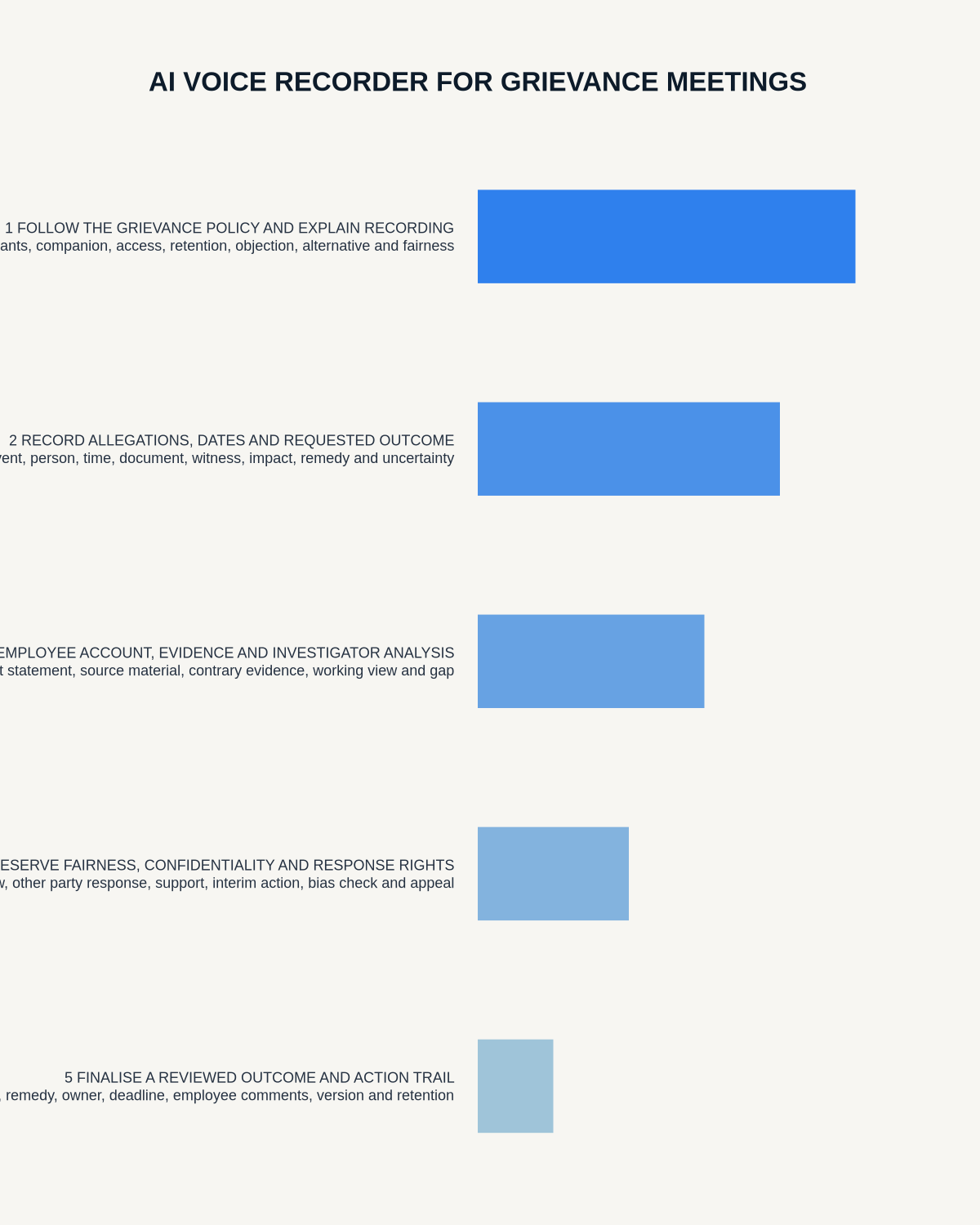
Visual map for AI Voice Recorder for Grievance Meetings: Fair Records, Evidence and Sensitive Information
- Prepare the approved useDefine purpose, safe position, permission and the required formal record.
- Capture context firstState the case, asset, person, location or event identifier before detail.
- Human-verify evidenceCheck technical terms, units, names, dates, decisions and uncertainty.
- Complete the formal recordTransfer only verified information and apply access and retention controls.
On this page
Related guides
See whether Halo fits this workflow
Review the NERALVO Halo specifications, included services, delivery information and current offer only after completing the guide.
Found an error or an out-of-date claim? Email support@neralvo.com with the article address and a supporting source.