
The 60-second verdict
Quick answer: an AI voice recorder can support an authorised disciplinary meeting by preserving questions, answers, objections and actions, but it cannot make the process fair, determine credibility or decide an outcome.
Best fit: Disciplinary Meetings who need recoverable audio and human-verified notes in an authorised workflow. Use another method when: recording is prohibited, a participant declines or the approved process requires manual notes.
Evidence basis and limits
- Decision factors covered: Build six separate records; Use a readiness gate before recording; Keep evidence states distinct.
- Evidence rule: Claims are weighted by consequence: capture failure, changed meaning, access and recovery matter more than polished wording.
- Boundary: Examples and workflow recommendations must be tested with representative recordings, the intended users and the actual approval process before rollout.
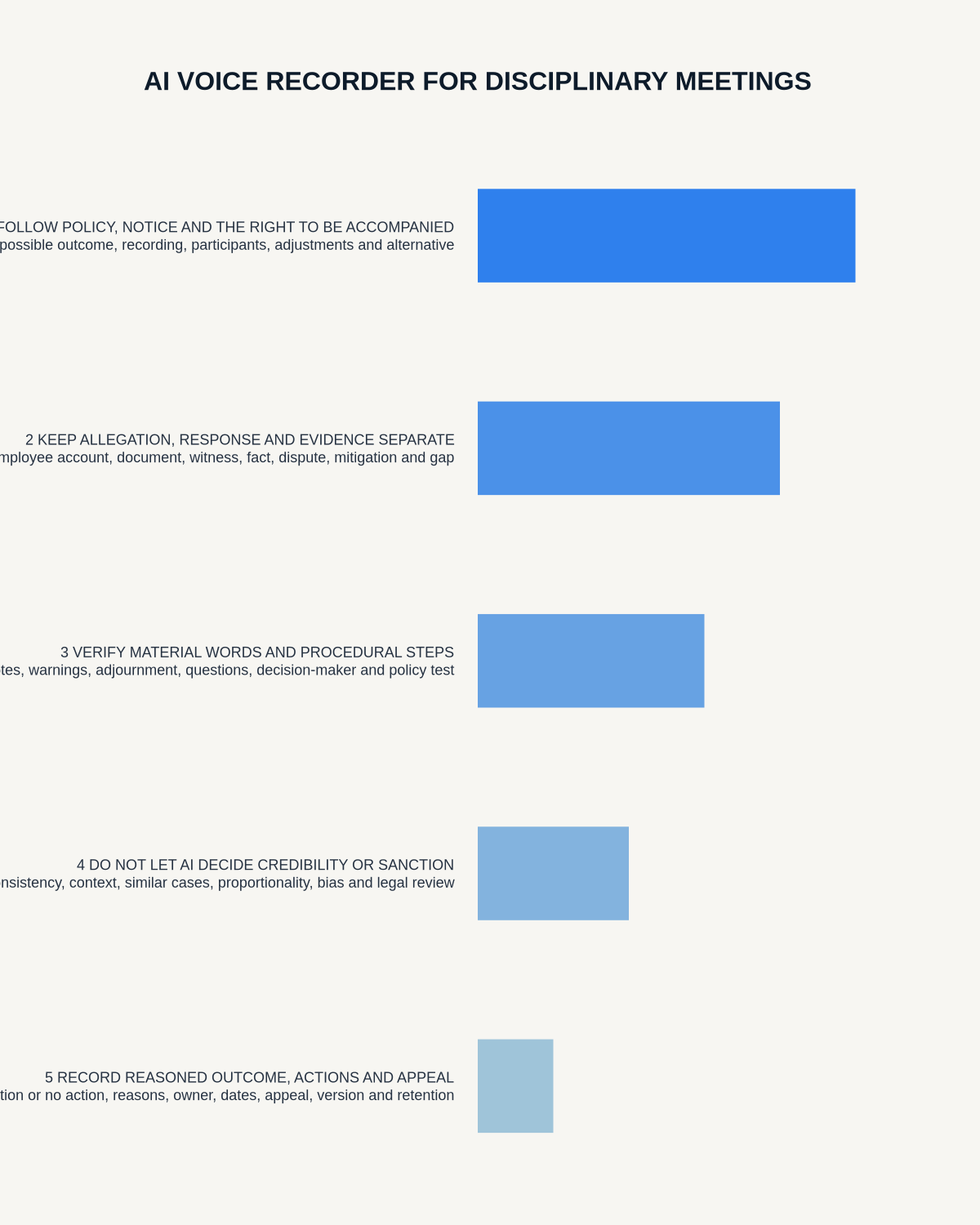
Fairness depends on clear allegations, proper notice, access to relevant evidence, an opportunity to respond, impartial consideration and an authorised decision. The transcript should support a controlled case record rather than become the case record.
Build six separate records
| Record | Purpose | Main control |
|---|---|---|
| Allegation notice | Defines the matter being considered | Clear scope and sufficient detail |
| Evidence bundle | Contains documents and attributable evidence | Version control and appropriate disclosure |
| Meeting source | Authorised audio and working transcript | Restricted access and defined retention |
| Checked meeting note | Records material questions and answers | Human review against the audio |
| Outcome record | Explains findings and reasoning | Decision-maker approval |
| Appeal record | Preserves grounds and appeal outcome | Separate authorised review |
Use a readiness gate before recording
- The allegation and possible consequences have been communicated through the proper process.
- The employee has received relevant information and preparation time.
- The chair, note-taker, adviser and decision-maker roles are clear.
- Representation, accompaniment, language and accessibility needs are addressed.
- The recording purpose, audience and retention are approved.
- A written-note alternative exists where recording is inappropriate.
Keep evidence states distinct
- Allegation: the matter under consideration.
- Evidence: documents, observations and attributable statements.
- Employee response: explanation, admission, denial or context.
- Disputed fact: point requiring further inquiry.
- Mitigation: relevant circumstances raised for consideration.
- Procedural point: objection, request, adjustment or adjournment issue.
- Action: further evidence, owner and review date.
AI summaries can blur these categories. Review the original wording before recording a finding or decision.
Handle adjournments deliberately
Pause recording during private deliberation, legal advice, representative discussion or unrelated personal conversation unless a separately approved reason applies. When the formal meeting resumes, state that recording has restarted and confirm who is present.
Verify the transcript before reliance
- Check speaker attribution, names, dates and figures.
- Preserve qualifications such as “possibly”, “I think” and “I cannot confirm”.
- Mark inaudible or uncertain sections rather than inventing words.
- Record objections, requests and technical failures.
- Keep further actions open until completed.
Write the outcome from findings
The outcome should address each allegation, relevant evidence, the employee’s response, the finding, reasoning and any action. The appeal route should follow the applicable process.
A long transcript does not justify a stronger outcome. The decision must remain proportionate, consistent and authorised.
Protect privacy and retention
Disciplinary material may include employment, health, family, equality or third-party information. Restrict access and apply separate retention decisions to raw audio, working transcript, checked note and final outcome.
Official workplace guidance
- Acas disciplinary procedure guidance
- Acas guidance on holding and recording investigation meetings
- ICO guidance on monitoring workers
How NERALVO Halo fits
Check whether NERALVO Halo fits disciplinary meetings work provides NOTE recording, supported CALL capture, 64GB local storage, up to 35 hours of recording and DOWAY transcripts and structured summaries, with one year of DOWAY Max. The device does not determine fairness, findings or sanction.
Cloud software, a dedicated recorder or manual notes?
For Disciplinary Meetings, the right answer changes with the setting. This matrix deliberately gives each method a situation where it can be the strongest choice.
| Situation | Best starting point | Reason |
|---|---|---|
| scheduled remote meetings | Cloud meeting software | Calendar automation and shared integrations are usually the strongest advantage. |
| in-person or mobile work | Dedicated recorder | Independent capture reduces reliance on an active phone or laptop. |
| recording is refused or prohibited | Manual notes or an approved alternative | The boundary takes priority over convenience. |
| mixed online and offline work | Governed hybrid | Use each method only in the setting it actually fits. |
Frequently asked questions
Can a recording prove that the procedure was fair?
No. It may support the evidence, but fairness depends on the full procedure and decision-making process.
Can AI decide whether a witness is credible?
No. Credibility and evidential weight require accountable human judgement.
Should private deliberations be recorded?
Usually not unless a specific authorised process requires it.
Can the transcript replace the outcome letter?
No. The outcome must explain the findings, reasoning, action and appeal route.
Final case checklist
- Every allegation has a finding
- Evidence and employee response remain separate
- Transcript errors and uncertainty are marked
- Further actions completed before decision
- Outcome explains reasoning and appeal
- Access and retention controlled
- Authoritative record identified
Bottom line: recording can improve accuracy, but fairness remains a human, procedural and accountable responsibility.
Related AI voice recorder guides
On this page
Related guides
See whether Halo fits this workflow
Review the NERALVO Halo specifications, included services, delivery information and current offer only after completing the guide.
Found an error or an out-of-date claim? Email support@neralvo.com with the article address and a supporting source.