The 60-second verdict
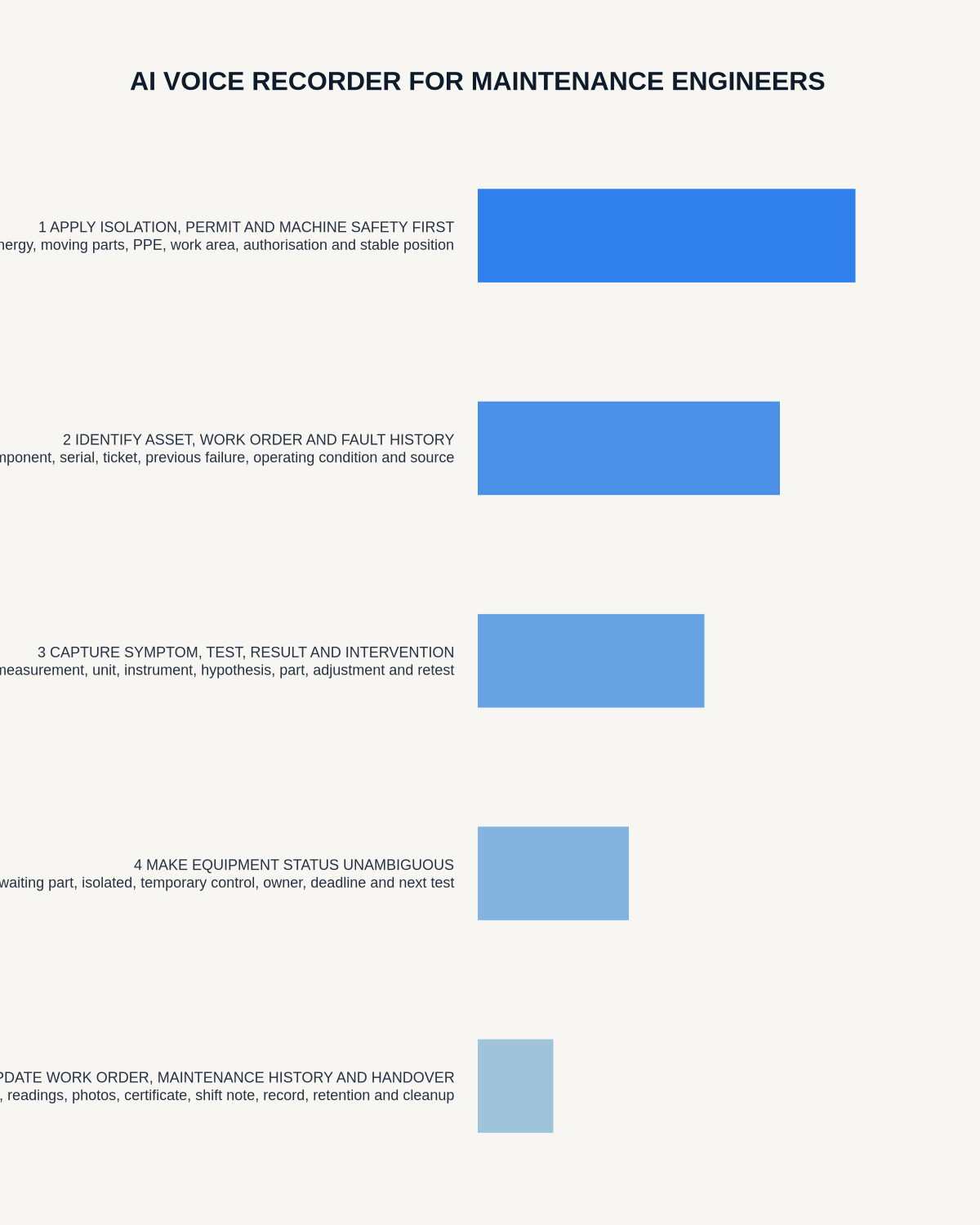
Quick answer: an AI voice recorder can help maintenance engineers capture fault context, alarms, measurements, interventions, parts, shift risks and follow-up actions after hazardous energy is controlled. It should feed the CMMS and approved maintenance records, not become a parallel system.
Best fit: Maintenance Engineers who need recoverable audio and human-verified notes in an authorised workflow. Use another method when: recording is prohibited, a participant declines or the approved process requires manual notes.
Evidence basis and limits
- Decision factors covered: Why fault notes fail without operating context; The asset → context → evidence → intervention → outcome → recurrence workflow; Control hazardous energy before recording.
- Evidence rule: A claim earns weight only when the source, date, configuration and limitation are clear enough for a reader to check.
- Boundary: Examples and workflow recommendations must be tested with representative recordings, the intended users and the actual approval process before rollout.

Assess Halo against the maintenance engineers workflow matrix can support rapid post-intervention capture. Isolation, permit, test, condition-monitoring and maintenance systems remain authoritative.
Why fault notes fail without operating context
Intermittent faults often depend on load, speed, product, temperature, environment, cycle stage, upstream condition or operator sequence. “Motor tripped—reset and running” does not reveal why it happened or whether recurrence risk remains.
The asset → context → evidence → intervention → outcome → recurrence workflow
| Stage | Question | Output |
|---|---|---|
| Asset | Which site, line, machine and component? | Verified identity |
| Context | Under which load, cycle and environment did it occur? | Reproducible conditions |
| Evidence | What alarm, trend, measurement or observation exists? | Traceable source |
| Intervention | What test, repair, adjustment or part was used? | Work history |
| Outcome | What function returned and what limitation remains? | Verified result |
| Recurrence | What history and preventive action must be reviewed? | Reliability action |
Control hazardous energy before recording
Follow the approved isolation, lockout, permit and verification process before using the device. Do not record near moving machinery, exposed energy, active lifting, pressure, heat or chemicals where attention is required.
The recorder is not a permit, condition monitor, alarm or emergency system.
Use stable asset identity
State site, production area, line, asset tag, component, control reference and current work order. Verify the label and CMMS record.
Where similar assets exist, add location and serial or component reference to prevent the intervention being logged against the wrong machine.
Preserve the full operating context
Record:
- Load, speed and cycle stage.
- Product or process condition.
- Temperature, pressure, vibration or environment.
- Alarm sequence and timestamps.
- Operator steps and recent change.
- Upstream and downstream conditions.
- Frequency and duration.
- Previous related events.
A fault that disappears after shutdown may require more context, not a more confident summary.
Separate restoration from root cause
| Status | Meaning |
|---|---|
| Immediate restoration | Action that returned operation |
| Failure mode | What component or function failed |
| Contributing condition | Load, contamination, alignment, environment or process factor |
| Possible cause | Hypothesis requiring evidence |
| Confirmed cause | Explanation supported by analysis |
| Preventive action | Change intended to reduce recurrence |
Replacing a component does not prove it was the underlying cause merely because the machine restarted.
Create a test and measurement chain
For each material result, state the instrument or system, measurement point, operating condition, value, unit, time and source record. Check decimals, prefixes and channels against the original data.
Link trends, logs, photographs, samples and removed parts where useful.
Write work orders that can be completed safely
A strong work order includes:
- Asset and exact task.
- Problem statement and evidence.
- Hazard controls, permit or isolation requirement.
- Competence or specialist support required.
- Parts, tools and drawings.
- Access and production dependency.
- Acceptance test.
- Expected downtime and communication.
- Closure evidence.
“Investigate noise” is weak. Identify when, where and under which condition the noise occurs.
Separate ordinary maintenance from engineering change
Like-for-like work under an approved maintenance instruction is different from changing the design basis. Route non-standard parts or substitutions, changed setpoints or software, removed or bypassed guards and interlocks, altered lubrication or torque requirements, repeated temporary repairs, and drawings or procedures that no longer match the asset through the authorised engineering-change process.
The voice note should identify the proposed difference, reason, risk, affected documents and approval still required. It must not turn a discussed modification into an authorised configuration.
Use a return-to-service gate
- Work and installed parts verified.
- Temporary equipment and tools removed.
- Guards, covers and safety devices restored.
- Interlocks and alarms checked.
- Required test completed under relevant conditions.
- Operations informed of limitations.
- Authorised person approves return.
- Monitoring and review period defined.
Build a useful shift handover
Prioritise:
- Assets out of service or restricted.
- Temporary repairs and isolations.
- Active permits and safety controls.
- Pending parts or specialist support.
- Tests and monitoring due.
- Production risks and workarounds.
- Actions, owners, deadlines and escalation triggers.
Speaker-separated notes can help, but confirm who accepted each action.
Use fault history to find recurrence
Link dates, operating conditions, alarms, parts, downtime and prior interventions. Compare whether the same failure occurs under the same conditions and whether preventive actions changed the relevant measure.
Review preventive-action effectiveness
After return to service, monitor the relevant alarm, quality result, vibration, temperature, cycle or downtime measure for a suitable period. Do not close the reliability action merely because one shift passed without a fault.
Protect security and commercially sensitive information
Maintenance notes may expose process settings, network details, security controls, production data and supplier information. Do not dictate passwords or unnecessary restricted detail. Use approved accounts and access controls.
How NERALVO Halo fits maintenance engineering
NERALVO Halo includes NOTE mode, supported CALL capture, 64GB local storage, up to 35 hours of recording and Bluetooth sync with DOWAY. DOWAY can create transcripts, summaries, speaker-separated notes, templates, translations, mind maps and exports. One year of DOWAY Max is included from activation.
Use it after energy is controlled, begin with the asset and operating context, then verify the draft before entering history, work orders and handover actions into the CMMS.
Cloud software, a dedicated recorder or manual notes?
For Maintenance Engineers, the right answer changes with the setting. This matrix deliberately gives each method a situation where it can be the strongest choice.
| Situation | Best starting point | Reason |
|---|---|---|
| scheduled video briefings | Cloud meeting software | Auto-join and central collaboration can remove routine admin. |
| site visits, inspections or mobile calls | Dedicated recorder | Dedicated hardware suits movement, variable rooms and offline source capture. |
| a restricted site or participant prevents recording | Manual notes or an approved alternative | A clear alternative respects policy and participant choice. |
| office-to-site work | Governed hybrid | One governed process prevents gaps between desk and field work. |
Frequently asked questions
Can AI determine the root cause?
No. It can organise evidence and hypotheses, but root-cause confirmation requires engineering analysis and verified data.
Can audio replace the CMMS history?
No. Useful information should be transferred into the controlled work order, asset history and reliability process.
Can the recorder be used during troubleshooting?
Only when the task and energy are controlled and recording does not reduce supervision or hazard awareness.
Final maintenance-note checklist
- Hazardous energy controlled.
- Asset identity verified.
- Operating context preserved.
- Alarms and measurements checked.
- Restoration separated from root cause.
- Non-standard parts, setpoint, software or protection changes routed through engineering change control.
- Parts and configuration changes recorded.
- Return-to-service tests complete.
- Shift actions owned.
- Recurrence review defined.
- CMMS updated.
Bottom line: maintenance voice notes are strongest when they preserve the conditions around the fault and convert every intervention, limitation and preventive action into the controlled maintenance system.
Related guides
See the guides for field service technicians, electricians and fleet managers.
On this page
Related guides
See whether Halo fits this workflow
Review the NERALVO Halo specifications, included services, delivery information and current offer only after completing the guide.
Found an error or an out-of-date claim? Email support@neralvo.com with the article address and a supporting source.