The 60-second verdict
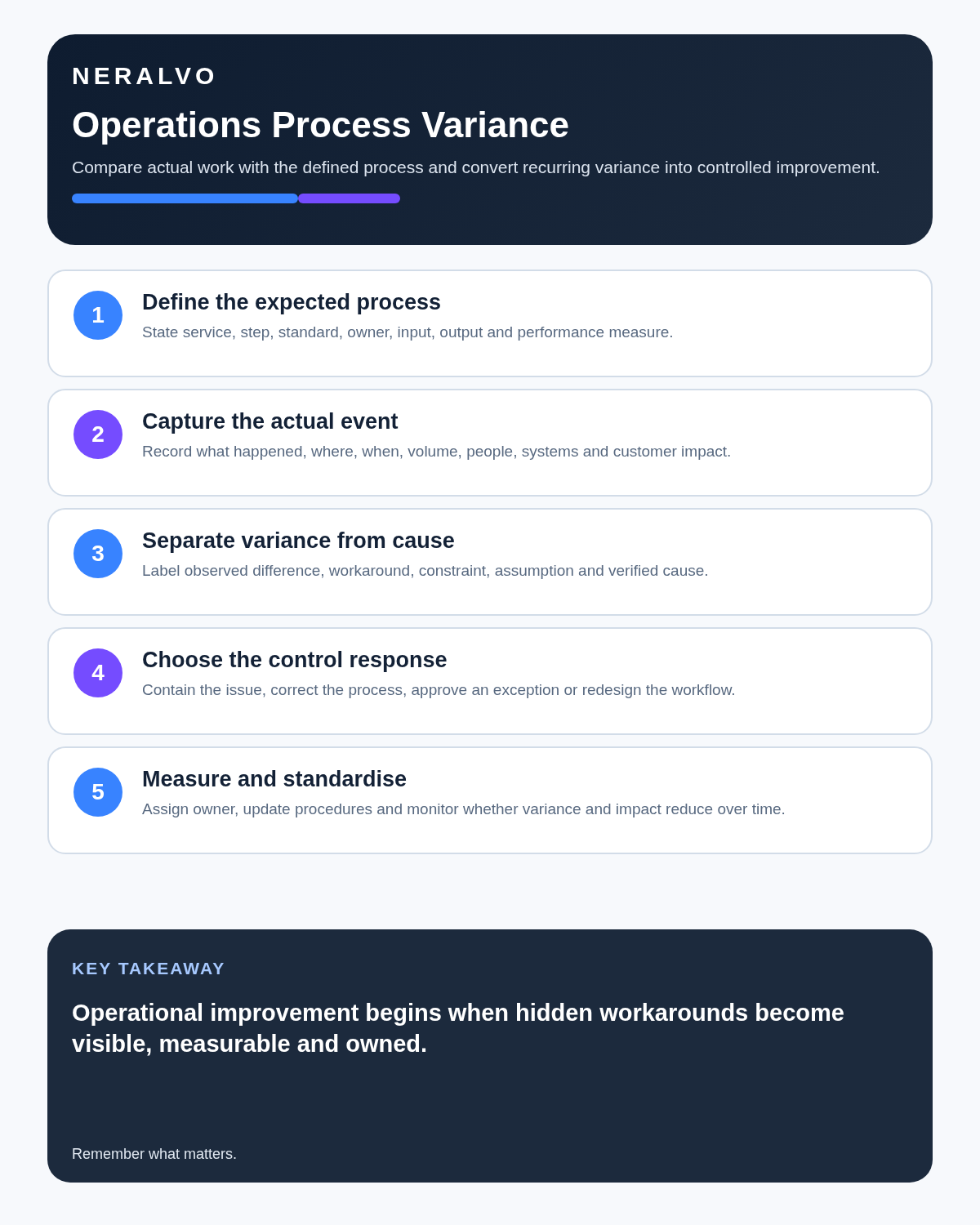
Quick answer: operations managers can use an AI voice recorder during approved walkthroughs, reviews and handovers to expose the gap between the intended process and actual work. The recording should feed a verified process-variance register, controlled change process and measurable improvement—not replace procedures or operational systems.
Best fit: Operations Managers who need recoverable audio and human-verified notes in an authorised workflow. Use another method when: recording is prohibited, a participant declines or the approved process requires manual notes.
Evidence basis and limits
- Decision factors covered: Compare the four process versions; Use the variance card; Ask for exceptions, not only the happy path.
- Evidence rule: The decision is based on the complete capture-to-action workflow, not a single feature or marketing accuracy percentage.
- Boundary: Examples and workflow recommendations must be tested with representative recordings, the intended users and the actual approval process before rollout.

View Halo specifications for operations managers use can preserve authorised process context while controlled procedures, dashboards, workflow and incident systems remain authoritative.
Compare the four process versions
| Version | Meaning | Evidence |
|---|---|---|
| Designed process | How the process was intended to work | Policy, flow, control design or specification |
| Documented process | What the current controlled procedure states | Approved SOP, form and work instruction |
| Observed process | What people actually do | Walkthrough, timestamps, records and direct observation |
| Workaround | Temporary or local method used to achieve the outcome | Frontline explanation, system evidence and operating data |
A transcript may describe all four and still fail to identify which one is approved or safe. Preserve status explicitly.
Use the variance card
- Process step: exact task or handoff.
- Documented method: current approved requirement.
- Observed method: what happened during the walkthrough.
- Reason given: attributed frontline explanation.
- Evidence: system log, queue, form, timestamp or sample.
- Effect: safety, quality, customer, cost or time impact.
- Status: isolated exception, common workaround or approved variation.
- Next test: evidence needed before changing the process.
Ask for exceptions, not only the happy path
During an approved walkthrough, ask:
- What happens when required information is missing?
- Which step creates rework?
- Where do people wait?
- Which system does not match the real work?
- What do experienced staff do differently?
- Which workaround creates another risk?
- Who decides when the normal route may be bypassed?
- Which customer, safety or quality commitments are threatened?
AI summaries tend to produce a clean linear process. Operations management often depends on understanding the messy branches and control failures.
Use an outcome → flow → constraint → evidence → action structure
- Outcome: customer or business result required.
- Flow: actual process, demand and handoffs.
- Constraint: capacity, quality, information, supplier, system or policy.
- Evidence: current metric, observation and source.
- Action: owner, deadline, expected effect and verification.
Separate metric from interpretation
Check definition, reporting period, source, denominator and comparison. Label explanations as reported, observed, suspected or confirmed. A repeated explanation from several people may indicate a theme, but it does not prove root cause.
Move from voice note to verified process map
- Define the question and scope.
- Confirm recording approval and participant notice.
- Capture the actual sequence, branches and exceptions.
- Correct system names, roles, measures and timestamps.
- Compare the transcript with observation, records and controlled documents.
- Enter every material difference in the variance register.
- Test explanations using data and other roles.
- Assess safety, quality, customer and control effects.
- Use formal change approval before updating procedures.
- Train affected roles and verify effectiveness.
Control workarounds
A temporary workaround should record:
- Reason and affected process.
- Risk and control.
- Owner.
- Start date and expiry.
- Check frequency.
- People and systems affected.
- Permanent action and dependency.
- Escalation trigger.
Do not let “use the spreadsheet until IT fixes it” become the undocumented process for years.
Create an operational decision log
State the decision, authority, evidence, trade-off, dependency, implementation owner and review trigger. Preserve rejected options where they explain future constraints.
Discussion does not change the process until the authorised decision and controlled documents are updated.
Investigate incidents beyond individual error
Keep direct observation, reported information, hypothesis and conclusion separate. Review task design, workload, systems, supervision, competence, competing targets, communication and earlier warnings.
A person’s explanation may reveal an important condition, but it does not establish root cause by itself.
Use exception-based handovers
Routine status belongs in dashboards. The handover should focus on:
- Current state and service risk.
- Temporary control or workaround.
- Open safety, quality or customer issue.
- Customer commitment.
- Capacity or staffing constraint.
- Supplier dependency.
- Owner and next evidence point.
- System requiring update.
The next manager should not need to replay audio to understand what requires action.
Map actions into real systems
Tasks should enter the project, service, workforce, supplier, quality or incident system that owns them. Each action needs a specific output, one owner, deadline, dependency and completion evidence.
Verify improvement through evidence
Define:
- Baseline and data source.
- Change being introduced.
- Leading indicator.
- Outcome measure.
- Safety, quality and customer guardrails.
- Review date.
- Adopt, adapt or stop decision rule.
Do not declare success because training occurred, a procedure was issued or a meeting was held. Verify the operating result.
Protect frontline trust and sensitive information
Explain the improvement purpose and avoid turning process walks into hidden performance monitoring. Remove unnecessary personal detail and restrict access to raw recordings. Use the official HR route for individual performance or conduct matters.
How NERALVO Halo fits operations management
NERALVO Halo includes NOTE mode, supported CALL mode, 64GB local storage, up to 35 hours of recording and Bluetooth sync with DOWAY. DOWAY can create transcripts, summaries, speaker-separated notes, templates, translations, mind maps and exports, with one year of DOWAY Max included.
It may support approved walkthroughs, operational reviews and private debriefs. Halo is not an ERP, workflow, incident, performance or process-control system.
Cloud software, a dedicated recorder or manual notes?
For Operations Managers, the right answer changes with the setting. This matrix deliberately gives each method a situation where it can be the strongest choice.
| Situation | Best starting point | Reason |
|---|---|---|
| scheduled remote client meetings | Cloud meeting software | Native remote-meeting workflows can be more efficient here. |
| in-person visits and travel | Dedicated recorder | A separate battery and recoverable local source improve resilience. |
| a client declines or policy requires manual notes | Manual notes or an approved alternative | Manual notes are the correct control when recording is unavailable. |
| mixed CRM and field work | Governed hybrid | A hybrid can combine automation with reliable physical capture. |
Frequently asked questions
Can an AI transcript become the process map?
It can help draft one, but the sequence, roles, controls and exceptions must be verified against observation and records.
Can frontline explanations be treated as root cause?
No. Attribute them and test them with other evidence.
Should every workaround be removed immediately?
Not without assessing why it exists and the risk of change. Control it, investigate it and decide through the authorised process.
What proves an improvement worked?
Measured change against the baseline, while required safety, quality and customer guardrails remain acceptable.
Final operations-manager checklist
- Designed, documented, observed and workaround processes distinguished.
- Variance linked to exact evidence.
- Frontline explanation attributed, not assumed true.
- Exceptions and branches captured.
- Workarounds have owners and expiry.
- Root cause tested beyond individual error.
- Decision authority and change route recorded.
- Actions entered the correct systems.
- Outcome and guardrail measures defined.
- Effectiveness verified before standardisation.
Bottom line: an AI recorder can expose the gap between intended and actual work. Verify every variance, understand why it exists and change the controlled process only after evidence and approval.
Related guides
See the guides for quality managers, operations directors and change managers.
On this page
Related guides
See whether Halo fits this workflow
Review the NERALVO Halo specifications, included services, delivery information and current offer only after completing the guide.
Found an error or an out-of-date claim? Email support@neralvo.com with the article address and a supporting source.