The 60-second verdict
Quick answer: use an AI voice recorder for shift handovers only as a governed support layer. Prepare from authoritative systems, communicate urgent risks first, use a live two-way exchange, verify critical details through read-back and cross-checking, and transfer the final status into the authorised operational record.
Best fit: Shift Handovers who need recoverable audio and human-verified notes in an authorised workflow. Use another method when: recording is prohibited, a participant declines or the approved process requires manual notes.
Evidence basis and limits
- Decision factors covered: Why shift handover is safety-critical; A recording is support—not the handover itself; Prepare the outgoing handover.
- Evidence rule: A claim earns weight only when the source, date, configuration and limitation are clear enough for a reader to check.
- Boundary: Examples and workflow recommendations must be tested with representative recordings, the intended users and the actual approval process before rollout.

A handover fails when essential information stays in one person’s memory or is buried in a long narrative. Assess Halo against the shift handovers workflow matrix can support approved capture, but audio cannot replace safety, clinical or operational handover procedures.
Why shift handover is safety-critical
HSE describes effective handover as accurate, reliable communication of task-relevant information so work continues safely and effectively. Its core elements are:
- Preparation by outgoing personnel.
- Information exchange between outgoing and incoming personnel.
- Cross-checking by incoming personnel as responsibility transfers.
HSE also recommends two-way verbal and written communication with enough time and resource for the transfer. Review the current HSE shift-handover guidance.
A recording is support—not the handover itself
A one-way audio file cannot ask questions, inspect equipment, challenge an assumption or confirm understanding. Critical handovers should use the organisation’s required live process, supported by written logs, displays, permits and records.
A recording may help draft the outgoing summary, preserve a permitted live briefing for verification, support remote participants where allowed, capture agreed actions or review recurring communication weaknesses. It must not delay the live transfer of control.
Prepare the outgoing handover
Review authoritative systems and prepare:
- Operating status and service position.
- Safety, security, welfare or environmental risks.
- Abnormal conditions, alarms and deviations.
- Equipment unavailable, isolated or overridden.
- Permits to work and maintenance in progress.
- Temporary repairs, controls and compensating measures.
- Work completed and verification status.
- Work in progress and safe stopping point.
- People, parts, approvals or information awaited.
- Incidents, near misses and investigations.
- First priorities and timed checks for the incoming shift.
- Escalation triggers and contacts.
Use a fixed risk-first sequence
| Section | Key question |
|---|---|
| Current state | What is operating, stopped or degraded now? |
| Highest risks | What could cause harm or loss during this shift? |
| Controls | Which barriers, isolations or temporary measures are active? |
| Work in progress | Who is doing what, under which permit or instruction? |
| Required checks | What must the incoming shift verify first and when? |
| Escalation | Which result or change requires stopping or contacting whom? |
Use the exception-based handover card
| Handover field | Required detail |
|---|---|
| Current state | Verified status at a named time |
| Change | What improved, worsened or failed |
| Exception | Anything outside normal operation |
| Control | Restriction, isolation, monitoring or workaround |
| Next action | Owner, deadline and completion evidence |
| Escalation | Trigger, route and urgency |
Make critical information explicit
Avoid phrases such as “keep an eye on it”, “it should be fine” or “the usual issue”. State the exact asset, area or process; current reading or condition; expected range or control; check time and responsible role; escalation threshold; action already taken; and authoritative log, permit or work order.
Separate information status
- Confirmed: checked current status.
- Reported: information received but not independently verified.
- Pending: task or result outstanding.
- Risk: issue and current control.
- Escalate if: defined trigger requiring action.
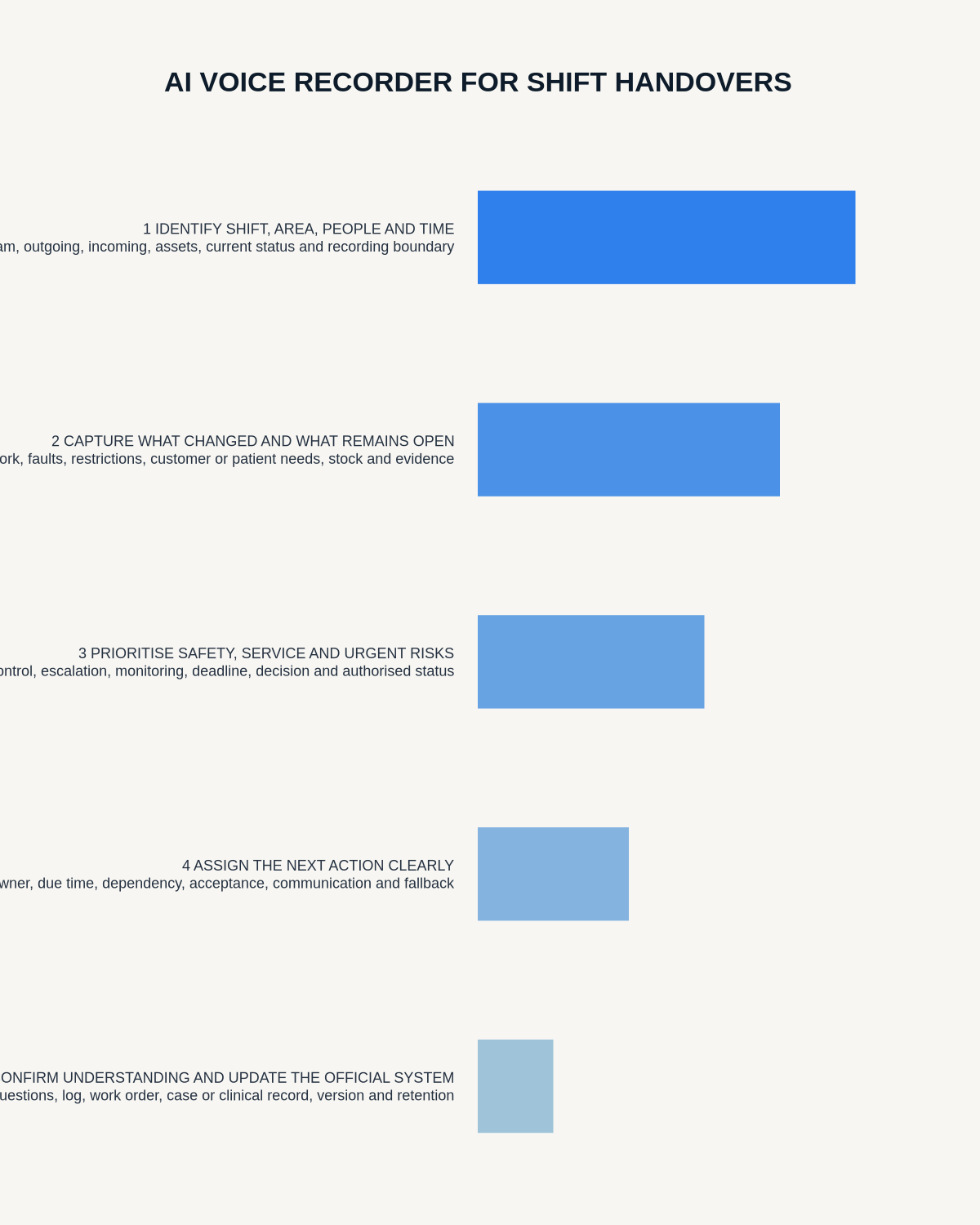
Use closed-loop read-back and cross-checking
- The sender states the critical item.
- The receiver reads it back.
- The sender corrects any difference.
- The receiver confirms the action and deadline.
- The authorised system is updated.
The incoming person should also check control-room displays, operational logs, permits, isolation records, work orders, maintenance status, physical conditions where required, staffing arrangements and emergency instructions. Resolve discrepancies before responsibility is treated as transferred.
Verify AI transcript risk fields manually
- Asset and tag numbers.
- “Open” versus “closed” and “on” versus “off”.
- Negative wording such as “not isolated”.
- Readings, units and decimal points.
- Times, dates and shift references.
- Permit status.
- Speaker attribution.
- Conditional or provisional instructions.
Do not use an AI summary as the sole source for operating a safety-critical system.
Use a controlled post-handover workflow
- Complete the required log and transfer-of-responsibility process.
- Confirm urgent tasks and timed checks in the official system.
- Link permits, work orders, incidents and temporary controls.
- Correct any permitted transcript against the live discussion and records.
- Record discrepancies or missed information for improvement.
- Restrict access to operational and personal information.
- Delete temporary audio under the organisation’s retention process.
Do not wait for AI processing
Emergency, safety, security, safeguarding and environmental information must be communicated and escalated immediately through the authorised process. Recording and transcription are administrative support, not an emergency channel.
Measure handover quality
Track missed actions, wrong ownership, repeated unresolved exceptions, read-back corrections and incidents linked to incomplete handover. The goal is safer continuity, not more recorded hours.
How NERALVO Halo fits suitable handovers
NERALVO Halo offers NOTE mode for permitted in-person briefings and supported CALL mode for compatible remote calls where recording is lawful, disclosed and permitted. It includes 64GB local storage, up to 35 hours of recording and Bluetooth sync with DOWAY for transcripts, summaries, templates, translations, mind maps and exports, with one year of DOWAY Max included.
Halo may support a draft handover note. It does not replace the live two-way exchange, written log, permit system, physical check or competent acceptance of responsibility.
Cloud software, a dedicated recorder or manual notes?
For Shift Handovers, the right answer changes with the setting. This matrix deliberately gives each method a situation where it can be the strongest choice.
| Situation | Best starting point | Reason |
|---|---|---|
| scheduled remote meetings | Cloud meeting software | Auto-join and central collaboration can remove routine admin. |
| in-person or mobile work | Dedicated recorder | Dedicated hardware suits movement, variable rooms and offline source capture. |
| recording is refused or prohibited | Manual notes or an approved alternative | A clear alternative respects policy and participant choice. |
| mixed online and offline work | Governed hybrid | One governed process prevents gaps between desk and field work. |
Frequently asked questions
Can a recorded message replace a live handover?
Not for critical information requiring questions, cross-checking and acceptance of responsibility.
Should handovers be verbal or written?
HSE recommends both, supported by incoming-team cross-checking.
Can AI identify the highest operational risk?
It may highlight repeated terms, but competent staff must assess current conditions.
What if recording fails?
Use the approved written or verbal fallback immediately. Safe transfer cannot depend on one device.
Final shift-handover checklist
- Outgoing preparation completed.
- Urgent risks communicated first.
- Fixed risk-first sequence used.
- Confirmed and reported information separated.
- Abnormal conditions, isolations and permits explicit.
- Critical details read back and cross-checked.
- Actions and deadlines assigned.
- Escalation triggers visible.
- Authoritative log and systems updated.
- Fallback and retention defined.
Bottom line: a strong handover leaves the incoming team able to explain the current state, active risks and exact next actions. Recording can support that process, but preparation, two-way communication and cross-checking keep it safe.
Related guides
See the guides for inspections, site visits and choosing an AI voice recorder.
On this page
Related guides
See whether Halo fits this workflow
Review the NERALVO Halo specifications, included services, delivery information and current offer only after completing the guide.
Found an error or an out-of-date claim? Email support@neralvo.com with the article address and a supporting source.