The 60-second verdict
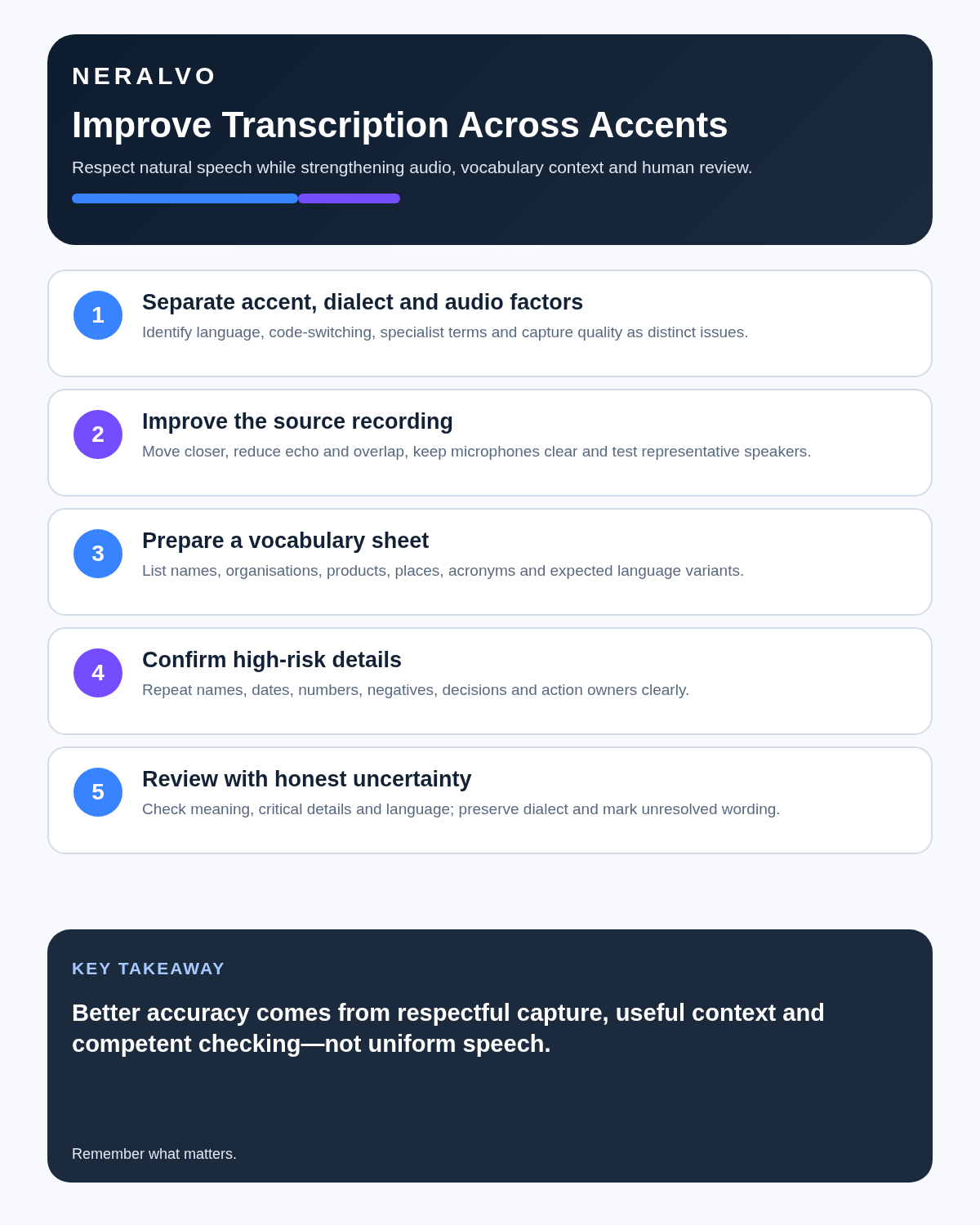
Quick answer: improve AI transcription across accents by improving source audio, selecting the correct language, preparing names and specialist vocabulary, preserving dialect and uncertainty, and reviewing material details with a fluent human where the consequence is high.
Decision focus: use the method below only where it produces a recoverable source, a verifiable output and a clear next action. If one of those fails, change the workflow rather than trusting a polished summary.
Evidence basis and limits
- Decision factors covered: Separate the factors before diagnosing the error; Why performance varies; Create a useful vocabulary sheet.
- Evidence rule: Claims are weighted by consequence: capture failure, changed meaning, access and recovery matter more than polished wording.
- Boundary: Examples and workflow recommendations must be tested with representative recordings, the intended users and the actual approval process before rollout.

Accents are normal forms of speech, not errors to correct. Check whether NERALVO Halo fits this workflow can provide a clear source recording and DOWAY transcription, but no system guarantees equal accuracy for every accent, dialect, language and environment.
Separate the factors before diagnosing the error
| Factor | What it changes | Useful control |
|---|---|---|
| Accent | Pronunciation, stress, rhythm and vowel or consonant patterns | Test real speakers and preserve natural delivery |
| Dialect | Vocabulary, grammar, idiom and local meaning | Use a fluent reviewer and retain original wording |
| Language model | Expected spelling, vocabulary and sound patterns | Select the correct language and regional convention where available |
| Code-switching | Language or variety changes inside one sentence or turn | Mark changes and review each language separately |
| Specialist vocabulary | Names, products, acronyms and technical terms | Prepare a vocabulary sheet and verify against sources |
| Audio conditions | Whether the speech signal reaches the microphone clearly | Reduce distance, overlap, echo and competing noise |
| Speaker interaction | Interruptions, short replies and attribution | Use turn-taking and verify speaker labels |
Why performance varies
Recognition quality depends on the training and tuning of the selected system, the speaker population represented, microphone distance, room acoustics, background noise, code-switching and the kinds of names or terminology used. A model can perform well for one speaker and poorly for another with a similar regional label.
Do not treat a single generic accuracy percentage as a guarantee. Test the exact people, languages, rooms and consequential terms involved in the real workflow.
Improve the source first
- Move the recorder closer to the intended speakers.
- Reduce fans, traffic, music and echo.
- Avoid simultaneous speech.
- Keep microphones clear of clothing, hands and papers.
- Test the quietest and farthest important speaker.
- Use a stable position rather than moving the device continuously.
- Repeat important names and numbers naturally.
- Use the correct language or multilingual setting where supported.
Do not ask people to imitate an unfamiliar accent. A natural measured pace is preferable to forced over-enunciation, which can reduce comfort and still fail to solve poor placement or noise.
Create a useful vocabulary sheet
Prepare the information the reviewer will need:
- Participant names and preferred spellings.
- Organisations, products and project names.
- Places, streets and local names.
- Acronyms and abbreviations.
- Technical, medical, legal or academic terms.
- Local expressions and likely dialect words.
- Codes, part numbers and reference formats.
- Expected language changes or borrowed terms.
The sheet should support correction rather than encourage replacement of the speaker’s natural language with a generic standard form.
State high-risk details clearly
Repeat names, numbers, dates, addresses, negatives, decisions and action owners. Useful confirmation patterns include:
- “Fifteen—one five.”
- “The surname is M-A-C-L-E-O-D.”
- “Not approved yet.”
- “The deadline is Thursday, 14 August.”
- “Priya owns the action; Daniel is supporting.”
Clear read-back improves both the source audio and human understanding.
Fluent text is not always faithful meaning
A transcript may look grammatical while changing the source. Check for:
- A local term replaced with a familiar but different word.
- A negative omitted.
- A hesitation removed even though uncertainty matters.
- Two speakers merged.
- A code-switched phrase translated or omitted without notice.
- A culturally specific expression converted into an unsupported literal sentence.
- A name or place silently normalised.
- An inaudible passage reconstructed into plausible prose.
Review meaning, not only spelling and punctuation.
Review in three passes
- Meaning pass: identify missing sections, impossible sentences, abrupt topic changes and likely speaker errors.
- Risk pass: replay names, figures, dates, negatives, quotations, decisions, instructions and action ownership.
- Language pass: use a fluent or appropriately qualified reviewer for dialect, code-switching, culturally specific meaning and translation where consequence is material.
Use an honest uncertainty convention
| Situation | Safer notation |
|---|---|
| Speech cannot be understood | [inaudible 00:12:42] |
| Two interpretations remain possible | [unclear: fifteen or fifty] |
| Spelling needs confirmation | [spelling to confirm] |
| Speaker cannot be identified | [speaker uncertain] |
| Original term should be preserved | [original phrase retained] |
| Language changes | [switches to Welsh] or the relevant language label |
| Translation is provisional | [working translation—review required] |
An honest gap is safer than confident invention. Keep the source timestamp so an authorised reviewer can return to the audio.
Use a multilingual and code-switching workflow
- Preserve the original audio unchanged.
- Select the most appropriate language or multilingual model.
- Mark where the language changes.
- Create a source-language transcript before translation where the purpose requires it.
- Keep borrowed words, names and specialist terms visible.
- Use fluent review for material passages.
- Treat translation as a separate version with its own reviewer and status.
- Store the final reviewed output alongside a controlled source reference.
Do not erase code-switching merely to make the transcript look uniform. The switch may carry identity, emphasis, humour or technical meaning.
Handle translation separately
Keep the original audio and source-language transcript. Machine translation can alter register, politeness, certainty and culturally specific meaning. Use qualified or fluent review for legal, health, financial, educational or professional consequences.
Protect fairness in professional and educational records
Do not judge intelligence, competence, credibility, honesty or language ability from transcription errors. High-stakes recruitment, education, legal, clinical, disciplinary and performance records require proportionate human review.
Where one group produces higher correction rates, treat that as a system and workflow issue. Test whether placement, language settings, vocabulary preparation or model choice disadvantage particular speakers.
Edit respectfully
Correct recognition mistakes without erasing the speaker’s identity or changing meaning. Preserve dialect in direct quotations where appropriate and agreed. For edited prose, distinguish a faithful paraphrase from a direct quote.
Do not “clean up” grammar, hesitation or wording when those features are relevant to research, evidence, accessibility or the speaker’s intended voice. Document material editorial changes.
A practical pre-session checklist
- Purpose and required level of accuracy defined.
- Recording permission and participant information clear.
- Correct language setting selected.
- Real speakers tested.
- Quietest and farthest positions checked.
- Vocabulary sheet prepared.
- Code-switching and translation plan defined.
- High-risk fields identified.
- Human reviewer arranged where needed.
- Uncertainty and correction convention agreed.
Common mistakes
- Blaming the speaker instead of testing microphone distance and noise.
- Using one language setting for a multilingual conversation.
- Correcting unfamiliar words from guesswork.
- Publishing direct quotations from unchecked text.
- Standardising dialect until meaning changes.
- Using transcription errors as evidence of competence or credibility.
- Translating before the source transcript has been checked.
- Removing visible uncertainty to make the output look polished.
Where NERALVO Halo fits
Halo provides portable NOTE and supported CALL capture, 64GB local storage and DOWAY transcription, translation and structured-note tools. Its value depends on clear audio, appropriate language settings, useful vocabulary context and human verification.
Test the complete device-to-app workflow with representative speakers before relying on it for consequential records.
Workflow choice matrix for AI Voice Recording and Accents
Choose the method that protects the source and reduces downstream correction. The table makes the non-hardware options explicit.
| Condition | Preferred route | Why |
|---|---|---|
| High-risk or mixed work | Governed hybrid | Separate capture, review, approval and retention rather than trusting one tool. |
| Recording is refused, prohibited or unnecessary | Manual notes / no recording | Respecting the boundary is the correct workflow, not a product failure. |
| In-person, mobile or unreliable-connectivity work | Dedicated recorder | Independent capture and a recoverable local source are usually more resilient. |
| Repeatable remote work with approved integrations | Cloud software | Automation and central collaboration may outweigh device independence. |
Frequently asked questions
Should speakers change their accent?
No. Improve recording conditions, model settings and context instead.
Can AI guarantee equal accuracy?
No. Performance varies by system, speaker, language, vocabulary and environment.
Should dialect be standardised in quotations?
Correct recognition errors, but preserve the speaker’s meaning and wording. Any edited quotation should follow the applicable professional process.
What if the system produces fluent but incorrect text?
Return to the source audio, mark uncertainty and verify the passage with a fluent reviewer where needed.
Should translation happen at the same time as transcription?
For consequential work, preserve and verify the source-language layer first, then review translation separately.
Can accent-related error rates be used to assess an employee or student?
No. They reflect the interaction between speaker, audio conditions and system performance, not competence.
What should happen when a name remains uncertain?
Mark it for confirmation and verify against an authoritative source rather than selecting the most familiar spelling.
Accent-transcription checklist
- Accent, dialect, language and audio factors separated.
- Correct language setting selected.
- Representative speakers and real environments tested.
- Source audio improved.
- Vocabulary list prepared.
- High-risk details repeated and checked.
- Three-pass review completed.
- Uncertainty marked honestly.
- Source language and translation kept separate.
- Dialect and speaker meaning edited respectfully.
- Human review matched to consequence.
Bottom line: fair accent-aware transcription starts with better audio and appropriate language context, then preserves uncertainty and uses human review where meaning matters.
Related AI voice recorder guides
On this page
Related guides
See whether Halo fits this workflow
Review the NERALVO Halo specifications, included services, delivery information and current offer only after completing the guide.
Found an error or an out-of-date claim? Email support@neralvo.com with the article address and a supporting source.