The 60-second verdict
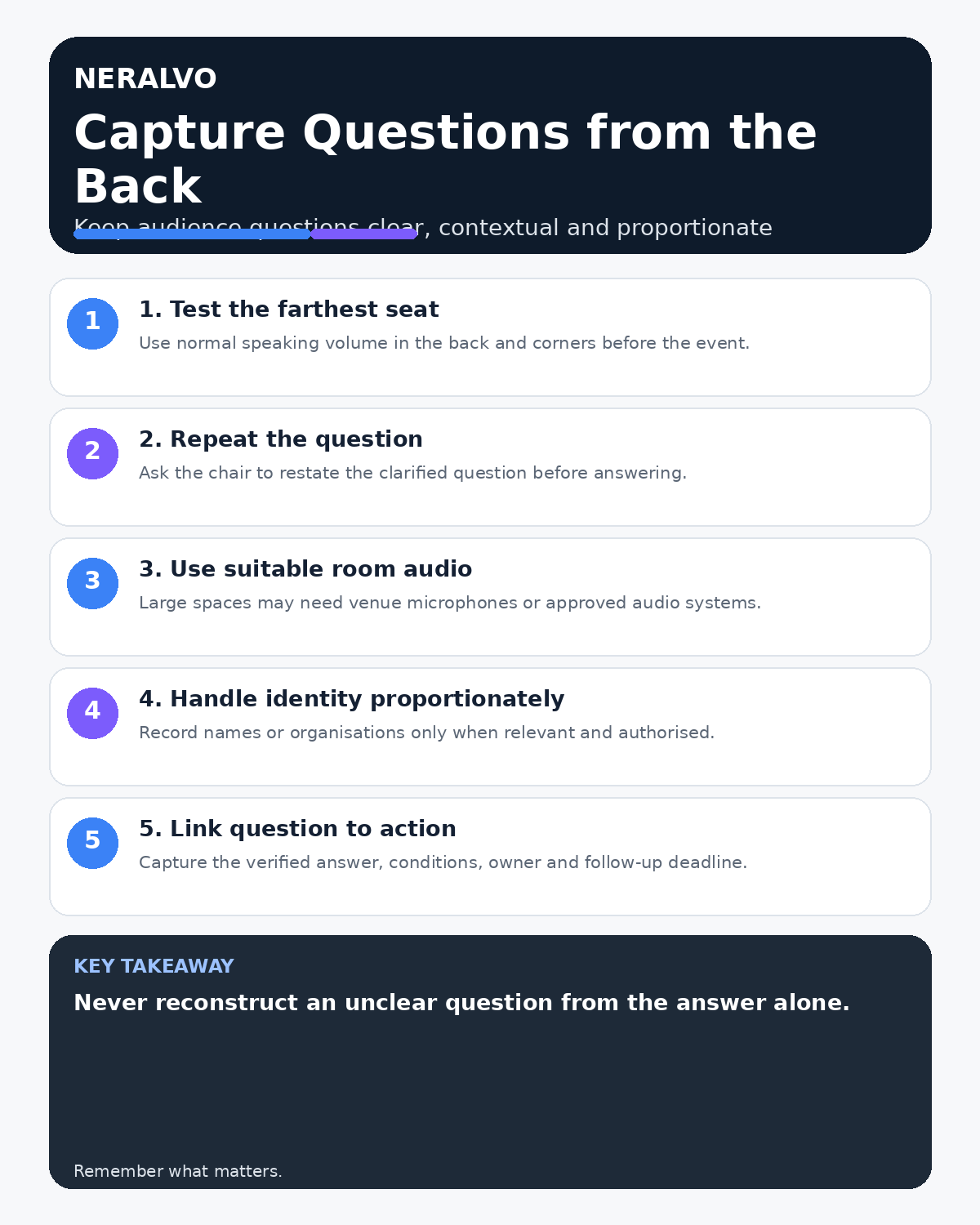
Quick answer: capture questions from the back of a room by testing the farthest seats before the event, using suitable room audio and asking the presenter or chair to repeat each material question clearly before answering it.
Decision focus: use the method below only where it produces a recoverable source, a verifiable output and a clear next action. If one of those fails, change the workflow rather than trusting a polished summary.
Evidence basis and limits
- Decision factors covered: Test the real room; Use suitable room audio; Capture identity proportionately.
- Evidence rule: Claims are weighted by consequence: capture failure, changed meaning, access and recovery matter more than polished wording.
- Boundary: Examples and workflow recommendations must be tested with representative recordings, the intended users and the actual approval process before rollout.
Audience questions are often the most valuable part of a session and the least likely to reach the recorder. A perfect answer is difficult to use when the transcript contains only an inaudible fragment of the question.

Test the real room
Ask a quiet speaker in the back row and far corners to speak at normal volume. Test with normal ventilation, amplification and room setup. Listen to the source audio and inspect the draft transcript.
An empty, silent room may perform very differently once the audience arrives.
Repeat every material question
The chair or presenter should clarify and repeat the question before answering:
“The question is whether the deadline includes supplier approval.”
This improves accessibility, gives the questioner a chance to correct the meaning and creates one clear version for the recording.
Use suitable room audio
Large rooms, formal events and distant seating may require roving microphones, fixed room microphones or another approved venue system. One table recorder cannot reliably cover every room size, layout and audience.
Protect sensitive questions
Do not ask someone to shout personal, confidential or sensitive information across the room. Offer a written, private or post-session route where appropriate.
Capture identity proportionately
Usually the question matters more than the person’s full identity. Record a name, role or organisation only when it is relevant, authorised and necessary for follow-up.
Handle unclear questions honestly
If the question was not repeated and the audio is unclear, do not reconstruct it from the answer. Use a marker such as [question unclear] with a timestamp and seek confirmation where the issue affects a decision, commitment or publication.
Create a complete Q&A record
- Clarified question
- Speaker or role where relevant
- Verified answer
- Conditions and limitations
- Evidence or source referenced
- Follow-up action, owner and deadline
Support remote and hybrid attendees
Monitor chat and raised-hand queues, repeat typed questions aloud and identify whether the answer applies to the whole group or a specific case. Mark connection failures where a participant may have missed the response.
Workflow choice matrix for How to Capture Questions from the Back of a Room
Choose the method that protects the source and reduces downstream correction. The table makes the non-hardware options explicit.
| Condition | Preferred route | Why |
|---|---|---|
| High-risk or mixed work | Governed hybrid | Separate capture, review, approval and retention rather than trusting one tool. |
| Recording is refused, prohibited or unnecessary | Manual notes / no recording | Respecting the boundary is the correct workflow, not a product failure. |
| In-person, mobile or unreliable-connectivity work | Dedicated recorder | Independent capture and a recoverable local source are usually more resilient. |
| Repeatable remote work with approved integrations | Cloud software | Automation and central collaboration may outweigh device independence. |
Frequently asked questions
Is central recorder placement always best?
No. Placement depends on presenter location, room shape, audience distance and noise.
Should every audience member state their name?
No. Capture identity only where it is necessary and authorised.
What if a question was not captured?
Do not invent it from the answer. Mark uncertainty and obtain clarification if material.
Useful resources
- UK government inclusive-communication guidance
- How to Position an AI Voice Recorder
- How to Handle Overlapping Speech
- Check whether NERALVO Halo fits this workflow
Final Q&A checklist
- Farthest seats tested
- Material questions repeated
- Suitable room audio used
- Question and answer linked
- Identity proportionate
- Conditions and follow-up verified
On this page
Related guides
See whether Halo fits this workflow
Review the NERALVO Halo specifications, included services, delivery information and current offer only after completing the guide.
Found an error or an out-of-date claim? Email support@neralvo.com with the article address and a supporting source.