The 60-second verdict
Quick answer: ask permission to record a meeting by explaining purpose, use, AI processing, access, retention and the genuine non-recorded alternative, then capture a clear response, inform late joiners, reassess when circumstances change and respect refusal or conditional permission.
Decision focus: use the method below only where it produces a recoverable source, a verifiable output and a clear next action. If one of those fails, change the workflow rather than trusting a polished summary.
Evidence basis and limits
- Decision factors covered: The four-part permission formula; Ready-to-use scripts; Record the response properly.
- Evidence rule: A claim earns weight only when the source, date, configuration and limitation are clear enough for a reader to check.
- Boundary: Examples and workflow recommendations must be tested with representative recordings, the intended users and the actual approval process before rollout.

Asking permission to record should be clear enough for the other person to make a real choice. A rushed “you don’t mind, do you?” can create confusion, especially in employment, client, healthcare, legal or other sensitive settings.
The script should explain four things: purpose, use, access and choice. Organisations must still follow their current legal, professional and internal requirements.
The four-part permission formula
“I would like to record [this meeting/call] so that [specific purpose]. I will use it to [output], it will be available to [audience] and handled under [retention or policy]. Are you comfortable proceeding, or would you prefer that I take written notes?”
Avoid promising absolute security, perfect transcription or deletion that the system cannot actually deliver.
Ready-to-use scripts
| Situation | Suggested wording |
|---|---|
| General business meeting | “May I record this meeting so I can prepare an accurate decision and action note? The authorised project team will have access, and the source recording will follow our retention process. Written notes are available instead.” |
| Client consultation | “I would like to record this consultation to draft an accurate file note. I will check the transcript before it enters your record. It will not be used for marketing. Are you happy to proceed?” |
| Interview or research | “With your permission, I would like to record the interview for transcription and analysis for this project. The participant information explains access, quotation use, retention and withdrawal. Shall I start?” |
| Training session | “I would like to record this section to review the demonstration and improve the training material. Please avoid sharing personal case details. A non-recorded alternative is available.” |
| Remote meeting | “Before we begin, I plan to record the audio to create checked minutes. The recording is separate from the meeting platform and will be stored in our approved account. Is everyone content?” |
| Supplier call | “May I record this call to capture the specification, decisions and actions accurately? Formal prices and commitments will still be confirmed through the written order process.” |
| Workplace meeting | “The organisation proposes recording so an accurate note can be prepared. Please take time to consider this and speak with your representative if relevant. We can use an agreed note-taker instead.” |
| Existing recording restarted | “We paused the recording for a private section. I would now like to restart it for the agreed agenda. Is everyone still comfortable?” |
Record the response properly
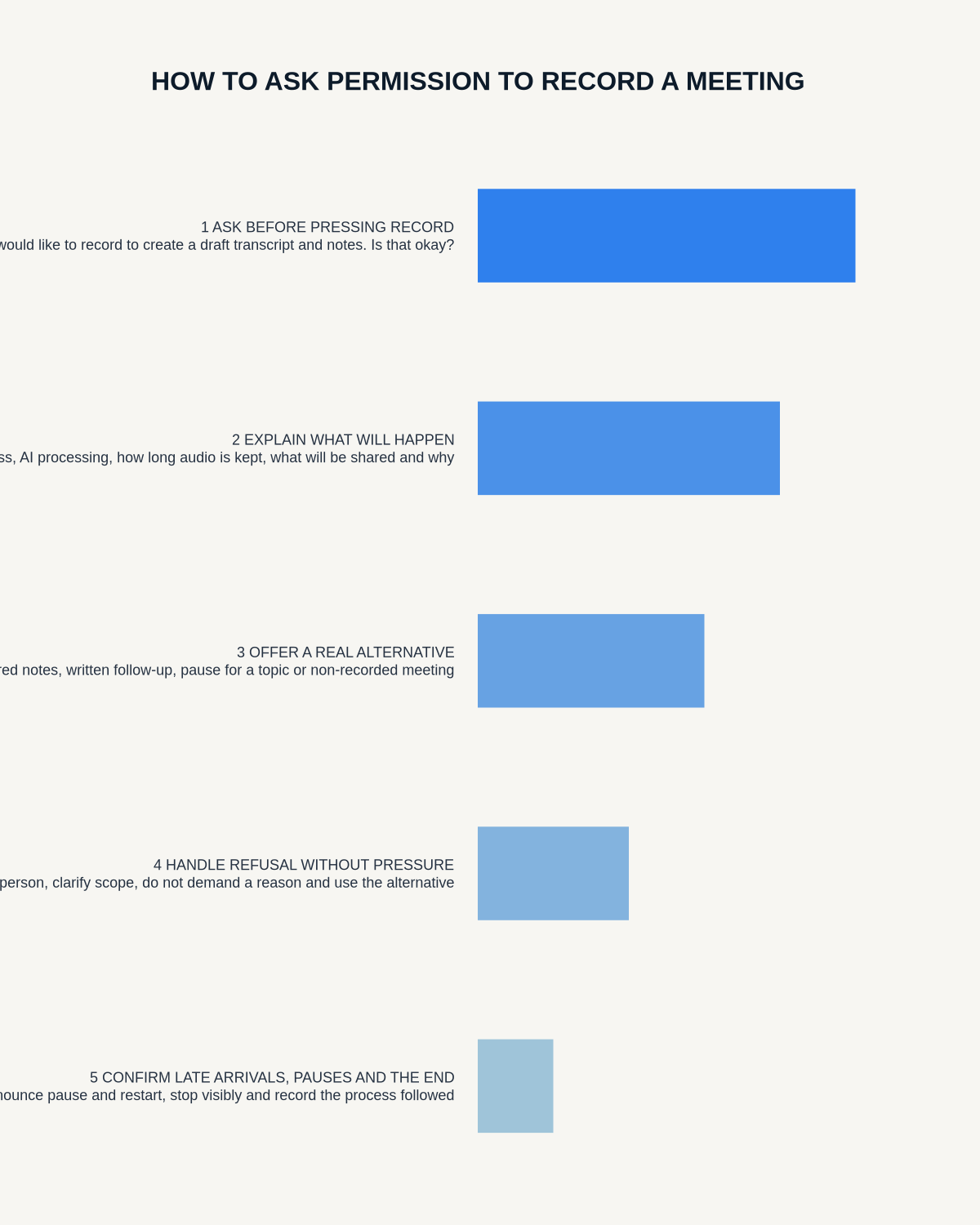
- Ask before substantive discussion begins.
- Allow questions and time to decide.
- Capture a clear yes, no or agreed condition.
- Inform late joiners before they participate.
- Repeat the request if the purpose or audience changes.
- Stop when a participant withdraws permission where the process requires it.
What to say when someone refuses
Use neutral wording:
“That is fine. I will not record. We will use written notes and circulate the key decisions for review.”
Do not argue that recording is harmless or imply that refusal is suspicious. Follow the approved alternative and document the method used.
Conditional permission
A participant may agree only if:
- a sensitive section is paused
- the recording is not shared externally
- quotations require separate approval
- raw audio is deleted after a checked note is created
- another person is excluded from access
Confirm whether the organisation can honour the condition before recording. Do not accept a condition that conflicts with the required process.
Do not confuse permission with every other control
Permission does not automatically settle lawful basis, confidentiality, professional duties, security, supplier contracts, access rights or retention. Those decisions require their own assessment.
How NERALVO Halo may support transparent recording
Apply this guide before assessing NERALVO Halo provides NOTE recording, supported CALL capture, 64GB local storage, up to 35 hours of recording and Bluetooth sync with DOWAY. One year of DOWAY Max is included from activation.
Tell participants when Halo and DOWAY are part of the workflow. A physical recorder should not be used to make recording less visible.
Before pressing record
- The purpose is specific.
- The audience and retention are understood.
- The script matches the actual data flow.
- Participants have a genuine choice where required.
- Late joiners and restarts are covered.
- A non-recording alternative is ready.
Bottom line: a good permission request is brief, accurate and easy to refuse. That clarity protects the relationship as well as the record.
Workflow choice matrix for Meeting Recording Permission Scripts
Choose the method that protects the source and reduces downstream correction. The table makes the non-hardware options explicit.
| Condition | Preferred route | Why |
|---|---|---|
| High-risk or mixed work | Governed hybrid | Separate capture, review, approval and retention rather than trusting one tool. |
| Recording is refused, prohibited or unnecessary | Manual notes / no recording | Respecting the boundary is the correct workflow, not a product failure. |
| In-person, mobile or unreliable-connectivity work | Dedicated recorder | Independent capture and a recoverable local source are usually more resilient. |
| Repeatable remote work with approved integrations | Cloud software | Automation and central collaboration may outweigh device independence. |
Related guides
On this page
Related guides
See whether Halo fits this workflow
Review the NERALVO Halo specifications, included services, delivery information and current offer only after completing the guide.
Found an error or an out-of-date claim? Email support@neralvo.com with the article address and a supporting source.