The 60-second verdict
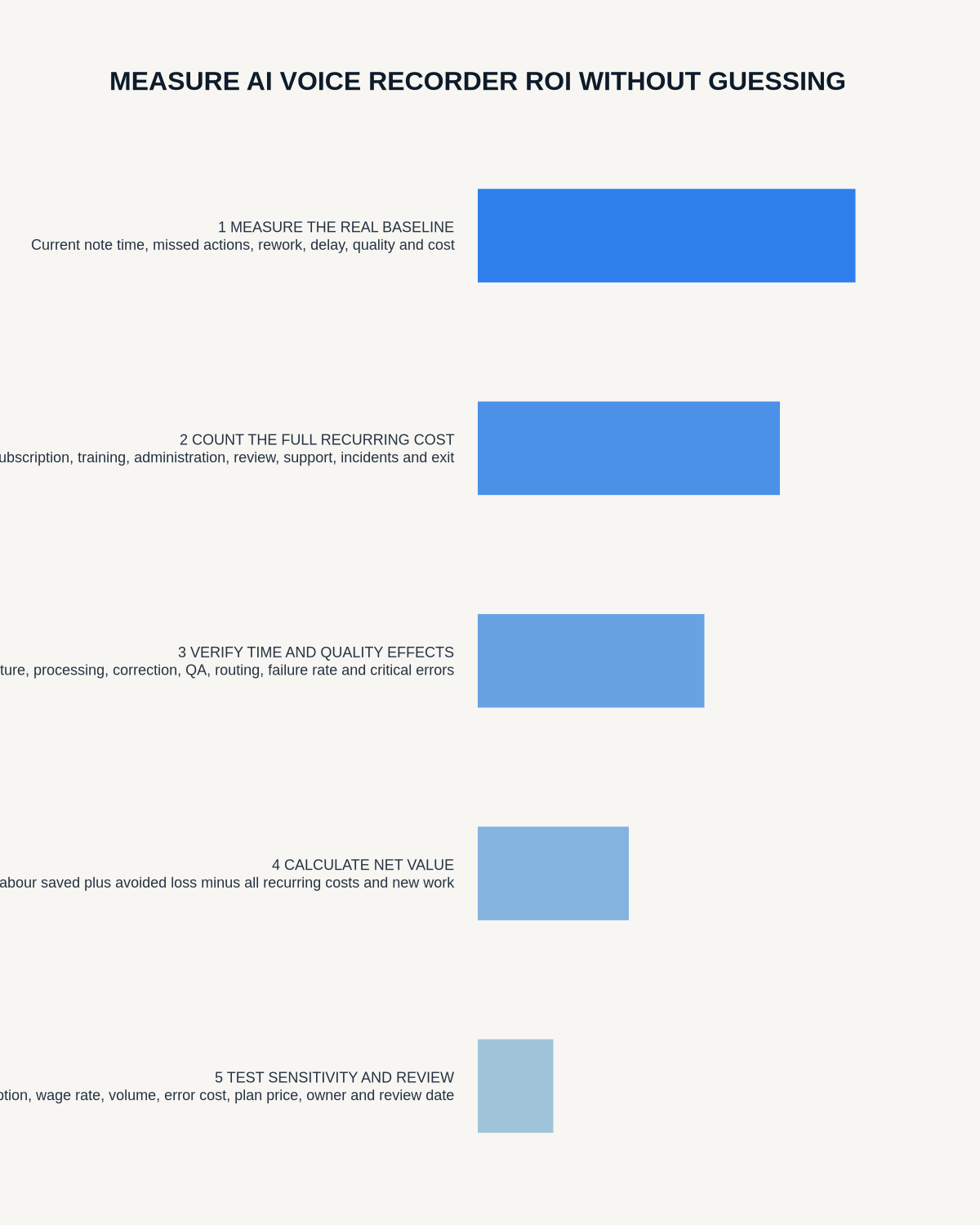
Quick answer: measure AI voice recorder ROI by comparing the complete old and new workflows for one repeatable approved output. Include preparation, capture, transcription, correction, approval, export, storage, failures, training and subscriptions—not only minutes saved during the meeting.
Decision focus: use the method below only where it produces a recoverable source, a verifiable output and a clear next action. If one of those fails, change the workflow rather than trusting a polished summary.
Evidence basis and limits
- Decision factors covered: Define one unit of work; Measure the current workflow; Measure the complete new workflow.
- Evidence rule: A claim earns weight only when the source, date, configuration and limitation are clear enough for a reader to check.
- Boundary: Examples and workflow recommendations must be tested with representative recordings, the intended users and the actual approval process before rollout.

A faster first draft can still create negative value if it increases material errors, review work, failed captures or uncontrolled information. ROI should therefore include quality and operating risk as well as time.
Define one unit of work
Select a repeatable output such as one approved client-call note, set of board minutes, inspection draft or research transcript. Measure from preparation through the point when the approved record reaches its authorised destination.
Measure the current workflow
- preparation time;
- manual note-taking burden;
- post-event drafting;
- time spent finding missing facts;
- manager or peer review;
- corrections and rework;
- cost or impact of delayed and forgotten actions.
Observe actual examples rather than relying on estimates from memory.
Measure the complete new workflow
| Cost | Include |
|---|---|
| Hardware | Purchase cost over a realistic useful period |
| Software | Subscriptions, credits and add-ons |
| Training | Users, reviewers and administrators |
| Capture | Setup, participant explanation and labelling |
| Processing | Transfer, transcription and waiting where material |
| Correction and approval | Replay, editing and accountable review |
| Administration | Export, filing, access and deletion |
| Failure | Recovery from missed, incomplete or unsafe captures |
Use transparent formulas
Net monthly value = time-cost saved + verified avoided failure cost + measurable additional value − monthly technology and operating cost.
ROI percentage = net monthly value ÷ monthly technology and operating cost × 100.
Show every assumption and avoid a precise-looking percentage built on guessed wage rates or imaginary error savings.
Run three scenarios
- Conservative: lower savings, higher correction cost and slower adoption.
- Expected: observed median values from representative use.
- Optimistic: stronger adoption and fewer defects, shown as upside rather than commitment.
Measure quality separately
Track material factual corrections, missing decisions, wrong owners or deadlines, recipient clarifications, time to approved note, correct-system filing, incidents and failed captures. A workflow that saves minutes but increases harmful errors has negative value.
Separate benefit types
- Cashable: actual spend removed, such as external transcription or overtime.
- Capacity: staff time released for other work.
- Risk reduction: lower likelihood or impact of missing records.
- Revenue support: faster follow-up or billable capacity supported by evidence.
Do not count the same saved time as both cash and capacity.
Use matched comparisons
Compare similar meeting length, environment, speaker count and output type. Include difficult sessions and failures, not only clean demonstrations. Report the training period separately.
Calculate break-even volume
Determine how many successful approved outputs per month are required to cover hardware allocation, software, training, administration and average correction effort. A workflow used below break-even may be better served by another method.
Build a monthly dashboard
- Approved outputs completed.
- Median old-process time.
- Median new-process time.
- Material error rate.
- Technology and operating cost.
- Verified cash or capacity benefit.
- Incidents and failed captures.
- Adoption by approved use case.
Evaluate NERALVO Halo fairly
Apply this guide before assessing NERALVO Halo includes 64GB local storage, up to 35 hours of recording, NOTE mode, supported CALL mode and one year of DOWAY Max. Include future software assumptions, correction time and the operational value of dedicated local capture in the model.
Workflow choice matrix for How to Measure AI Voice Recorder ROI Without Guessing
Choose the method that protects the source and reduces downstream correction. The table makes the non-hardware options explicit.
| Condition | Preferred route | Why |
|---|---|---|
| High-risk or mixed work | Governed hybrid | Separate capture, review, approval and retention rather than trusting one tool. |
| Recording is refused, prohibited or unnecessary | Manual notes / no recording | Respecting the boundary is the correct workflow, not a product failure. |
| In-person, mobile or unreliable-connectivity work | Dedicated recorder | Independent capture and a recoverable local source are usually more resilient. |
| Repeatable remote work with approved integrations | Cloud software | Automation and central collaboration may outweigh device independence. |
Frequently asked questions
Are saved minutes cash savings?
Not automatically. They may create capacity rather than reduce spend.
Should failure costs be included?
Yes, using observed evidence and transparent assumptions.
Can one ROI average cover every team?
No. Report by use case because quality and correction effort can differ greatly.
When should ROI be reviewed?
After the pilot, after adoption stabilises and whenever pricing, volume or workflow changes.
Should hardware cost be charged in one month?
Use a reasonable useful period for management analysis while retaining the correct accounting treatment separately.
Authoritative guidance and related reading
- APM benefits-management guidance
- How to Pilot an AI Voice Recorder in One Team
- How to Standardise AI Meeting Notes Across a Team
Final ROI checklist
- One unit of work defined
- Old and new workflows fully measured
- Quality and failures included
- Benefits classified without double counting
- Break-even volume known
- Scenarios and assumptions visible
- Review date set
On this page
Related guides
See whether Halo fits this workflow
Review the NERALVO Halo specifications, included services, delivery information and current offer only after completing the guide.
Found an error or an out-of-date claim? Email support@neralvo.com with the article address and a supporting source.