The 60-second verdict
Quick answer: an AI voice recorder can help care coordinators capture authorised assessments, reviews and multidisciplinary meetings more accurately. The useful output is a reviewed, person-centred plan that clearly separates the person’s wishes, family observations, professional assessments, service status, sharing boundaries and accountable actions.
Best fit: Care Coordinators who need recoverable audio and human-verified notes in an authorised workflow. Use another method when: recording is prohibited, a participant declines or the approved process requires manual notes.
Evidence basis and limits
- Decision factors covered: Start with the outcome the person wants; Map need, strength, risk and support separately; Make consent and information sharing explicit.
- Evidence rule: The decision is based on the complete capture-to-action workflow, not a single feature or marketing accuracy percentage.
- Boundary: Examples and workflow recommendations must be tested with representative recordings, the intended users and the actual approval process before rollout.
It should never delay safeguarding action, replace professional judgement or create wider access to sensitive information than the care purpose requires.
Start with the outcome the person wants
Before discussing services, record:
- what matters most to the person
- what they want to maintain or change
- what a good week would look like
- which current support is helpful
- what they are worried may happen
- who they want involved in decisions
This prevents the meeting from becoming a catalogue of available services rather than a plan built around outcomes.
Separate five information sources
| Source | How it should appear in the note |
|---|---|
| Person’s account | Their goals, experience and preferences in their own terms |
| Family or carer account | Attributed observations and concerns |
| Professional assessment | Named discipline, date and scope |
| Documented fact | Supported by the approved care or clinical record |
| Working concern | Unverified issue requiring assessment or evidence |
An AI summary may merge these into one authoritative voice. Keep attribution visible, especially where the person and family disagree.
Map need, strength, risk and support separately
For each area of life, record:
- current need
- existing strength or protective factor
- risk if support fails
- current service or informal support
- gap
- preferred outcome
- next action
This avoids a deficit-only record and makes it clearer why a service is being considered.
Make consent and information sharing explicit
At the point information is discussed, note:
- what the person has agreed may be shared
- which organisation or professional may receive it
- the purpose of sharing
- any limits or objections
- information that must be handled under another authorised basis or safeguarding process
- when consent or the sharing decision should be reviewed
Do not assume that because a meeting was multidisciplinary, every participant should receive the full recording or transcript.
Use decision-status labels
Every proposal should be marked as one of the following:
- suggested
- accepted by the person
- subject to assessment
- subject to funding or eligibility
- referred
- confirmed
- declined
- on hold
This stops a summary from presenting a possible service as arranged.
Actions need a single accountable owner
“The team will contact housing” is not enough. Each action should include:
- specific task
- single named role or organisation
- dependency
- deadline
- evidence of completion
- person to be updated
- review point if the action fails
Where responsibility is shared, identify the lead coordinator and the contribution expected from others.
Handover should show what changed
A useful handover is not a full life history. It focuses on:
- current situation
- recent change
- immediate risks and protective factors
- important communication needs
- current services and gaps
- actions in progress
- consent or sharing limits
- next review and escalation trigger
Keep historical detail available in the approved record rather than repeating it in every handover.
Safeguarding operates outside the transcription delay
If a safeguarding concern arises, follow the authorised pathway immediately. Do not wait for the transcript or ask AI to judge credibility, urgency or the correct response.
Record the factual concern, source, action taken, person notified and time through the approved system. The meeting transcript may support later review but should not be the only safeguarding record.
Preserve disagreement without forcing consensus
The person, relatives and professionals may hold different views about risk, independence or acceptable support. Record:
- the point of disagreement
- each position
- evidence or experience offered
- the decision made
- who is accountable for it
- what would trigger reconsideration
A smooth AI summary should not erase a material disagreement.
Review the plan for practical failure points
Before closing the meeting, ask:
- What happens if the service does not start?
- Who notices deterioration?
- Who can the person contact?
- Which action is time-critical?
- What requires transport, equipment or another assessment?
- What happens outside office hours?
These questions turn an optimistic plan into a safer coordination record.
A person-centred meeting workflow
- Confirm the purpose, participants and approved recording process.
- Record the person’s goals and communication preferences.
- Map needs, strengths, risks and current support.
- Label each information source.
- Clarify consent and sharing boundaries.
- Use decision-status labels for proposed services.
- Assign actions with one lead owner and deadlines.
- Summarise what changes now and what remains uncertain.
- Transfer the reviewed plan into the authorised care record.
- Delete or retain the audio under organisational policy.
How NERALVO Halo may support approved coordination
View Halo specifications for care coordinators use provides portable NOTE recording, supported CALL capture, 64GB local storage and DOWAY transcription and structured-note tools. It may support approved assessments, multidisciplinary meetings and handover drafting.
Care organisations should approve the device, app, participant process, information-sharing route and retention controls before use. Test speaker separation in realistic meetings and verify names, service status, dates and action owners manually.
Care-plan quality check
- Does the record begin with the person’s outcomes?
- Are person, family, professional and documentary sources separated?
- Are consent and information-sharing limits visible?
- Are service proposals labelled by status?
- Does every action have one accountable lead?
- Were disagreements preserved?
- Were safeguarding actions completed immediately?
- Has the reviewed plan entered the approved care system?
An AI voice recorder can help care coordinators preserve complex multidisciplinary discussions. The reliable outcome is a reviewed, person-centred plan that protects sensitive information and makes responsibility, consent and next steps unmistakably clear.
Cloud software, a dedicated recorder or manual notes?
For Care Coordinators, the right answer changes with the setting. This matrix deliberately gives each method a situation where it can be the strongest choice.
| Situation | Best starting point | Reason |
|---|---|---|
| scheduled remote consultations | Cloud meeting software | Native remote-meeting workflows can be more efficient here. |
| in-person consultations or ward handovers | Dedicated recorder | A separate battery and recoverable local source improve resilience. |
| a patient declines or policy prohibits recording | Manual notes or an approved alternative | Manual notes are the correct control when recording is unavailable. |
| mixed remote and clinical work | Governed hybrid | A hybrid can combine automation with reliable physical capture. |
Related guides
Profession workflow
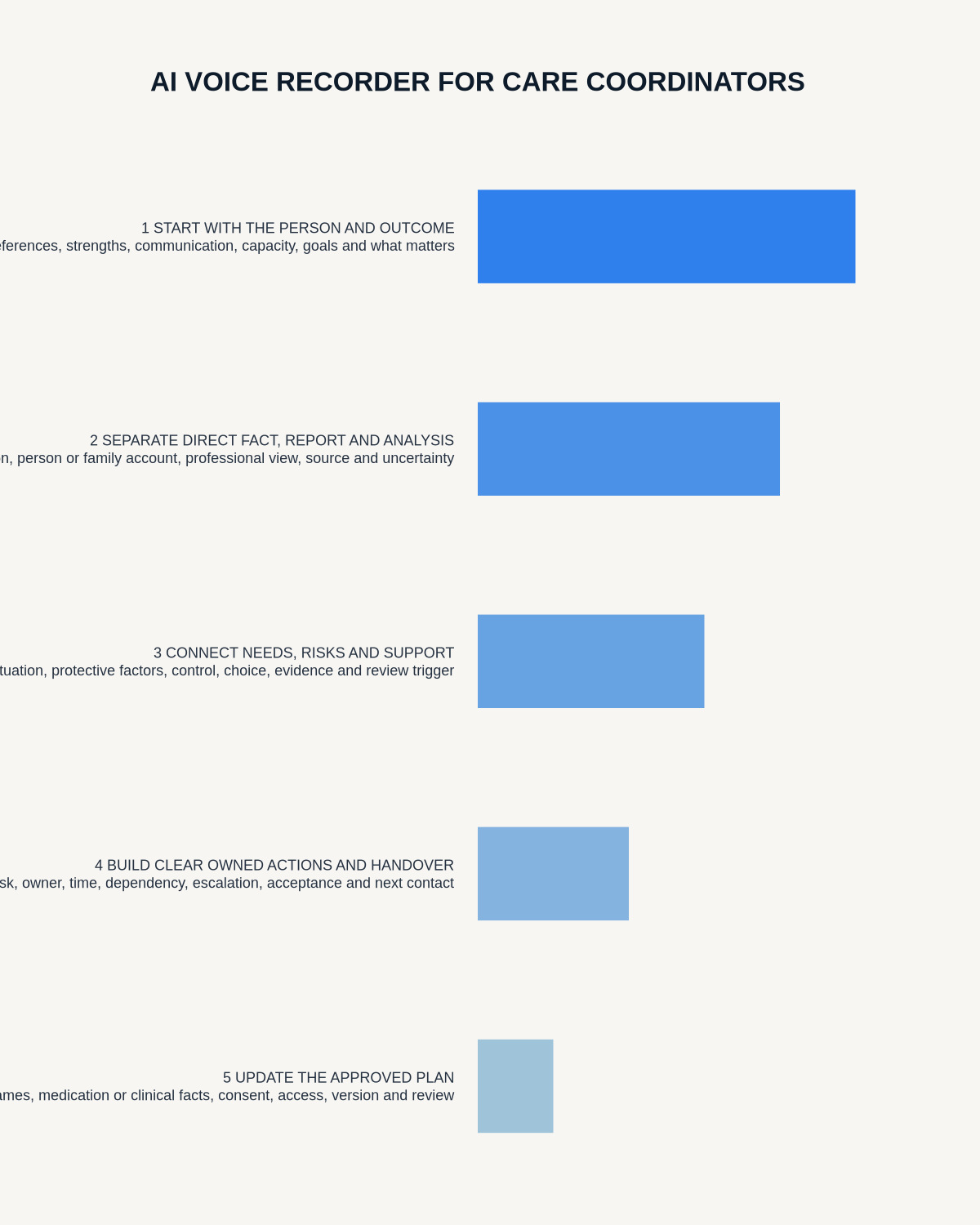
Visual map for AI Voice Recorder for Care Coordinators: Person-Centred Plans and Clear Handover
- Prepare the approved useDefine purpose, safe position, permission and the required formal record.
- Capture context firstState the case, asset, person, location or event identifier before detail.
- Human-verify evidenceCheck technical terms, units, names, dates, decisions and uncertainty.
- Complete the formal recordTransfer only verified information and apply access and retention controls.
On this page
Related guides
See whether Halo fits this workflow
Review the NERALVO Halo specifications, included services, delivery information and current offer only after completing the guide.
Found an error or an out-of-date claim? Email support@neralvo.com with the article address and a supporting source.