The 60-second verdict
Quick answer: cleaning managers can use an AI voice recorder for authorised site walks and shift handovers by tying every note to an exact area, required standard, observable result, immediate control, action owner and closure evidence. AI should not decide contract performance or turn private staff commentary into a formal record.
Best fit: Cleaning Managers who need recoverable audio and human-verified notes in an authorised workflow. Use another method when: recording is prohibited, a participant declines or the approved process requires manual notes.
Evidence basis and limits
- Decision factors covered: Anchor every note to an area and standard; Use the area-standard-result method; Separate observed failure from suspected cause.
- Evidence rule: The decision is based on the complete capture-to-action workflow, not a single feature or marketing accuracy percentage.
- Boundary: Examples and workflow recommendations must be tested with representative recordings, the intended users and the actual approval process before rollout.
Cleaning audits become unreliable when room numbers are confused, vague comments replace evidence and promised corrections are marked complete without reinspection. A structured spoken workflow preserves context while keeping safety and privacy in control.

Anchor every note to an area and standard
State the building, floor, room or zone, inspection time and required specification before describing the result. Repeat the location whenever you move. Reference the checklist, photograph or contract measure where available.
Use the area-standard-result method
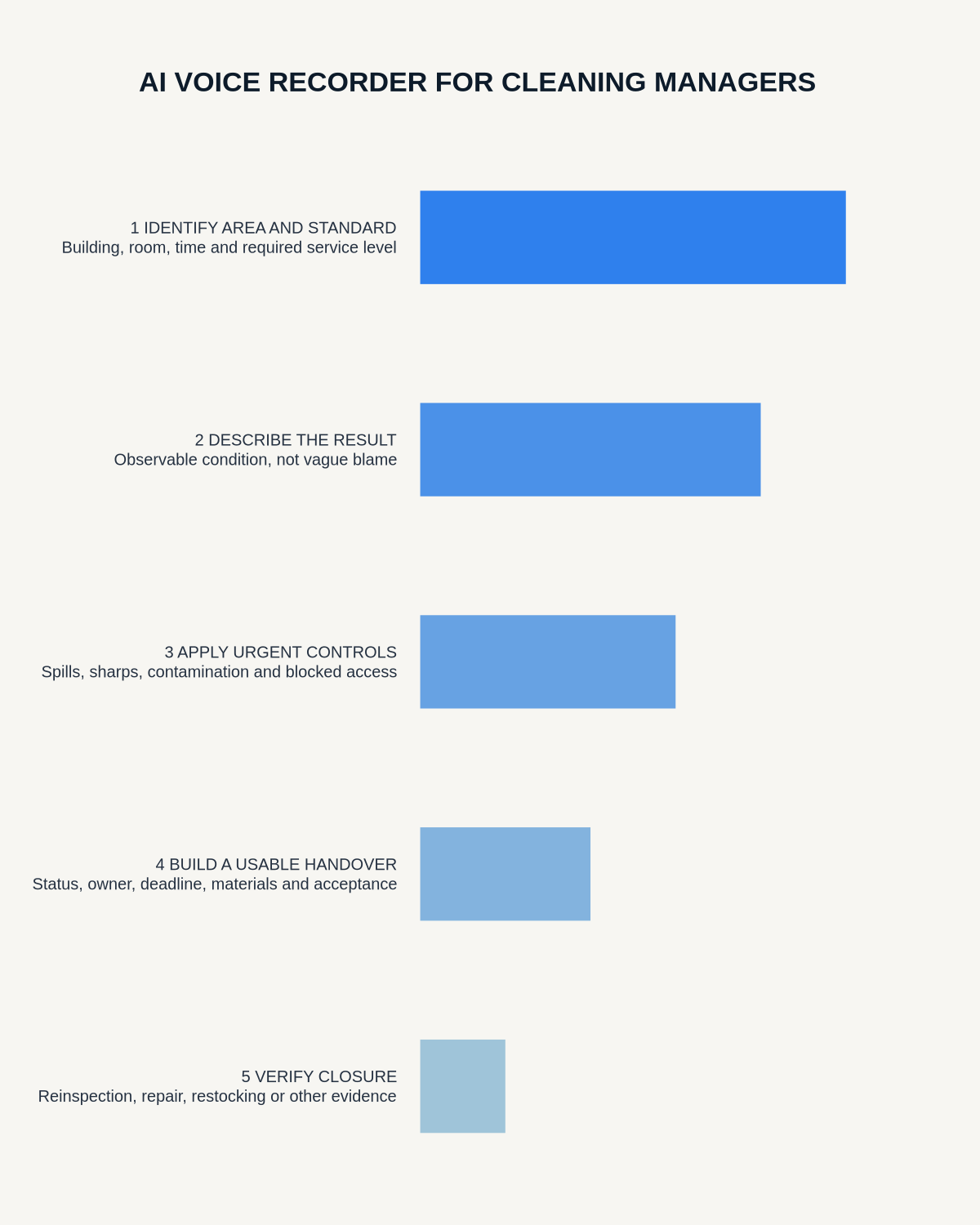
- Area: exact location and access condition.
- Standard: required task, quality level or frequency.
- Result: visible condition and evidence.
- Control: immediate response to hygiene or safety risk.
- Owner: responsible person or team.
- Verification: reinspection time and acceptance evidence.
Replace “needs attention” with a precise observation such as “visible debris remains beneath three desks in meeting room 2.14 after the scheduled evening clean.”
Separate observed failure from suspected cause
Record the service result first. Locked access, staff absence, missing consumables, equipment failure or an unexpected event may explain it, but the explanation should remain reported or provisional until checked.
This prevents the audit from becoming an argument about blame before the facts are established.
Handle urgent hygiene and safety issues first
Spills, sharps, contamination, blocked access and infection-control concerns require immediate action before routine note processing. Record the temporary control, who was notified and the evidence required before reopening or closing the issue.
Protect employee and customer privacy
Do not record private conversations, health information or detailed performance commentary during a public walkaround. Where conduct, capability or attendance requires formal action, transfer relevant facts into the authorised HR or management process.
Create a useful shift handover
Each handover item should contain:
- exact location;
- current status;
- temporary control;
- task owner;
- deadline or priority;
- materials, access or equipment needed;
- acceptance condition.
A general end-of-shift narrative is less useful than a small list of precise, owned items.
Verify completion rather than promises
A statement that an area “will be done” is not closure. Reinspect or obtain the required evidence and then update the operational system with completed, partly completed, deferred or escalated status.
Use a site-walk-to-closure workflow
- Confirm the inspection purpose and recording process.
- State the site, area and standard.
- Record observable condition and evidence.
- Apply urgent controls.
- Generate the draft and correct locations, times and task names.
- Separate results from explanations.
- Create one owned action for each unresolved issue.
- Reinspect or obtain closure evidence.
- Update the authorised audit or task system.
- Delete temporary audio under policy.
Review patterns, not just incidents
Repeated failures in one area, shift, task or equipment type may indicate a systemic problem. Use the verified audit record to identify access issues, staffing gaps, training needs, supply failures or specification problems without treating one explanation as proven automatically.
Cloud software, a dedicated recorder or manual notes?
For Cleaning Managers, the right answer changes with the setting. This matrix deliberately gives each method a situation where it can be the strongest choice.
| Situation | Best starting point | Reason |
|---|---|---|
| scheduled remote client meetings | Cloud meeting software | Native remote-meeting workflows can be more efficient here. |
| in-person visits and travel | Dedicated recorder | A separate battery and recoverable local source improve resilience. |
| a client declines or policy requires manual notes | Manual notes or an approved alternative | Manual notes are the correct control when recording is unavailable. |
| mixed CRM and field work | Governed hybrid | A hybrid can combine automation with reliable physical capture. |
Frequently asked questions
Can AI decide whether a cleaning standard was met?
No. A manager must compare the observed condition with the specification and evidence.
Can staff performance discussions be recorded during the walk?
Formal employee matters should use the approved private HR and recording process.
What proves corrective action is complete?
The agreed closure evidence, such as reinspection, a verified repair or restocking confirmation.
Should the full site walk be retained?
Not automatically. Keep the minimum source needed under the approved retention rule.
Useful resources
- HSE cleaning-industry guidance
- AI Voice Recorder for Waste Managers
- AI Voice Recorder for Operations Managers
- View Halo specifications for cleaning managers use
Audit checklist
- Each issue tied to the correct area and standard
- Observed facts separated from suspected causes
- Urgent controls applied first
- Personal information proportionate
- Every action has owner and deadline
- Handover contains usable status
- Closure supported by evidence
- Repeated patterns reviewed
On this page
Related guides
See whether Halo fits this workflow
Review the NERALVO Halo specifications, included services, delivery information and current offer only after completing the guide.
Found an error or an out-of-date claim? Email support@neralvo.com with the article address and a supporting source.