The 60-second verdict
Quick answer: waste managers can use an AI voice recorder for authorised inspections by starting every note with the correct stream, container or load identifier, then linking observations to evidence, documents, immediate controls and corrective actions. Waste classification, codes, quantities and statutory records must be verified through the approved process.
Best fit: Waste Managers who need recoverable audio and human-verified notes in an authorised workflow. Use another method when: recording is prohibited, a participant declines or the approved process requires manual notes.
Evidence basis and limits
- Decision factors covered: Open with a waste-stream identifier; Build a complete evidence chain; Separate observation from classification.
- Evidence rule: Claims are weighted by consequence: capture failure, changed meaning, access and recovery matter more than polished wording.
- Boundary: Examples and workflow recommendations must be tested with representative recordings, the intended users and the actual approval process before rollout.
Waste inspections create a demanding evidence chain across source, material, container, carrier, destination and corrective action. Voice capture can preserve context, but it must never classify waste, replace formal documentation or distract staff around vehicles, machinery or hazardous materials.

Open with a waste-stream identifier
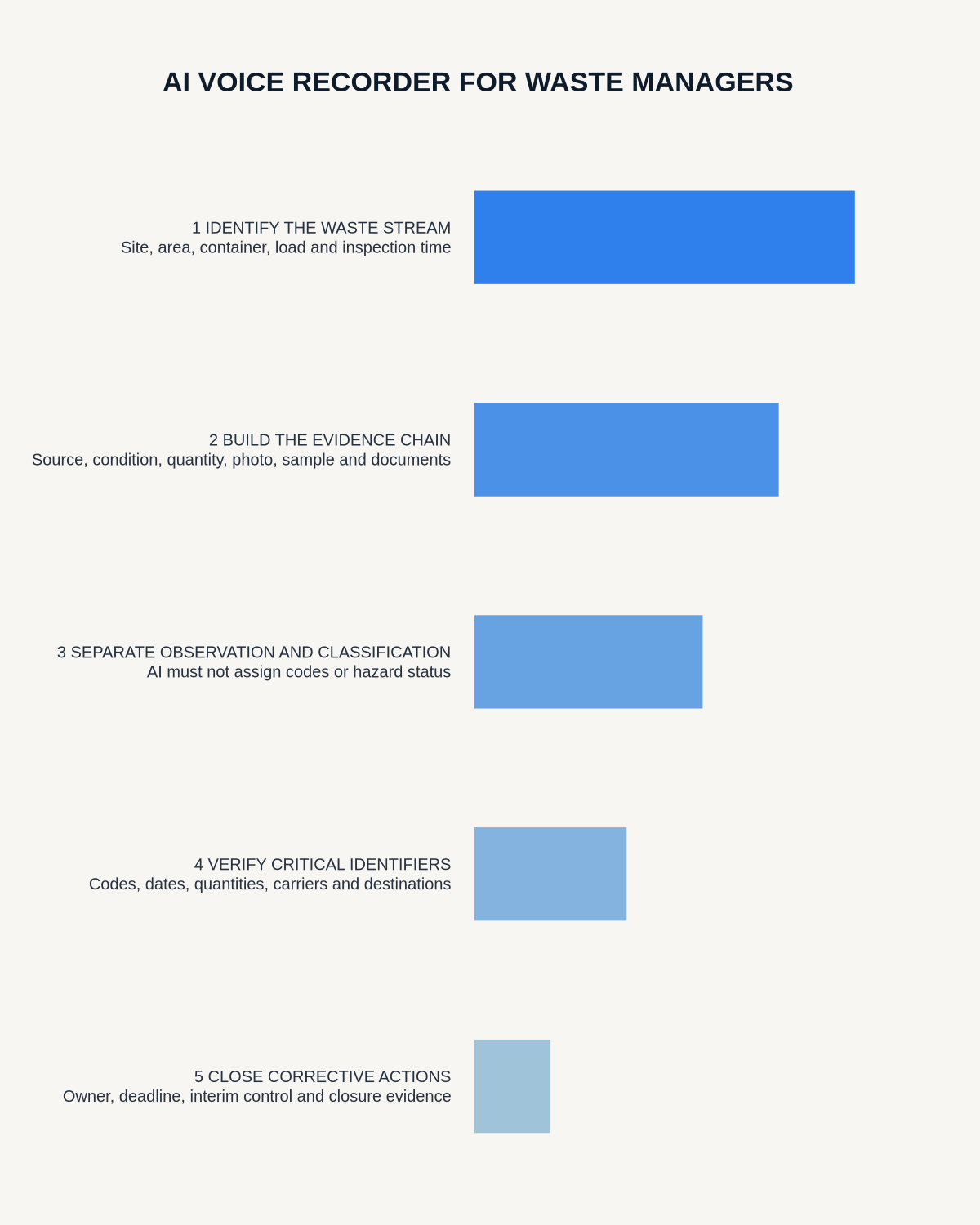
State the site, area, waste stream, container or load reference, inspection time and current status. Repeat the identifier whenever you move to another container, material or vehicle.
This prevents one of the most serious documentation errors: attaching observations or actions to the wrong waste stream.
Build a complete evidence chain
- source and process producing the waste;
- material description and visible condition;
- quantity or estimate and method used;
- container, segregation and labelling status;
- photograph, document or sample reference;
- carrier, destination or transfer reference where relevant;
- immediate control;
- corrective action, owner, deadline and closure evidence.
Separate observation from classification
Describe what is visible and what the documents state. Use labels such as observed, documented, reported, suspected and awaiting sampling.
Do not allow an AI summary to determine whether material is hazardous, assign a waste code or make another specialist legal or technical conclusion.
Control contamination and segregation findings
State the affected stream, nature and extent of contamination, immediate containment and the effect on collection, storage or recovery. Record whether the issue is confirmed or awaiting testing or specialist review.
Link physical conditions to documentation
Check transfer, consignment, carrier and destination details through authorised systems. Speech recognition can alter codes, registrations, quantities, dates and company names. Verify each critical identifier manually before approval.
Use safe recording practice
Stop in a stable authorised position before dictating. Do not handle the recorder near moving vehicles, compactors, lifting equipment, unstable loads or hazardous substances. Apply immediate controls and emergency procedures before continuing with note capture.
Turn observations into closed actions
Every corrective action should identify the required outcome, responsible person, deadline, interim control and evidence needed for closure. Depending on the issue, closure may require reinspection, corrected paperwork, removal confirmation, sampling or training evidence.
Use an inspection-to-closure workflow
- Confirm recording is approved.
- State the stream and container reference.
- Record direct observations and evidence links.
- Apply urgent safety or containment controls.
- Generate and correct the transcript.
- Verify material names, codes, quantities, dates and organisations.
- Check documents and specialist conclusions.
- Create owned actions and closure evidence.
- Review repeated findings for systemic causes.
- Delete temporary audio under policy.
Keep formal records authoritative
The voice note is a capture source. Transfer checked information into the required compliance, duty-of-care, transfer, consignment or operational record. Do not leave material regulatory information only in the recording application.
How NERALVO Halo may support waste inspections
Check whether NERALVO Halo fits waste managers work provides portable NOTE recording, supported CALL capture, 64GB local storage, up to 35 hours of recording and Bluetooth sync with DOWAY. DOWAY can create transcripts, summaries, speaker-separated notes, templates, translations, mind maps and exports, with one year of DOWAY Max included from activation.
Use it only from a safe, authorised position and verify every code, quantity, registration, organisation and date against the controlling waste record. Formal classification, statutory documentation and compliance systems remain authoritative.
Cloud software, a dedicated recorder or manual notes?
For Waste Managers, the right answer changes with the setting. This matrix deliberately gives each method a situation where it can be the strongest choice.
| Situation | Best starting point | Reason |
|---|---|---|
| scheduled remote client meetings | Cloud meeting software | Calendar automation and shared integrations are usually the strongest advantage. |
| in-person visits and travel | Dedicated recorder | Independent capture reduces reliance on an active phone or laptop. |
| a client declines or policy requires manual notes | Manual notes or an approved alternative | The boundary takes priority over convenience. |
| mixed CRM and field work | Governed hybrid | Use each method only in the setting it actually fits. |
Frequently asked questions
Can AI assign a waste code from a description?
No. Classification requires the approved professional and legal process.
Can quantities and registration numbers be trusted automatically?
No. Critical figures and identifiers should be checked manually.
Can recording continue near moving plant?
Only when safe and authorised. Operational safety takes priority.
Can the voice note replace the waste record?
No. Transfer verified information into the required formal system.
Useful resources
- GOV.UK waste-management overview
- AI Voice Recorder for Cleaning Managers
- AI Voice Recorder for Compliance Officers
- AI Voice Recorder for Pest Control Technicians
- Check whether NERALVO Halo fits waste managers work
Waste-record checklist
- Each observation tied to the correct stream and container
- Observation separated from classification
- Codes, quantities, dates and documents verified
- Urgent controls applied first
- Corrective actions have owners and closure evidence
- Formal records updated
- Repeated findings reviewed systemically
- Temporary audio retained appropriately
On this page
Related guides
See whether Halo fits this workflow
Review the NERALVO Halo specifications, included services, delivery information and current offer only after completing the guide.
Found an error or an out-of-date claim? Email support@neralvo.com with the article address and a supporting source.