The 60-second verdict
Risk workshops often sound productive while producing weak records. Participants jump from causes to consequences, rate several different risks at once and describe controls without showing whether they operate. An AI voice recorder for risk managers can preserve the reasoning that ordinary minutes lose, provided the transcript is converted into a disciplined risk record rather than stored as a long conversation.
Best fit: Risk Managers who need recoverable audio and human-verified notes in an authorised workflow. Use another method when: recording is prohibited, a participant declines or the approved process requires manual notes.
Evidence basis and limits
- Decision factors covered: Begin with the objective at risk; Record the complete causal chain; Do not store a rating without its argument.
- Evidence rule: Claims are weighted by consequence: capture failure, changed meaning, access and recovery matter more than polished wording.
- Boundary: Examples and workflow recommendations must be tested with representative recordings, the intended users and the actual approval process before rollout.
The strongest use is not “automatic minutes.” It is recovering the logic behind the rating, the disagreement around controls and the conditions that should trigger review.
Begin with the objective at risk
A risk statement is clearer when the team first identifies the objective that may be affected. Ask:
- What are we trying to achieve?
- Over what period?
- Which customers, services, assets or obligations matter?
- What level of disruption or loss would be material?
This prevents the workshop from becoming a list of general worries with no connection to decisions.
Record the complete causal chain
Use a consistent sequence:
- Cause or condition: What creates exposure?
- Uncertain event: What might happen?
- Immediate effect: What changes first?
- Business consequence: Which objective is affected and how?
- Existing controls: What prevents, detects or corrects the event?
- Residual uncertainty: What remains after those controls?
When a discussion contains several different events, split them into separate risk records. One broad title should not hide multiple owners and control sets.
Do not store a rating without its argument
“High risk” is not useful unless a later reviewer can understand why. Capture:
- the likelihood basis
- the impact dimensions considered
- time horizon
- assumptions
- data or experience cited
- credible worst case
- most likely case
- what would change the score
- who challenged the rating
If the group reaches a score by compromise, preserve the range of views. An AI summary should not turn debate into false unanimity.
Separate control design, operation and assurance
| Question | What it tests |
|---|---|
| What is the control meant to do? | Design and purpose |
| Who performs it and when? | Ownership and frequency |
| What evidence is created? | Operation |
| Who checks that evidence? | Assurance |
| What happens when it fails? | Escalation and correction |
A participant saying “we review all cases” is a description. Samples, logs, approvals or exception reports are evidence.
Use the transcript to expose hidden dependencies
Risk discussions often reveal dependencies that do not appear in the register:
- one specialist who knows the process
- a supplier with no tested alternative
- manual workarounds that are not documented
- data supplied by another team
- a system interface with unclear ownership
- a control that assumes another control has already worked
Extract these as dependencies or concentration risks. They may need their own monitoring indicators.
Preserve minority views
A dissenting participant may have operational knowledge that the majority lacks. Record:
- the disputed point
- each view
- evidence offered
- assumption causing the difference
- decision taken
- condition for reopening the question
This is more useful than a summary saying “the team agreed the risk was moderate.”
Convert discussion into a treatment decision
Every proposed action should state which part of the risk it changes. A treatment may reduce likelihood, reduce impact, improve detection, transfer exposure, increase resilience or provide better information.
Record:
- specific action
- risk or control gap addressed
- single accountable owner
- delivery date
- resources or approval required
- evidence of completion
- expected effect on the residual rating
- date for effectiveness review
Installing a control is not the same as proving it works.
Scenario workshops need an information timeline
For scenario analysis, build the event in stages. At each stage, ask:
- what is known now
- what remains uncertain
- which decision is required
- which threshold is crossed
- which control activates
- what second-order effect appears
This avoids judging early decisions using information revealed later in the exercise.
Use indicators that tell you when to review
The transcript can help identify leading indicators hidden in operational language. Examples include backlog age, error frequency, supplier response time, staff turnover, exception volume or failed control checks.
For each indicator, define:
- data source
- owner
- frequency
- normal range
- warning threshold
- escalation threshold
- required response
A risk register without review triggers becomes a static document.
Board and committee reporting should retain uncertainty
Senior reporting needs brevity, but removing all nuance can distort the decision. A useful summary includes:
- objective and risk event
- current trajectory
- material assumptions
- control confidence
- treatment status
- decision or support required
Keep the transcript and workshop note as supporting evidence, not as the committee paper itself.
A workshop-to-register workflow
- Define objectives and scope before the session.
- Agree recording and confidentiality controls.
- Use one risk at a time.
- Capture the causal chain and rating rationale.
- Label control claims separately from evidence.
- Preserve dissent and unresolved assumptions.
- Extract dependencies, indicators and treatments.
- Draft the risk-register entry.
- Return it to accountable owners for correction and approval.
- Review action effectiveness, not just completion.
How NERALVO Halo may support risk workshops
NERALVO Halo provides portable NOTE recording, 64GB local storage and current DOWAY transcription and structured-note tools. It may help teams revisit rating arguments, identify action owners and search long multi-speaker discussions.
Risk information can be commercially sensitive. Approve the recording, access and processing route before use, test speaker separation in realistic workshops and verify every score, owner and deadline manually.
Risk-record quality check
- Is the affected objective clear?
- Are cause, event and consequence separated?
- Does every rating have a recorded rationale?
- Are control statements distinguished from evidence?
- Are dependencies and assumptions visible?
- Was disagreement preserved?
- Do treatments state the effect they are meant to achieve?
- Are indicators linked to review thresholds?
Authoritative guidance
An AI voice recorder can make risk workshops more accountable by preserving the reasoning behind the register. Its value appears when the organisation turns that reasoning into clearer risk statements, testable controls and treatments that are reviewed for effectiveness.
Cloud software, a dedicated recorder or manual notes?
For Risk Managers, the right answer changes with the setting. This matrix deliberately gives each method a situation where it can be the strongest choice.
| Situation | Best starting point | Reason |
|---|---|---|
| scheduled remote client meetings | Cloud meeting software | Calendar automation and shared integrations are usually the strongest advantage. |
| in-person visits and travel | Dedicated recorder | Independent capture reduces reliance on an active phone or laptop. |
| a client declines or policy requires manual notes | Manual notes or an approved alternative | The boundary takes priority over convenience. |
| mixed CRM and field work | Governed hybrid | Use each method only in the setting it actually fits. |
Related guides
Profession workflow
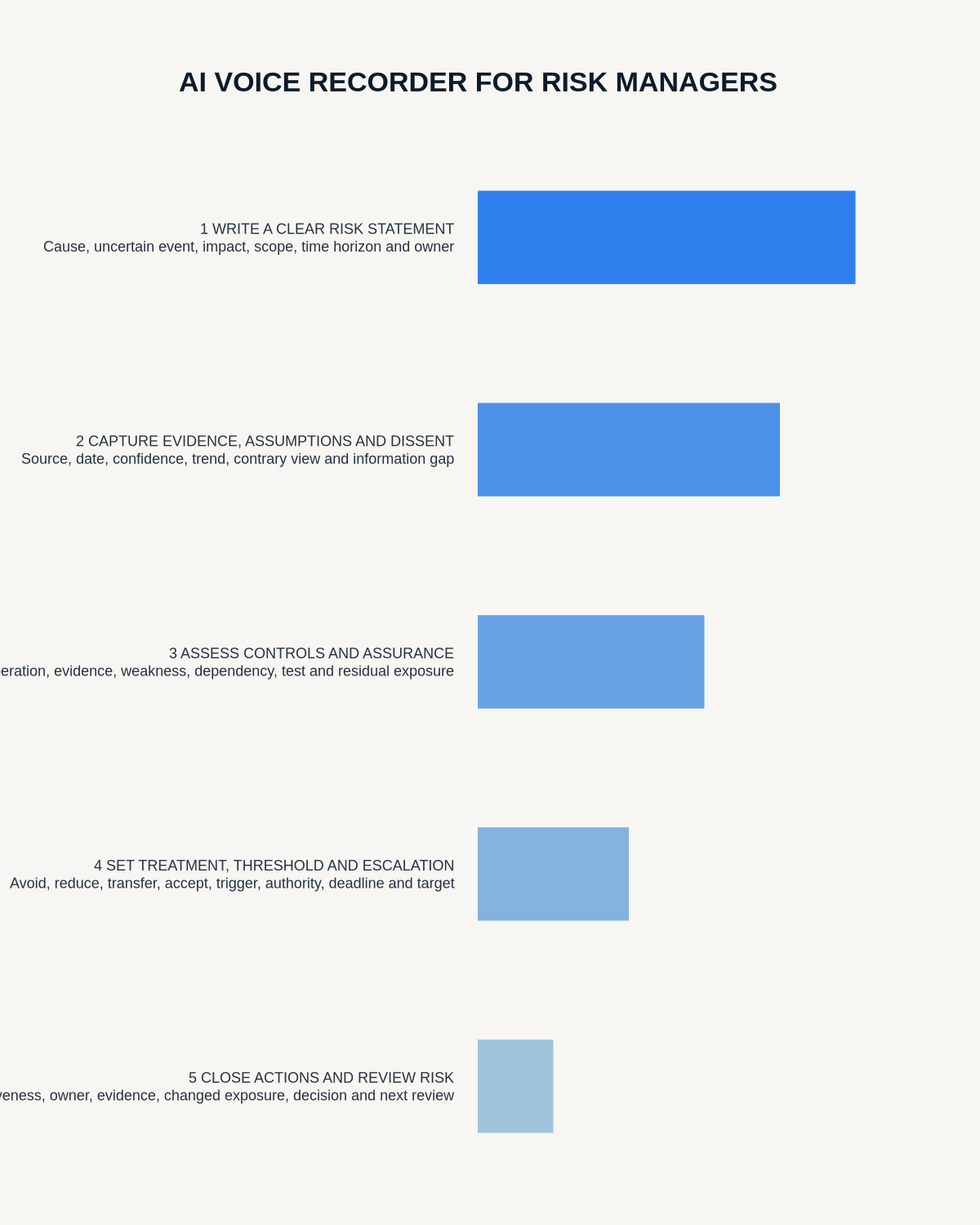
Visual map for AI Voice Recorder for Risk Managers: Better Workshops, Controls and Action Tracking
- Prepare the approved useDefine purpose, safe position, permission and the required formal record.
- Capture context firstState the case, asset, person, location or event identifier before detail.
- Human-verify evidenceCheck technical terms, units, names, dates, decisions and uncertainty.
- Complete the formal recordTransfer only verified information and apply access and retention controls.
On this page
Related guides
See whether Halo fits this workflow
Review the NERALVO Halo specifications, included services, delivery information and current offer only after completing the guide.
Found an error or an out-of-date claim? Email support@neralvo.com with the article address and a supporting source.