The 60-second verdict
Quick answer: an AI voice recorder can support authorised family calls, professional updates and case-coordination meetings for coroners’ officers. It must never turn an early account, family concern or working view into a formal finding. The reviewed coronial case system remains authoritative.
Best fit: Coroners’ Officers who need recoverable audio and human-verified notes in an authorised workflow. Use another method when: recording is prohibited, a participant declines or the approved process requires manual notes.
Evidence basis and limits
- Decision factors covered: Decide whether recording is appropriate; Begin with a case anchor; Build an evidence-linked chronology.
- Evidence rule: The decision is based on the complete capture-to-action workflow, not a single feature or marketing accuracy percentage.
- Boundary: Examples and workflow recommendations must be tested with representative recordings, the intended users and the actual approval process before rollout.

Coroners’ officers coordinate information from families, clinicians, police, registrars, witnesses and other organisations while facts are still developing. A short call can contain new names, corrections and evidence leads, but the transcript remains working source material.
Decide whether recording is appropriate
Consider purpose, distress, sensitivity, third parties and whether a conventional note would be safer. Explain why recording is proposed, who can access it, how it will be used and when it will be deleted. Pause when unrelated personal information falls outside the case purpose.
Begin with a case anchor
- case reference;
- date and time;
- caller and relationship or professional role;
- purpose of the call;
- other people present;
- documents or questions discussed.
Label every new fact by source and status
| Status | Meaning |
|---|---|
| Family account | Information supplied by a relative or representative |
| Professional account | Information supplied by a clinician, officer or professional |
| Document-supported | Information checked against a record held |
| Correction | Previous information is being amended |
| To verify | Another source is required |
| Formal direction or finding | Authorised decision through the coronial process |
Build an evidence-linked chronology
For each material event, capture date and time, location, people, source, what is said to have occurred, record or witness that may confirm it, difference from information already held and action required. Preserve conflicting versions until evidence resolves them.
Check names, relationships and authority
Confirm spelling, relationship to the deceased, professional role, approved contact route, other family members mentioned and disputed or uncertain relationships. Do not distribute one person’s private comments to another relative without a clear case purpose and authority.
Make family communication accountable
- Question or concern raised.
- Information provided.
- What cannot yet be confirmed.
- Document, report or decision awaited.
- Who will make the next contact.
- Expected review point.
Separate questions from determinations
Keep the family’s question, available information, process explanation, matter requiring professional or judicial consideration, formal decision and communication still pending as separate fields. AI should not offer a medical or legal conclusion.
Create evidence and hearing-preparation registers
Move evidence leads into a register with holder, relevance, request status, owner, review date and result. Extract witness status, reports outstanding, special requirements, document bundles, family updates and hearing dates into the authorised case system.
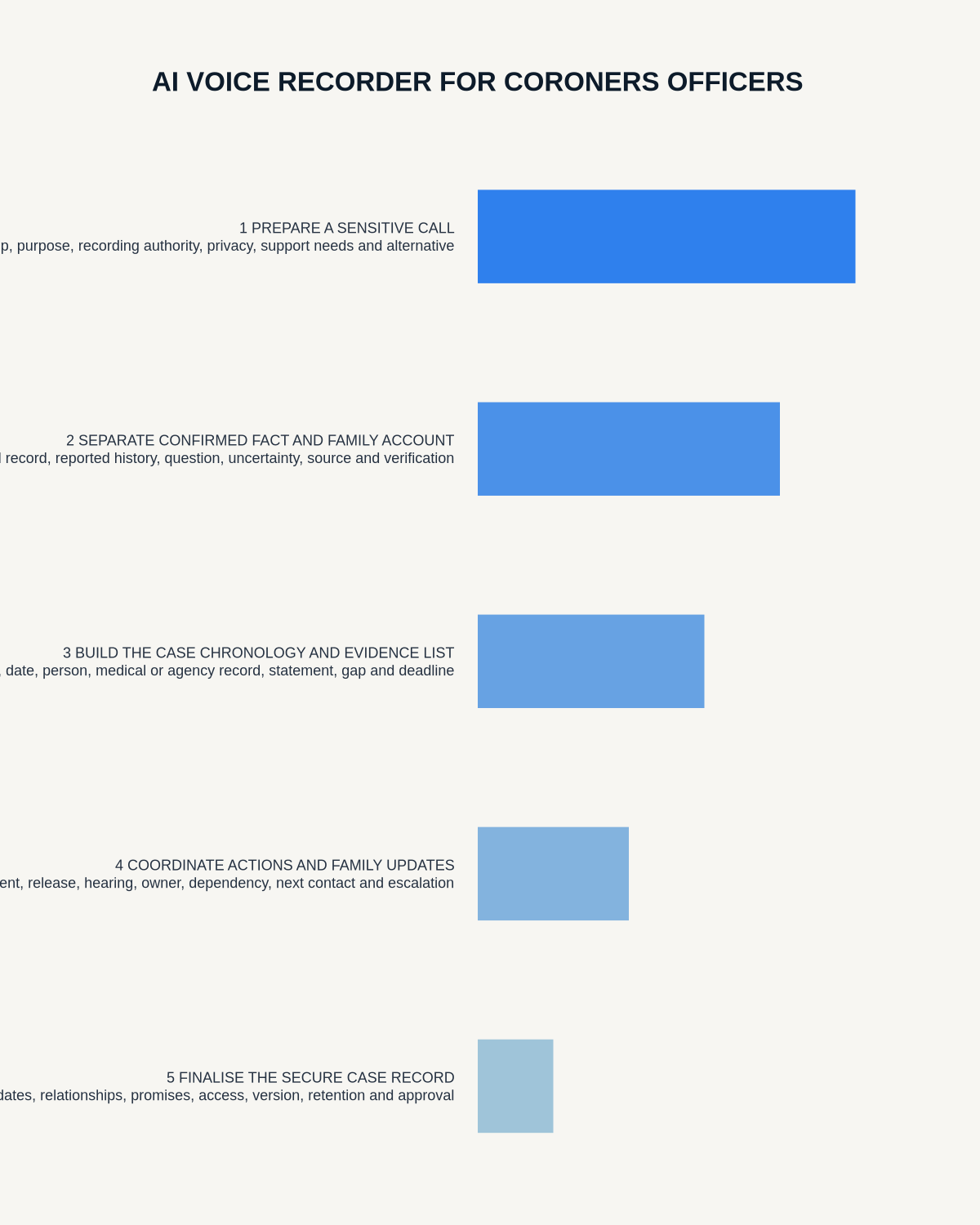
Use a call-to-case workflow
- Confirm recording is permitted and explain the purpose.
- State the case anchor and participants.
- Use source-status labels.
- Repeat names, dates and critical details.
- End with a clear summary of next steps.
- Generate and check the transcript.
- Update chronology, evidence and communication actions.
- Issue formal correspondence through the established process.
- Retain or delete audio under policy.
Where NERALVO Halo fits
View Halo specifications for coroners’ officers use can support authorised family calls, internal debriefs and private drafting with NOTE mode, supported CALL capture, 64GB local storage and structured DOWAY notes. Public bodies should approve the complete data path and deletion process.
Cloud software, a dedicated recorder or manual notes?
For Coroners’ Officers, the right answer changes with the setting. This matrix deliberately gives each method a situation where it can be the strongest choice.
| Situation | Best starting point | Reason |
|---|---|---|
| scheduled remote meetings | Cloud meeting software | Native remote-meeting workflows can be more efficient here. |
| in-person or mobile work | Dedicated recorder | A separate battery and recoverable local source improve resilience. |
| recording is refused or prohibited | Manual notes or an approved alternative | Manual notes are the correct control when recording is unavailable. |
| mixed online and offline work | Governed hybrid | A hybrid can combine automation with reliable physical capture. |
Frequently asked questions
Can AI decide which account is correct?
No. Conflicts must be preserved and assessed through the coronial process.
Should every family call be recorded?
No. Consider necessity, distress, proportionality and policy.
Can the transcript replace formal correspondence?
No. Formal communications and directions use the established process.
Can an early account be described as a finding?
No. Keep accounts, evidence and formal findings separate.
What happens when a family member corrects information?
Record the correction, identify the previous information and update the case through the authorised route.
Authoritative guidance and related reading
- Chief Coroner’s guidance
- AI Voice Recorder for Data Protection Officers
- AI Voice Recorder for Family Lawyers
Final case-note checklist
- Correct case anchor
- Sources and formal statuses separated
- Corrections and contradictions visible
- Names and relationships checked
- Evidence and communication actions owned
- Questions separate from determinations
- Reviewed information filed in the case system
On this page
Related guides
See whether Halo fits this workflow
Review the NERALVO Halo specifications, included services, delivery information and current offer only after completing the guide.
Found an error or an out-of-date claim? Email support@neralvo.com with the article address and a supporting source.