The 60-second verdict
Quick answer: financial-crime investigators can use an authorised AI voice recorder to preserve interview questions, answers, caveats and case-conference decisions. The transcript must keep system facts, documents, intelligence, interview accounts, analytical inferences and model alerts as separate evidence categories.
Best fit: Financial Crime Investigators who need recoverable audio and human-verified notes in an authorised workflow. Use another method when: recording is prohibited, a participant declines or the approved process requires manual notes.
Evidence basis and limits
- Decision factors covered: Convert suspicions into testable propositions; Prepare a neutral transaction chronology; Interview one transaction cluster at a time.
- Evidence rule: Claims are weighted by consequence: capture failure, changed meaning, access and recovery matter more than polished wording.
- Boundary: Examples and workflow recommendations must be tested with representative recordings, the intended users and the actual approval process before rollout.

Financial-crime work combines transactions, alerts, documents, customer explanations and intelligence. The central risk is allowing a suspicion, model output or fluent interview answer to acquire more evidential weight than it deserves.
Convert suspicions into testable propositions
- Who initiated or authorised the transaction?
- What was the stated purpose?
- Which account, entity, device or channel was involved?
- What relationship exists between the parties?
- Which records should exist if the explanation is accurate?
- What legitimate alternative remains possible?
Use a six-category source model
| Category | Control |
|---|---|
| System fact | Verify source system and extraction |
| Documentary evidence | Check authenticity, date and relevance |
| Interview account | Attribute and test against records |
| Intelligence | Apply handling and corroboration rules |
| Analytical inference | State assumptions and alternatives |
| Model signal | Treat as a lead, not proof |
Prepare a neutral transaction chronology
For each material event, record date and time, account or entity, amount and currency, transaction type, origin and destination, device or channel, nearby communications, source record and question requiring explanation.
Interview one transaction cluster at a time
Ask the purpose, who requested and benefited, how the amount was determined, which goods or services were involved, which documents support it, why the route was used and who else can verify the account. Repeat names, dates, values and currencies.
Preserve corrections and uncertainty
Use status wording such as initially stated, later clarified, could not recall, estimated, subject to document check, disputed the premise and provided an alternative explanation. Do not overwrite an earlier account.
Maintain competing hypotheses
For each hypothesis, record supporting evidence, inconsistent evidence, alternative explanation, next data or interview required and current confidence. AI can organise the table but should not rank hypotheses from tone or frequency.
Record case-conference rationale
Capture the decision question, verified evidence, uncertainty, alternatives, applicable threshold or process, proportionality, customer impact, decision maker, conditions and review date.
Protect sensitive material
Use approved devices, accounts and access controls. Do not speak passwords, authentication secrets or full credentials. Distribute checked extracts rather than raw transcripts where possible, and document any redaction.
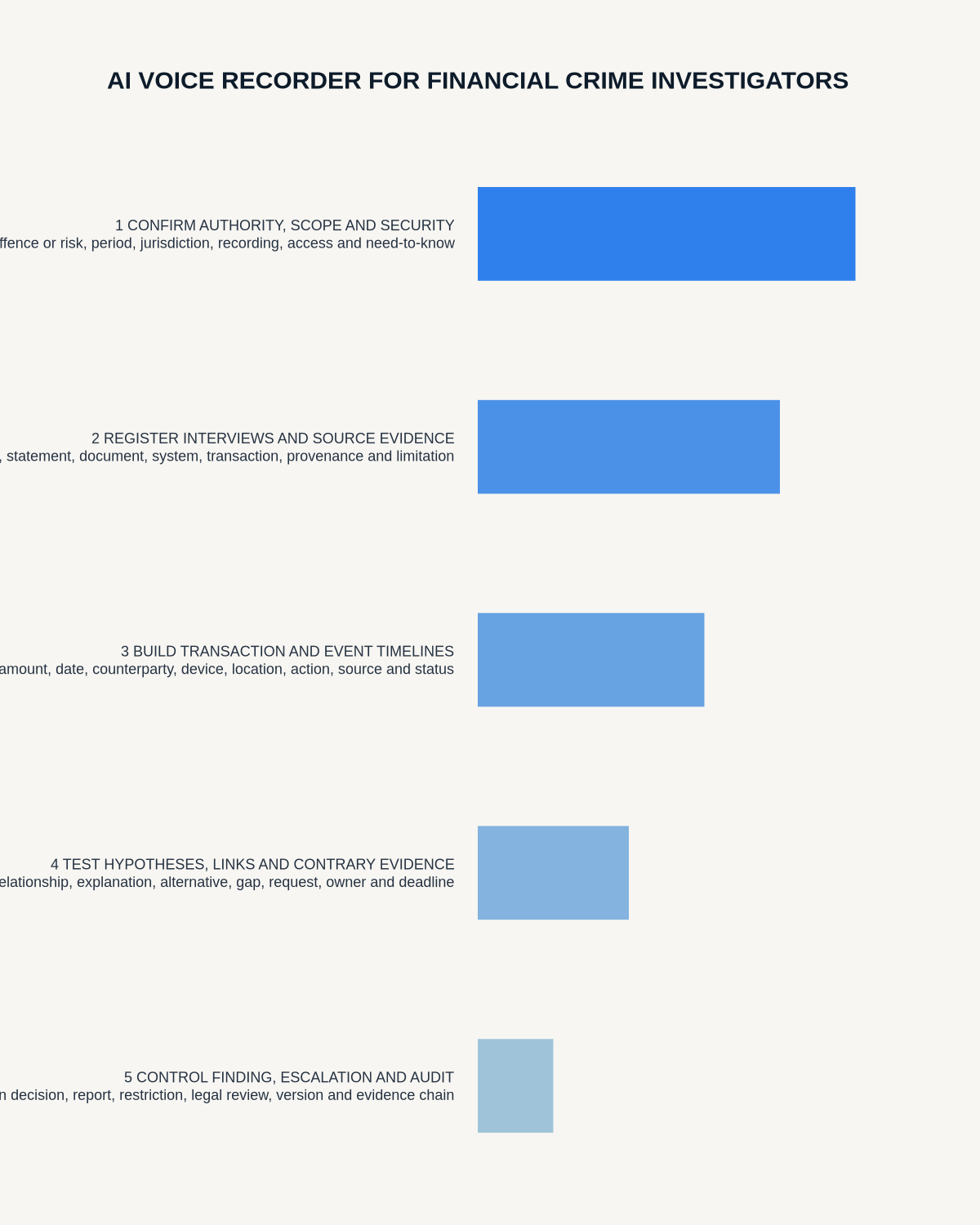
Use an interview-to-case workflow
- Confirm authority and participant process.
- State case reference, purpose and participants.
- Use the prepared chronology.
- Apply source labels.
- Repeat identifiers and values.
- Generate and correct the transcript.
- Update the evidence matrix and hypothesis table.
- Record decisions in the authorised case system.
- Apply disclosure, access and retention controls.
What AI must not infer
Do not use voice analysis or summarisation to infer honesty, criminal intent, stress as proof, identity from voice alone, future behaviour or case outcome.
Where NERALVO Halo fits
Check whether NERALVO Halo fits financial crime investigators work can support approved interviews, investigator dictation and internal reviews through NOTE mode, supported CALL capture, 64GB local storage and structured DOWAY notes. The organisation must approve the full device-to-app route.
Cloud software, a dedicated recorder or manual notes?
For Financial Crime Investigators, the right answer changes with the setting. This matrix deliberately gives each method a situation where it can be the strongest choice.
| Situation | Best starting point | Reason |
|---|---|---|
| scheduled remote case meetings | Cloud meeting software | Calendar automation and shared integrations are usually the strongest advantage. |
| authorised interviews or field discussions | Dedicated recorder | Independent capture reduces reliance on an active phone or laptop. |
| privilege, procedure or an objection prevents recording | Manual notes or an approved alternative | The boundary takes priority over convenience. |
| mixed casework | Governed hybrid | Use each method only in the setting it actually fits. |
Frequently asked questions
Can an AI summary determine whether activity is suspicious?
No. It can organise evidence but cannot make the accountable investigative decision.
Is a model alert evidence of wrongdoing?
No. It is a lead requiring investigation and corroboration.
Should a corrected interview answer replace the first answer?
No. Preserve both and record why the account changed.
Can tone of voice show dishonesty?
No. Do not use unsupported voice-based inference.
What belongs in the final case record?
Verified evidence, attributed accounts, reasoning, decisions, conditions and actions—not an unreviewed transcript.
Related reading
- AI Voice Recorder for Fraud Analysts
- AI Voice Recorder for Private Investigators
- AI Voice Recorder for Compliance Officers
Final case-record checklist
- Source categories separated
- Values and identifiers verified
- Corrections and uncertainty preserved
- Alternative explanations tested
- Decisions linked to evidence and authority
- Sensitive information controlled
- No unsupported AI inference used
On this page
Related guides
See whether Halo fits this workflow
Review the NERALVO Halo specifications, included services, delivery information and current offer only after completing the guide.
Found an error or an out-of-date claim? Email support@neralvo.com with the article address and a supporting source.