The 60-second verdict
Quick answer: fraud analysts can use an authorised AI voice recorder to preserve case reviews and customer explanations, but the official case file must keep alerts, system facts, attributed accounts, verified evidence and analyst conclusions separate. A score or rule hit is a lead—not proof of fraud.
Best fit: Fraud Analysts who need recoverable audio and human-verified notes in an authorised workflow. Use another method when: recording is prohibited, a participant declines or the approved process requires manual notes.
Evidence basis and limits
- Decision factors covered: Open the case with a neutral trigger; Separate four different things; Verify high-risk details outside the transcript.
- Evidence rule: A claim earns weight only when the source, date, configuration and limitation are clear enough for a reader to check.
- Boundary: Examples and workflow recommendations must be tested with representative recordings, the intended users and the actual approval process before rollout.

Fraud analysis begins with suspicion rather than proof. Transaction patterns, device signals, customer accounts and third-party information can support several competing explanations. Recording is valuable only when it makes the reasoning easier to reconstruct without prejudging the outcome.
Open the case with a neutral trigger
Describe the observable reason for review: a transaction outside the expected profile, an account change near a payment, a location or device mismatch, a dispute, an internal rule alert or a linked-account indicator. The trigger defines scope and priority; it should not state that fraud occurred.
Build one chronology from labelled sources
Normalise time zones and connect every event to its origin:
- transaction or account-system record;
- customer account;
- third-party information;
- analyst observation;
- model or rule output;
- working assumption;
- document or communication requiring verification.
Separate four different things
| Category | Meaning | Control |
|---|---|---|
| Signal | Feature increasing or reducing concern | Do not present as proof |
| Explanation | Attributed account from a customer or third party | Test against records |
| Evidence | Information checked against a reliable source | Record provenance and limitations |
| Conclusion | Reasoned outcome after review | Link to threshold and authority |
Prepare customer calls around verifiable questions
Where recording is authorised, ask whether the activity is recognised, whether devices or contact details changed, whether travel or merchant context explains the pattern, who possessed credentials and which documents can support the answer. Keep corrections visible rather than rewriting the final answer as though it was given immediately.
Verify high-risk details outside the transcript
Check names, dates, transaction values, currencies, account references, IP addresses, device identifiers and merchant details against authoritative systems. Speech recognition can produce plausible but materially wrong digits.
Test legitimate alternatives
For every suspicious feature, record at least one plausible non-fraud explanation and the evidence needed to test it. Possibilities may include travel, shared household spending, subscription renewal, device replacement, merchant-descriptor confusion, delayed presentation or business activity on a personal account.
Interpret model signals responsibly
Record the rule or score, features available at the time, data-quality limitations, supporting and contradictory evidence and the human decision. Do not infer honesty, intent or future behaviour from voice tone, stress or fluency.
Record proportional decisions and review points
For monitoring, additional verification, temporary restriction, referral or closure, state the threshold applied, evidence relied upon, customer impact, approver, conditions and review or expiry date. Temporary controls should not remain merely because nobody reopened the case.
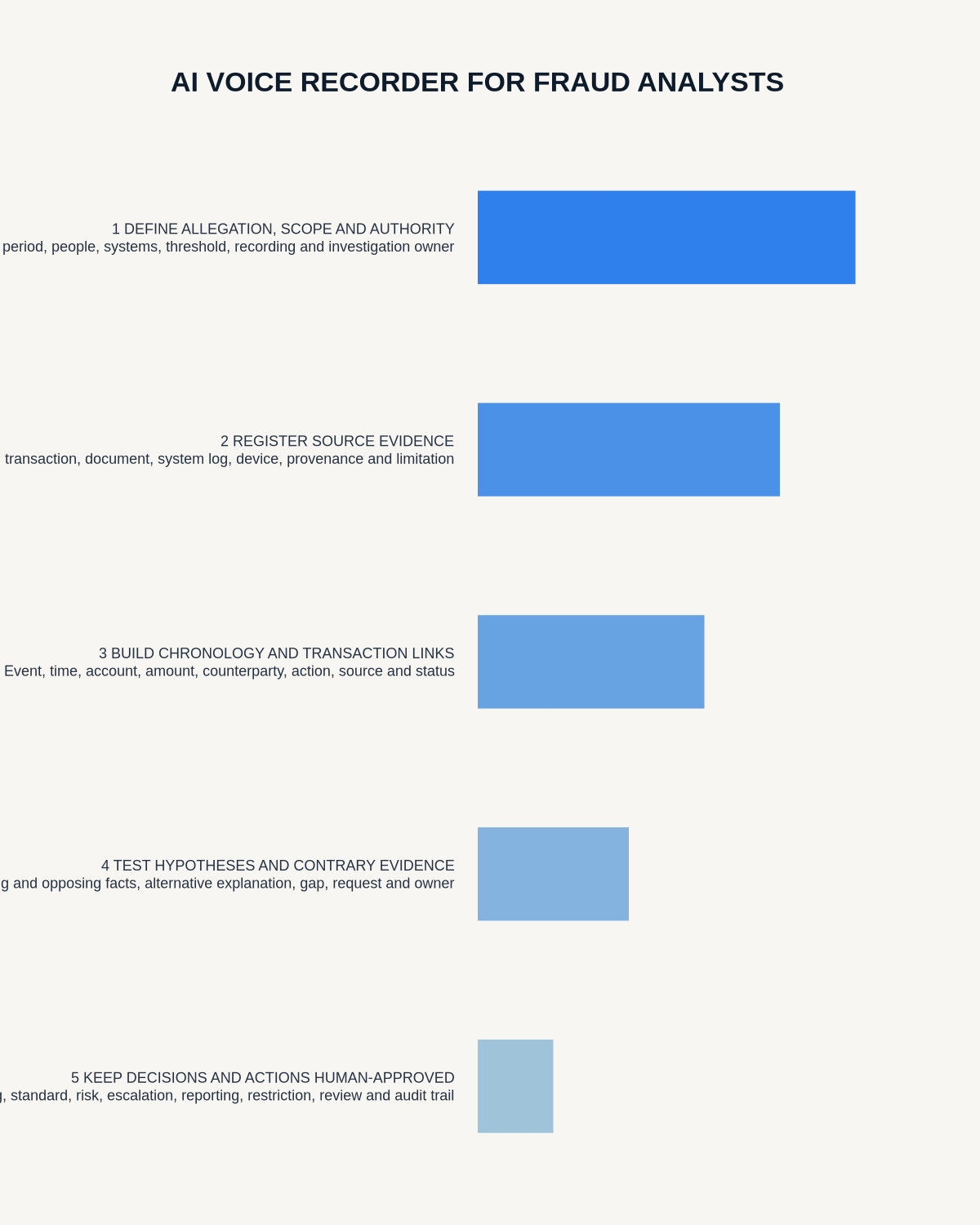
Use a defensible case-review workflow
- Write a neutral trigger and scope.
- Confirm recording and processing controls.
- Build the chronology from systems.
- Conduct the authorised call or review.
- Verify values, names and timestamps.
- Label signals, explanations, evidence and assumptions.
- Test legitimate alternatives.
- Record the decision threshold and rationale.
- Assign actions and review points.
- Transfer the checked outcome into the official case system.
Where NERALVO Halo fits
Assess Halo against the fraud analysts workflow matrix can support approved case-review meetings, investigator dictation and compatible call workflows with NOTE mode, supported CALL capture, 64GB local storage and structured DOWAY notes. Financial organisations should approve the complete device-to-app route before use.
Cloud software, a dedicated recorder or manual notes?
For Fraud Analysts, the right answer changes with the setting. This matrix deliberately gives each method a situation where it can be the strongest choice.
| Situation | Best starting point | Reason |
|---|---|---|
| scheduled remote meetings | Cloud meeting software | Auto-join and central collaboration can remove routine admin. |
| in-person or mobile work | Dedicated recorder | Dedicated hardware suits movement, variable rooms and offline source capture. |
| recording is refused or prohibited | Manual notes or an approved alternative | A clear alternative respects policy and participant choice. |
| mixed online and offline work | Governed hybrid | One governed process prevents gaps between desk and field work. |
Frequently asked questions
Can AI decide whether fraud occurred?
No. The outcome requires verified evidence, policy thresholds and accountable human judgement.
Can a high score be treated as proof?
No. It is a prioritisation or decision-support signal.
Should a corrected customer answer replace the first answer?
No. Preserve the sequence and explanation where material.
Can tone of voice reveal dishonesty?
No. Do not use unsupported voice-based inference.
Can the transcript replace the case note?
No. The checked official case record remains authoritative.
Authoritative guidance and related reading
- FCA financial-crime resources
- Action Fraud
- AI Voice Recorder for Financial Crime Investigators
- AI Voice Recorder for Risk Managers
Final case-file checklist
- Neutral trigger and sourced chronology
- Signals separated from evidence
- Customer corrections preserved fairly
- Legitimate alternatives tested
- Values and identifiers verified
- Decision linked to threshold, authority and review date
On this page
Related guides
See whether Halo fits this workflow
Review the NERALVO Halo specifications, included services, delivery information and current offer only after completing the guide.
Found an error or an out-of-date claim? Email support@neralvo.com with the article address and a supporting source.