The 60-second verdict
Journalism students need to preserve exact wording while continuing to listen, observe and ask follow-up questions. A recording can show what a source said, but it does not prove the source’s claim is true or that publication is fair and lawful.
Best fit: Journalism Students who need recoverable audio and human-verified notes in an authorised workflow. Use another method when: recording is prohibited, a participant declines or the approved process requires manual notes.
Evidence basis and limits
- Decision factors covered: The terms → capture → verify → publish workflow; Stage 2: Capture the interview without losing the reporting; Record field context separately.
- Evidence rule: A claim earns weight only when the source, date, configuration and limitation are clear enough for a reader to check.
- Boundary: Examples and workflow recommendations must be tested with representative recordings, the intended users and the actual approval process before rollout.
An AI voice recorder for journalism students can support agreed interviews, permitted events, private field observations and story planning. It cannot replace clear source terms, corroboration, source protection, editorial judgement or legal review.
The terms → capture → verify → publish workflow
| Stage | Reporting question | Output |
|---|---|---|
| Terms | What has the source agreed about recording, attribution and confidentiality? | Clear source relationship |
| Capture | What words, observations and context need preserving? | Secure source material |
| Verify | Which quotations, claims and identities require checking? | Corroborated reporting |
| Publish | What privacy, fairness, legal and editorial checks remain? | Accountable story |
This workflow keeps an accurate transcript separate from a verified article.
Stage 1: Agree the source terms
Before substantive questioning, explain:
- Who the student is.
- Which course, publication or project is involved.
- That the conversation will be recorded.
- Where the work may appear.
- Whether the source may be named and quoted.
- How sensitive contact information will be protected.
Terms such as “on the record,” “background” and “off the record” can be understood differently. Define them explicitly under the course or newsroom’s policy before the source provides the information.
Do not promise confidentiality casually. A confidential-source agreement requires secure handling and editorial supervision.
Stage 2: Capture the interview without losing the reporting
Recording should free the student to listen—not reduce the interview to a script. Use open questions, test vague answers and ask for:
- Dates and sequence.
- Names and roles.
- Documents or other evidence.
- Direct observation versus second-hand information.
- The source’s basis for knowing.
- People who may disagree.
- What the source is uncertain about.
At the end, confirm spellings, key facts, follow-up arrangements and the agreed attribution.
Record field context separately
A private field note can preserve:
- Time and location.
- Weather, sound, movement and atmosphere.
- What the reporter directly observed.
- What another person claimed.
- Documents or images collected.
- Questions still open.
Do not narrate unnecessary details about bystanders or record private conversations merely because they are audible.
Stage 3: Verify every quotation
Automatic transcripts can lose negation, merge separate statements and mishear names, accents or technical terms. Before using a quotation:
- Return to the original audio.
- Check the exact words.
- Preserve enough surrounding context.
- Confirm speaker identity.
- Verify names and specialist language.
- Distinguish direct quotation from paraphrase.
Do not edit grammar in a way that changes meaning or unfairly presents the source.
Then verify the claim
An accurate quote proves only that the source said it. Build the evidence chain:
| Claim type | Possible verification |
|---|---|
| Event | Documents, footage, eyewitnesses or official record |
| Number | Dataset, filing or methodology |
| Allegation | Independent evidence and fair opportunity to respond |
| Expert explanation | Qualifications, evidence and competing view |
| Personal experience | Accurate attribution and relevant context |
| Historical claim | Primary record or credible archive |
Identify what remains unverified. AI should not create a missing source, quotation or balancing response.
Use the current editorial code
IPSO says the latest Editors’ Code of Practice took effect on 1 January 2025. It covers areas including accuracy, privacy, children, clandestine devices and subterfuge, and confidential sources for publications it regulates.
See the current Editors’ Code of Practice. Students must also follow the course, broadcaster, publisher or newsroom rules that apply to their work.
Use covert methods only through proper authority
Do not attempt secret recording because it appears easier or more dramatic. Clandestine devices and subterfuge require a strong public-interest justification under relevant editorial standards and may raise legal and safety issues.
Students should seek explicit newsroom or course authorisation and appropriate legal guidance before any covert method. Never improvise it alone.
Protect privacy while reporting in the public interest
Audio may contain health, family, location, correspondence and other personal information. Children, victims, bereaved families and vulnerable sources require particular care.
The ICO explains that data-protection law recognises journalism and freedom of expression but media organisations still have data-protection responsibilities. See the ICO’s data protection and journalism guidance.
Follow the institution or newsroom’s process rather than treating journalistic purpose as a blanket permission to collect or share personal data.
Secure confidential source material
Source identity may itself create risk. Use approved storage and restrict access. Avoid:
- Unapproved transcription accounts.
- Open sharing links.
- Ordinary group chats.
- Filenames that expose a source.
- Unnecessary copies.
- Retention without a reporting or legal reason.
Agree whether the audio is transferred to a newsroom system, retained for verification or deleted under the source arrangement.
Stage 4: Run the pre-publication check
Before publication, ask:
- Is every material fact supported?
- Are quotations exact and fair?
- Has the subject received an appropriate opportunity to respond?
- Are privacy intrusions justified and proportionate?
- Are reporting restrictions or court rules relevant?
- Are children or vulnerable people protected?
- Does the headline match the evidence?
- Has an editor or tutor reviewed significant risk?
A transcript does not answer these questions automatically.
Maintain academic integrity
Do not submit invented interviews, quotations, scenes or sources. AI may organise permitted notes, but reporting, verification and final writing remain the student’s responsibility.
Disclose AI assistance where the course requires it and preserve the source trail so that the work can be checked.
A concise interview voice-note script
- Terms: identify source, recording and attribution agreement.
- Claim: state what the source says happened.
- Quote: mark the exact timecode to verify.
- Basis: record how the source knows.
- Evidence: identify documents or independent sources needed.
- Risk: note privacy, safety or legal issues.
- Follow-up: state the question, right of reply or editorial action.
How NERALVO Halo can support student reporting
Assess Halo against the journalism students workflow matrix can support agreed interviews, permitted events, private field notes and story planning. It includes NOTE mode, supported CALL capture, 64GB local storage, up to 35 hours of recording and Bluetooth sync with DOWAY. DOWAY can create transcripts, summaries, speaker-separated notes, templates, translations, mind maps and exportable files, with one year of DOWAY Max included from activation.
CALL mode should be used only where recording is lawful, disclosed, agreed, technically supported and permitted by the course or newsroom. Halo does not decide editorial ethics or legal risk.
Journalism-note quality check
- Were recording, attribution and confidentiality terms clear?
- Did the student continue listening and asking follow-ups?
- Was each quotation checked against the audio?
- Was each source claim independently evaluated?
- Were privacy and vulnerable-source risks considered?
- Was covert recording avoided without proper authority?
- Was a fair opportunity to respond considered?
- Is confidential source material secured?
- Is the final work authentic and editorially reviewed?
A strong journalism recording workflow preserves the source’s words, verifies the underlying story and keeps publication decisions accountable.
Cloud software, a dedicated recorder or manual notes?
For Journalism Students, the right answer changes with the setting. This matrix deliberately gives each method a situation where it can be the strongest choice.
| Situation | Best starting point | Reason |
|---|---|---|
| scheduled remote consultations | Cloud meeting software | Auto-join and central collaboration can remove routine admin. |
| in-person consultations or ward handovers | Dedicated recorder | Dedicated hardware suits movement, variable rooms and offline source capture. |
| a patient declines or policy prohibits recording | Manual notes or an approved alternative | A clear alternative respects policy and participant choice. |
| mixed remote and clinical work | Governed hybrid | One governed process prevents gaps between desk and field work. |
Related AI voice recorder guides
See the guides for journalists, researchers, law students and university lecturers.
Related guides
Profession workflow
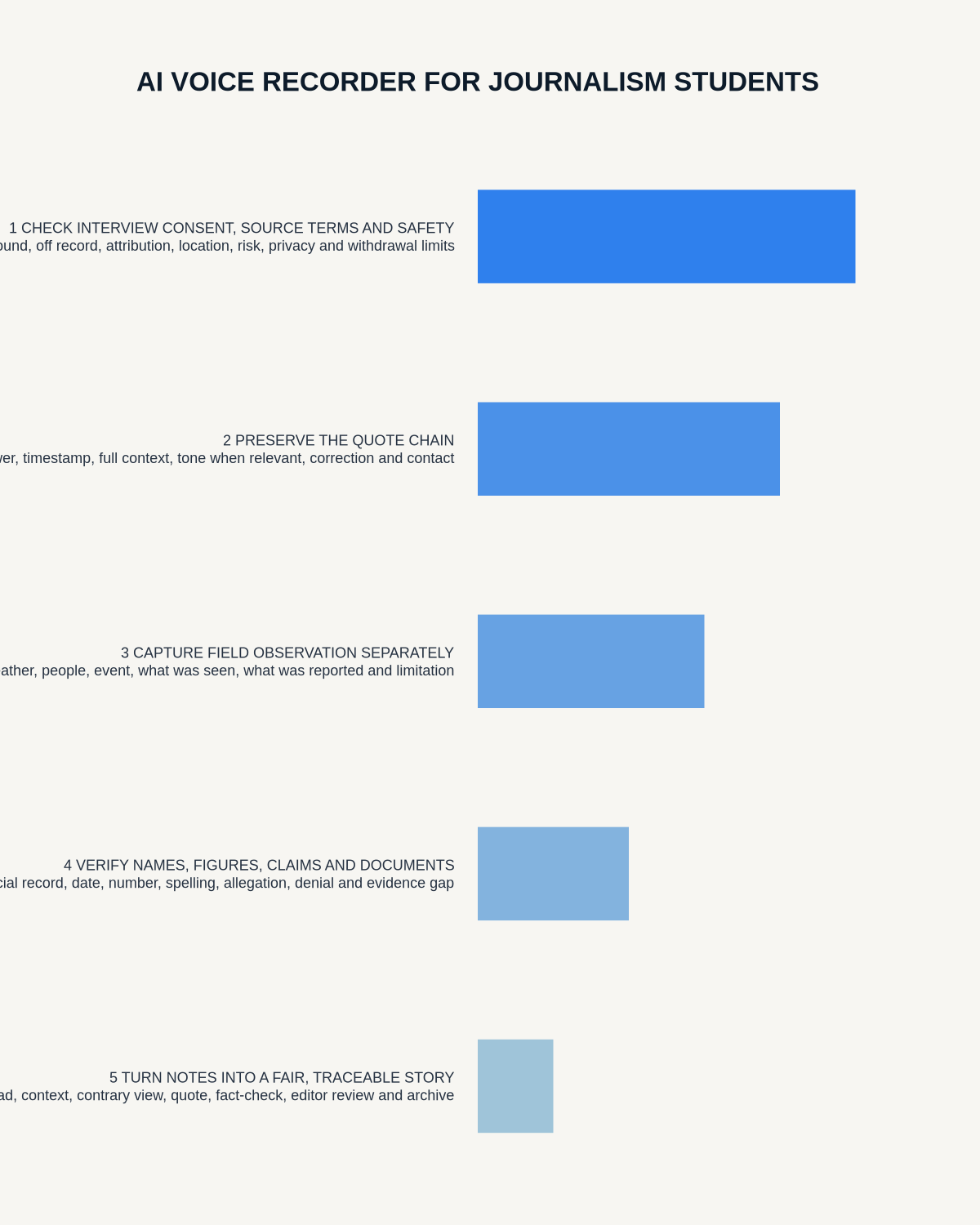
Visual map for AI Voice Recorder for Journalism Students: Interviews, Field Reporting and Story Notes
- Prepare the approved useDefine purpose, safe position, permission and the required formal record.
- Capture context firstState the case, asset, person, location or event identifier before detail.
- Human-verify evidenceCheck technical terms, units, names, dates, decisions and uncertainty.
- Complete the formal recordTransfer only verified information and apply access and retention controls.
On this page
Related guides
See whether Halo fits long-form study capture
After checking permission and your institution’s rules, compare Halo’s stated battery, storage and export workflow with the way you actually study.
Found an error or an out-of-date claim? Email support@neralvo.com with the article address and a supporting source.