The 60-second verdict
Psychology students need to evaluate how a claim was produced—not only remember the headline finding. A recorder can support permitted teaching and private methodological thinking, but participant audio is research data and must remain inside the approved ethics and data-management process.
Best fit: Psychology Students who need recoverable audio and human-verified notes in an authorised workflow. Use another method when: recording is prohibited, a participant declines or the approved process requires manual notes.
Evidence basis and limits
- Decision factors covered: The claim → method → result → limitation workflow; Stage 1: State the claim precisely; Stage 2: Reconstruct the method.
- Evidence rule: Claims are weighted by consequence: capture failure, changed meaning, access and recovery matter more than polished wording.
- Boundary: Examples and workflow recommendations must be tested with representative recordings, the intended users and the actual approval process before rollout.
An AI voice recorder for psychology students can support lectures, spoken revision and approved project planning. It cannot establish causation, interpret statistics reliably, diagnose a condition or authorise participant recording.
The claim → method → result → limitation workflow
| Stage | Psychology question | Output |
|---|---|---|
| Claim | What theory or relationship is being asserted? | Precise proposition |
| Method | How were constructs operationalised and data collected? | Research design |
| Result | What did the analysis actually show? | Evidence with uncertainty |
| Limitation | What alternative explanation or boundary remains? | Critical evaluation |
This workflow prevents a memorable theory or AI summary from becoming stronger than the research that supports it.
Stage 1: State the claim precisely
Separate:
- The theoretical claim.
- The study’s research question.
- The measured variables.
- The population studied.
- The direction and strength of the proposed relationship.
- Whether the claim is descriptive, correlational or causal.
“Stress causes poor memory” may overstate a study that measured self-reported stress and recall in one student sample. Preserve the actual scope.
Stage 2: Reconstruct the method
| Method field | Question |
|---|---|
| Design | Experiment, survey, observation, interview or another method? |
| Sample | Who participated and how were they recruited? |
| Operationalisation | How was each construct measured or manipulated? |
| Comparison | What control, baseline or counterfactual was used? |
| Procedure | What did participants experience? |
| Analysis | Which statistical or qualitative method was applied? |
| Ethics | What consent, risk, privacy and debriefing controls applied? |
Return to the original paper. A lecture or AI summary may omit exclusions, measure limitations or analytical choices that change interpretation.
Stage 3: Describe the result accurately
Check:
- What comparison or association was statistically tested.
- Effect size and uncertainty where reported.
- Direction of the result.
- Whether the hypothesis was supported fully, partly or not at all.
- Missing data and exclusions.
- Whether the analysis was planned or exploratory.
- What the authors did not conclude.
A significant result is not automatically large, important, causal or generalisable. Verify the numbers and interpretation independently.
Stage 4: Build the limitation
Consider:
- Alternative explanation or confound.
- Measurement validity and reliability.
- Sampling and generalisability.
- Demand characteristics or researcher influence.
- Statistical power and analytical flexibility.
- Replication and consistency with other evidence.
- Ethical or cultural boundary.
A limitation should explain how the issue affects the conclusion, not simply list “small sample” or “low ecological validity.”
Use an ethics gate before participant recording
The British Psychological Society’s Code of Human Research Ethics is organised around autonomy, privacy and dignity; scientific integrity; social responsibility; and maximising benefit while minimising harm. It covers valid consent, confidentiality, unequal relationships, student research and ethics review.
See the BPS Code of Human Research Ethics.
Do not recruit or record participants until the university has approved the study and the approved documents cover:
- The device and transcription service.
- Participant information and valid consent.
- Audio and transcript access.
- Storage, transfer and deletion.
- Withdrawal limits.
- Confidentiality and anonymisation.
- Risk, support and debriefing.
- Future use or sharing.
A change in recorder, account or cloud processor may require supervisor or ethics review before collection begins.
Recognise unequal relationships
Students, employees and clients may feel pressure to participate when the researcher appears to hold authority. BPS guidance calls for particular care to ensure valid consent and avoid perceived coercion in dependent or unequal relationships.
Where participation is connected to a course, use the approved recruitment and alternative arrangements. The researcher should not assume that classmates feel free to decline.
Audio is not automatically anonymous
Voice, accent, role, personal experience and context may identify a participant even after names are removed. Distinguish:
- Identifiable data: identity is directly or readily available.
- Pseudonymised data: identifiers are replaced but a key or context may reconnect identity.
- Anonymised data: identification is not reasonably likely under the applicable standard.
Follow the university’s approved definition, storage and access rules. Do not claim anonymity that the research design cannot provide.
Use AI carefully in qualitative analysis
Where the approved method permits AI assistance, generated themes should not replace a documented analytic process. Preserve:
- Transcript correction decisions.
- Coding framework and revisions.
- Researcher interpretation.
- Contradictory or negative cases.
- Links from themes to source material.
- Reflexive and audit-trail notes.
Never quote a participant from an unchecked summary. Apply the approved anonymisation and quotation process.
Keep diagnosis outside the study tool
Educational notes about symptoms, disorders or risk factors do not provide a valid diagnosis of the student, a friend or a research participant. Psychological assessment and diagnosis require appropriate professional processes.
Where study content raises personal concern, use university support, a GP or another qualified service rather than asking the recorder to interpret a voice note.
Maintain academic and research integrity
AI must not fabricate:
- Participants.
- Data.
- Statistical results.
- Interview quotations.
- Measures or procedures.
- References.
Follow course rules for AI use in reports, ethics applications and assessed work. The student remains responsible for the original source, analysis and final interpretation.
A concise psychology-study script
- Claim: state the theory or relationship precisely.
- Source: identify the original paper.
- Method: name design, sample and operationalisation.
- Result: state what the data showed without overclaiming.
- Limitation: give the strongest alternative or boundary.
- Ethics: identify a consent, risk or privacy issue.
- Retrieval: define a new example or comparison to explain.
How NERALVO Halo can support psychology study
Check whether NERALVO Halo fits psychology students work can support permitted lectures, private research-method planning and spoken revision. It includes NOTE mode, supported CALL capture, 64GB local storage, up to 35 hours of recording and Bluetooth sync with DOWAY. DOWAY can create transcripts, summaries, speaker-separated notes, templates, translations, mind maps and exportable files, with one year of DOWAY Max included from activation.
Halo is not automatically approved for participant data, sensitive personal information or placement material. The university and approved protocol control the device, account and processing route.
Psychology-study quality check
- Was the claim stated at the level supported by the study?
- Was the original method reconstructed accurately?
- Were statistics and findings checked?
- Does the limitation explain its effect on interpretation?
- Was participant recording approved before collection?
- Was consent free from actual or perceived coercion?
- Are audio, transcripts and identity protected appropriately?
- Is qualitative analysis documented and traceable?
- Is assessed work authentic and evidence-based?
A strong psychology voice-note workflow captures the explanation, returns to the original research and tests how far the evidence truly supports the claim.
Cloud software, a dedicated recorder or manual notes?
For Psychology Students, the right answer changes with the setting. This matrix deliberately gives each method a situation where it can be the strongest choice.
| Situation | Best starting point | Reason |
|---|---|---|
| scheduled remote consultations | Cloud meeting software | Calendar automation and shared integrations are usually the strongest advantage. |
| in-person consultations or ward handovers | Dedicated recorder | Independent capture reduces reliance on an active phone or laptop. |
| a patient declines or policy prohibits recording | Manual notes or an approved alternative | The boundary takes priority over convenience. |
| mixed remote and clinical work | Governed hybrid | Use each method only in the setting it actually fits. |
Related AI voice recorder guides
See the guides for counsellors, PhD students, researchers and research interviews.
Related guides
- How to Choose an AI Voice Recorder: Complete Buyer’s Guide
- AI Voice Recorder for Dental Students: Lectures, Clinical Skills and Revision Notes
- AI Voice Recorder for Veterinary Students: Lectures, Clinical Skills and Revision Notes
- AI Voice Recorder for Journalism Students: Interviews, Field Reporting and Story Notes
- AI Voice Recorder for Accountancy Students: Lectures, Worked Examples and Revision Notes
- AI Voice Recorder for Pharmacy Students: Lectures, Simulated Consultations and Revision
Profession workflow
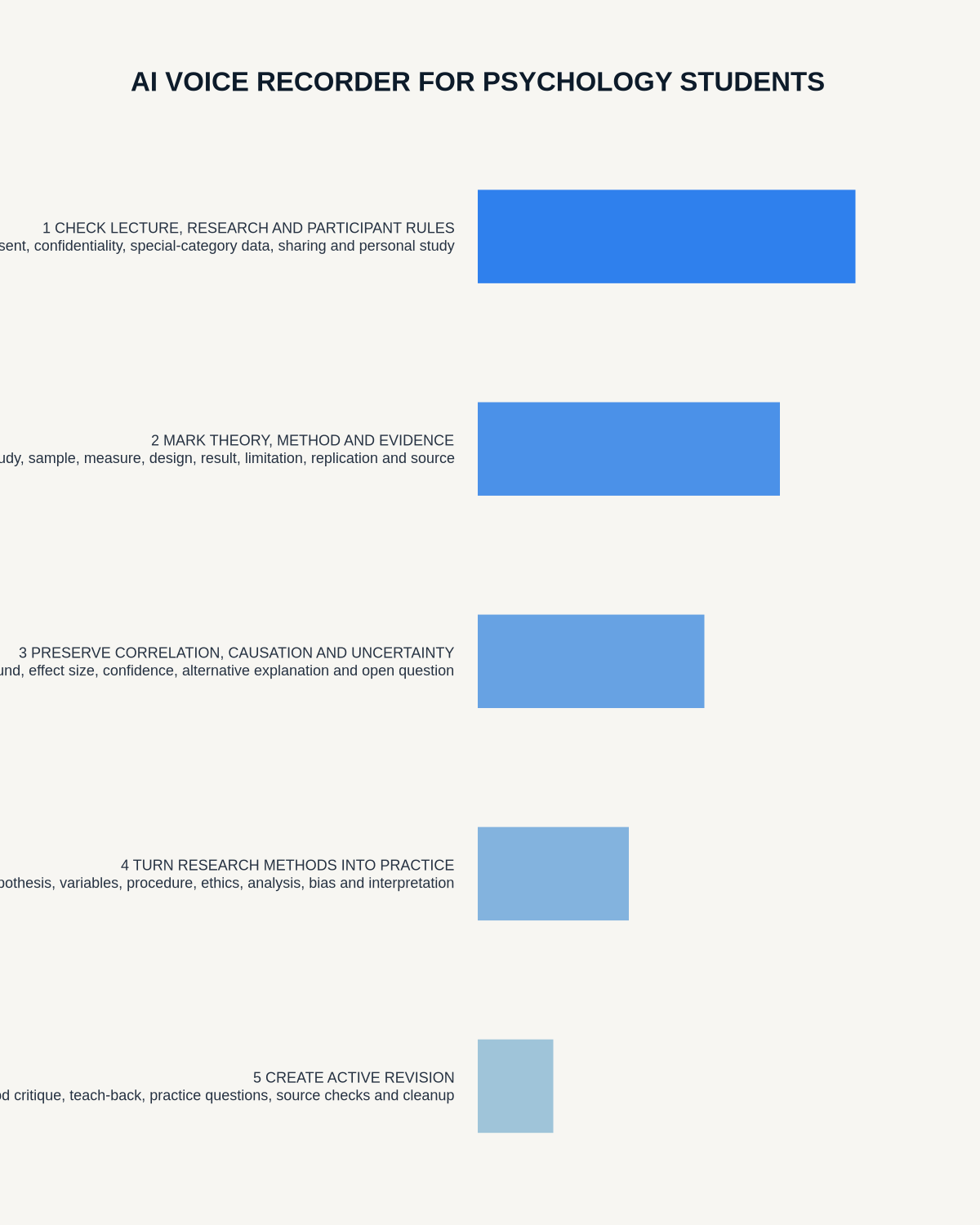
Visual map for AI Voice Recorder for Psychology Students: Lectures, Research Methods and Revision Notes
- Prepare the approved useDefine purpose, safe position, permission and the required formal record.
- Capture context firstState the case, asset, person, location or event identifier before detail.
- Human-verify evidenceCheck technical terms, units, names, dates, decisions and uncertainty.
- Complete the formal recordTransfer only verified information and apply access and retention controls.
On this page
Related guides
See whether Halo fits long-form study capture
After checking permission and your institution’s rules, compare Halo’s stated battery, storage and export workflow with the way you actually study.
Found an error or an out-of-date claim? Email support@neralvo.com with the article address and a supporting source.