The 60-second verdict
Quick answer: an AI voice recorder can help kitchen designers preserve client priorities, survey context, appliance requirements, service questions, product selections and agreed actions. It must not replace the measured survey, technical design, quotation, manufacturer instructions or final installation drawings.
Best fit: Kitchen Designers who need recoverable audio and human-verified notes in an authorised workflow. Use another method when: recording is prohibited, a participant declines or the approved process requires manual notes.
Evidence basis and limits
- Decision factors covered: Why kitchen-design conversations are easy to misread; The household → room → services → products → approval workflow; Build the household brief before drawing units.
- Evidence rule: A claim earns weight only when the source, date, configuration and limitation are clear enough for a reader to check.
- Boundary: Examples and workflow recommendations must be tested with representative recordings, the intended users and the actual approval process before rollout.

Assess Halo against the kitchen designers workflow matrix can support consultations and post-survey notes. The designer remains responsible for accuracy, accessibility, services, product compatibility and formal sign-off.
Why kitchen-design conversations are easy to misread
A client may discuss style, storage, accessibility, appliances, budget and building work in the same conversation. An AI summary can make every comment sound like a final decision even when some points are preferences, assumptions or questions.
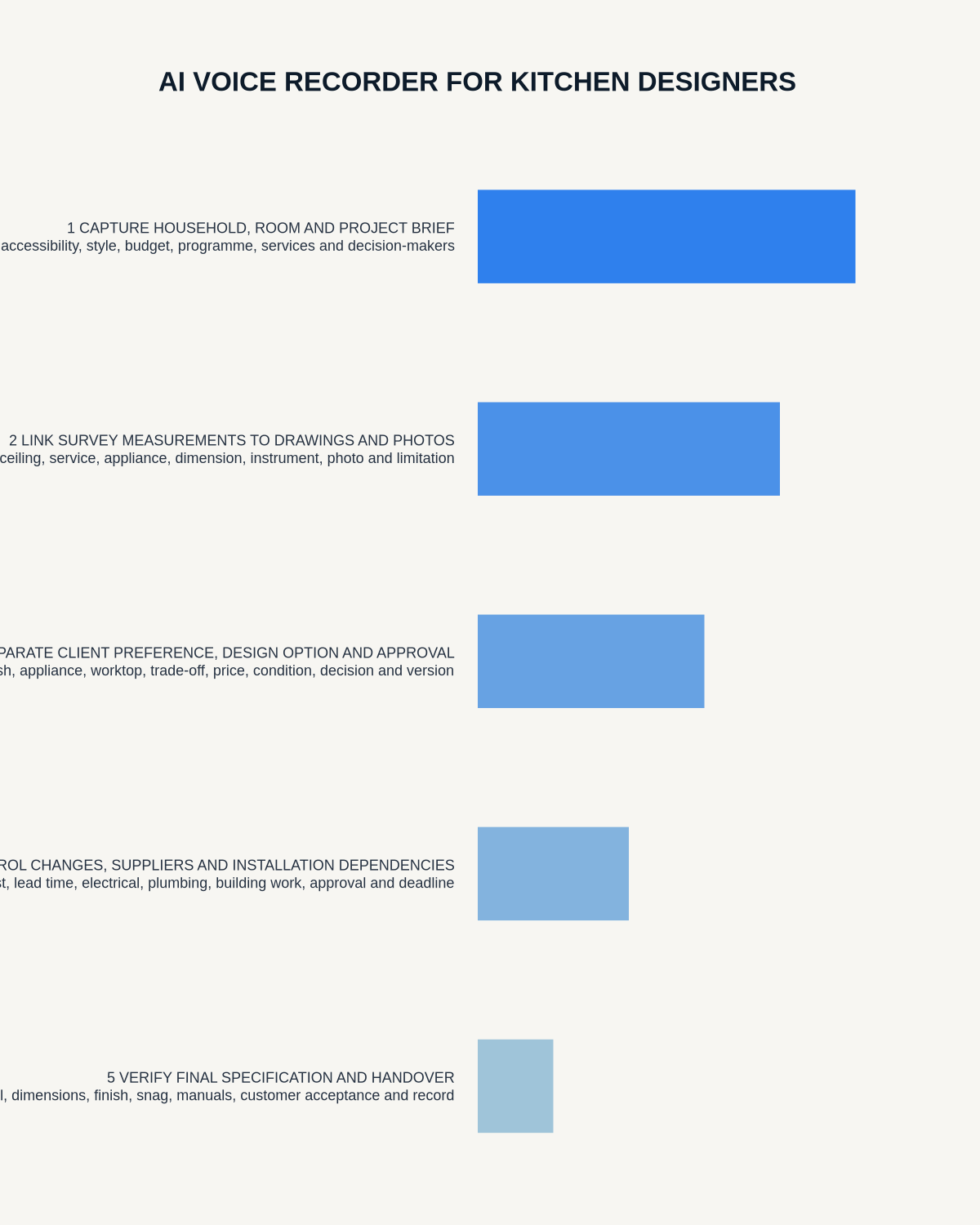
The household → room → services → products → approval workflow
| Stage | Question | Output |
|---|---|---|
| Household | Who uses the kitchen and how? | Functional brief |
| Room | What do verified dimensions and fixed conditions allow? | Measured constraints |
| Services | What power, water, waste, ventilation and heating are available? | Coordination plan |
| Products | Which cabinets, worktops and appliances fit the brief and constraints? | Specified selections |
| Approval | What is agreed, costed, versioned and ready to order? | Controlled design |
Build the household brief before drawing units
Capture the number and needs of regular users, cooking and eating routines, storage priorities, accessibility, cleaning expectations, appliances to retain, budget, programme and tolerance for building work.
Translate “more storage” into categories, quantities and access priorities. Translate “easy to use” into handle, reach, lighting, control and circulation requirements.
Separate needs, preferences, constraints and assumptions
| Status | Meaning | Example |
|---|---|---|
| Need | Essential functional or accessibility outcome | Seated preparation area |
| Preference | Desired aesthetic or convenience feature | Handleless fronts |
| Constraint | Verified physical, service, budget or programme limit | Drain position cannot move without building work |
| Assumption | Unverified detail requiring confirmation | Wall can support the proposed unit |
| Approved decision | Accepted choice entered into controlled documents | Specified appliance model and cabinet arrangement |
Verify the home survey independently
Check overall dimensions and diagonals, ceiling height, floor level, doors and windows, wall construction, obstructions, services, ventilation, heating, access, parking, delivery and waste removal. Use photographs and controlled drawings where permitted.
Do not order cabinetry, worktops or appliances from a transcript.
Use a dimension-confidence code
- V — verified: checked directly and suitable for design use.
- P — provisional: measured but dependent on strip-out, finished floor or another condition.
- S — supplied: provided by the customer or another party and awaiting confirmation.
- U — unknown: inaccessible or not yet established.
Do not release fitted items against provisional, supplied or unknown critical dimensions without the project’s defined control and approval.
Create an appliance and service coordination matrix
| Item | Verify | Dependency |
|---|---|---|
| Oven or hob | Model, dimensions, load, ventilation and clearances | Power or gas provision |
| Extractor | Type, route, airflow and manufacturer instructions | Duct path and external termination |
| Dishwasher | Width, door arrangement, water and waste | Adjacent cabinet and service access |
| Refrigeration | Built-in or freestanding dimensions and ventilation | Door clearance and heat source |
| Sink and tap | Cut-out, bowl, tap, waste and accessory needs | Worktop and cabinet configuration |
Verify the current manufacturer information. Model names, numbers, loads and clearances are particularly vulnerable to transcription errors.
Record workflow rather than only cabinet preferences
Ask how many people cook together, where food arrives and is stored, which small appliances are used daily, recycling habits, children and pets, entertaining, seating, cleaning and maintenance. Translate real routines into zones, access and clearances rather than assuming one standard layout solves every household.
Make accessibility part of the main design
Capture the client’s own priorities for approach space, work height, reach, seating, handles, controls, visibility, lighting and circulation. Avoid designing from assumptions about age or disability.
Where specialist advice is required, record the question and coordinate it through the appropriate professional route.
Use a staged approval ladder
| Approval stage | What the client is approving |
|---|---|
| Layout | Position, circulation and functional arrangement |
| Technical basis | Appliance and service assumptions requiring confirmation |
| Appearance | Door, worktop, handle, colour and visible details |
| Commercial scope | Price, exclusions, installation and work by others |
| Final order | Exact products, dimensions and current revision |
A positive comment during a showroom discussion is not automatically approval of the final order. Record the stage, exact revision, conditions and approver.
Use a decision register for selections
Each selection should show product or sample reference, location, status, cost, lead time, maintenance requirement and approval date. Keep proposed, client-preferred, specified, approved, ordered and installed statuses separate.
This is particularly important for doors, handles, worktops, splashbacks, sinks, taps, appliances and lighting.
Control design changes
For every change, record the exact request, reason, design impact, cost and programme effect, service or structural dependency, approval status, documents affected and people notified.
Changes to appliances, walls, flooring, services or finishes should trigger a dependency review before confirmation.
Use an installation-readiness gate
- Final survey approved.
- Critical dimensions verified or formally controlled.
- Room and service assumptions resolved.
- Appliance model numbers confirmed.
- Cabinet, worktop and panel schedules aligned.
- Finishes and samples approved.
- Access and delivery plan checked.
- Building-work responsibilities assigned.
- Quotation and drawings use the same revision.
- Outstanding decisions and hold points visible.
Build a useful installer handover
Include the current drawing set, key dimensions and confidence status, service plan, appliance schedule, worktop template requirements, site access, protection, dependencies, known risks, open decisions and inspection points. Avoid sending raw consultation audio to the installer.
How NERALVO Halo fits kitchen design
NERALVO Halo includes NOTE mode, supported CALL capture, 64GB local storage, up to 35 hours of recording and Bluetooth sync with DOWAY. DOWAY can create transcripts, summaries, speaker-separated notes, templates, translations, mind maps and exports. One year of DOWAY Max is included from activation.
It can support consultation and survey-context drafting. It is not a laser measure, CAD system, service-design tool or installation-control system.
Cloud software, a dedicated recorder or manual notes?
For Kitchen Designers, the right answer changes with the setting. This matrix deliberately gives each method a situation where it can be the strongest choice.
| Situation | Best starting point | Reason |
|---|---|---|
| scheduled remote meetings | Cloud meeting software | Auto-join and central collaboration can remove routine admin. |
| in-person or mobile work | Dedicated recorder | Dedicated hardware suits movement, variable rooms and offline source capture. |
| recording is refused or prohibited | Manual notes or an approved alternative | A clear alternative respects policy and participant choice. |
| mixed online and offline work | Governed hybrid | One governed process prevents gaps between desk and field work. |
Frequently asked questions
Can the transcript become the client specification?
It can help draft one, but each item must be checked, status-labelled and entered into the controlled brief, schedule or drawing.
Can appliance details be captured by voice?
Yes, but model numbers, dimensions, loads, ventilation and clearances must be checked against current manufacturer information.
Can provisional measurements be used for ordering?
Only through an explicit controlled process with the relevant risk, dependency and authority recorded. Critical fitted items should normally wait for verified information.
Final kitchen-design checklist
- Household needs separated from preferences.
- Survey values verified and confidence-coded.
- Services and appliance data checked.
- Accessibility requirements explicit.
- Selections have clear lifecycle status.
- Approval linked to stage and revision.
- Changes version-controlled across dependencies.
- Quotation and drawing revisions match.
- Installer dependencies assigned.
- Final order and installation acceptance recorded.
Bottom line: the best kitchen-design voice note preserves why a decision matters, while verified dimensions, staged approval and coordinated drawings determine what is ordered and installed.
Related guides
See the guides for interior designers, carpenters and joiners and site visits.
On this page
Related guides
See whether Halo fits this workflow
Review the NERALVO Halo specifications, included services, delivery information and current offer only after completing the guide.
Found an error or an out-of-date claim? Email support@neralvo.com with the article address and a supporting source.