The 60-second verdict
Medical students need to connect basic science, clinical reasoning, communication and professional behaviour across a large volume of teaching. A recorder can help with approved lectures and simulation, but the risk changes completely when real patients or clinical systems are involved.
Best fit: Medical Students who need recoverable audio and human-verified notes in an authorised workflow. Use another method when: recording is prohibited, a participant declines or the approved process requires manual notes.
Evidence basis and limits
- Decision factors covered: The learn → simulate → verify → retrieve workflow; Use a hard placement boundary; Stage 1: Learn from approved teaching.
- Evidence rule: The decision is based on the complete capture-to-action workflow, not a single feature or marketing accuracy percentage.
- Boundary: Examples and workflow recommendations must be tested with representative recordings, the intended users and the actual approval process before rollout.
An AI voice recorder for medical students can support permitted teaching, consenting peer simulation and private revision. It is not automatically suitable for wards, clinics, handovers, placement discussions or identifiable patient information.
The learn → simulate → verify → retrieve workflow
| Stage | Student action | Output |
|---|---|---|
| Learn | Capture approved teaching or a private explanation | Draft study material |
| Simulate | Practise communication with consenting peers or actors | Observable skills feedback |
| Verify | Check every clinical and safety-critical detail | Accurate notes |
| Retrieve | Apply the knowledge without relying on the transcript | Independent understanding |
This workflow keeps patient information outside the consumer-recording route and treats every AI output as an unverified educational draft.
Use a hard placement boundary
Do not use a personal consumer recorder for ward rounds, consultations, handovers, bedside teaching or real patient encounters unless the clinical organisation has expressly authorised the complete arrangement.
GMC confidentiality guidance says anonymised information should be used for education and training wherever practicable. Identifiable information requires an appropriate lawful basis and will usually require explicit consent when disclosed outside the direct-care team. Simply removing a name may not make a case anonymous because a voice, rare condition, location or combination of details can identify the patient.
See the GMC’s guidance on education and training.
Stage 1: Learn from approved teaching
For permitted lectures and classroom sessions, record a defined learning purpose rather than building a complete archive. Useful targets include:
- A difficult mechanism.
- A clinical reasoning framework.
- A communication structure.
- A calculation or interpretation method.
- A comparison between conditions.
Mark the sections to review and compare the transcript with slides, current teaching materials and recommended sources.
Stage 2: Simulate without real patient data
Where faculty permits recording, students can review simulated histories, explanations, escalation calls and structured handovers involving consenting peers, educators or actors.
A useful simulation review separates:
| Area | Example question |
|---|---|
| Opening | Was identity, role and purpose clear? |
| Information gathering | Were questions relevant, ordered and understandable? |
| Explanation | Was jargon translated accurately? |
| Clinical structure | Were red flags, uncertainty and escalation represented? |
| Communication | Was understanding checked? |
| Closure | Were next steps and safety-net instructions clear? |
AI may organise the transcript, but approved educators and assessment criteria determine whether performance is safe and competent.
Stage 3: Verify every clinical detail
Speech recognition and summarisation can confuse medicine names, decimal points, units, anatomy, abbreviations and negation. “No chest pain” can become a materially different statement if one word is lost.
Check:
- Generic and brand medicine names.
- Dose, unit, concentration, route and frequency.
- Age, pregnancy, renal and hepatic qualifiers.
- Anatomical side and structure.
- Red flags and exclusion criteria.
- Thresholds and calculations.
- Whether guidance has changed since the teaching session.
Do not use the AI output to guide real patient care. Use current approved clinical and curriculum sources.
Stage 4: Retrieve and apply
Close the transcript and explain the topic from memory. Then apply it to a new educational scenario.
A useful retrieval sequence is:
- Define the mechanism or problem.
- Identify relevant findings or information.
- Build a differential or explanatory structure.
- State uncertainty and information still required.
- Describe the educational management principle.
- Check against the approved source.
The aim is not to memorise an AI summary; it is to recognise errors and reason independently.
Create safe reflective notes
A private post-placement reflection can focus on learning, communication and future action without reconstructing the patient record. Follow the programme and placement provider’s anonymisation and portfolio rules.
A safe reflection may include:
- The learning theme.
- The student’s role.
- What communication or reasoning was difficult.
- Feedback received.
- What would change next time.
- A learning action.
Exclude names, dates of birth, addresses, exact locations and distinctive combinations of facts. Reflection must not create a parallel clinical file.
Keep patient recordings within authorised clinical processes
GMC guidance on recordings made as part of care requires patient consent in the circumstances it describes and secure handling. Secondary teaching use must also meet confidentiality and anonymisation requirements.
See the GMC’s patient-recording guidance.
A medical student should use the clinical organisation’s approved process—not introduce a consumer device independently.
Protect academic and professional integrity
Assessed reflections, case discussions, portfolios and presentations must follow medical-school AI and academic-integrity rules. AI must not fabricate:
- Patient encounters.
- Clinical findings.
- Feedback.
- Procedures observed or completed.
- Quotations.
- Sources or guidelines.
The student should understand every submitted statement and disclose assistance where required. Fabrication can raise academic and professionalism concerns.
A concise medical-study voice-note script
- Topic: module, mechanism or skill.
- Core explanation: state the principle in plain language.
- Safety-critical detail: identify the medicine, unit, threshold or red flag to verify.
- Uncertainty: record what remains unclear.
- Source: name the approved material to check.
- Retrieval task: define a new question or simulated scenario.
How NERALVO Halo can support medical study
View Halo specifications for medical students use can support permitted lectures, consenting peer simulation and private revision. It includes NOTE mode, supported CALL capture, 64GB local storage, up to 35 hours of recording and Bluetooth sync with DOWAY. DOWAY can create transcripts, summaries, speaker-separated notes, templates, translations, mind maps and exportable files, with one year of DOWAY Max included from activation.
These features do not make Halo or DOWAY approved for patient information. Medical schools and clinical organisations control which hardware, accounts and processors may handle their data.
Medical-study quality check
- Was the recording limited to approved teaching, simulation or private revision?
- Was all real-patient and placement information kept outside the consumer workflow?
- Were simulation participants informed and consenting?
- Were medicines, units, negation and clinical facts verified?
- Did the student retrieve and apply the knowledge independently?
- Does reflection protect patient identity and avoid a parallel record?
- Is assessed work truthful and compliant with programme rules?
- Has source audio been retained or deleted under policy?
- Would the workflow remain defensible to the medical school and placement provider?
A strong medical-student recording workflow supports approved learning while keeping real patient information, clinical decisions and professional accountability inside authorised systems.
Cloud software, a dedicated recorder or manual notes?
For Medical Students, the right answer changes with the setting. This matrix deliberately gives each method a situation where it can be the strongest choice.
| Situation | Best starting point | Reason |
|---|---|---|
| scheduled remote consultations | Cloud meeting software | Native remote-meeting workflows can be more efficient here. |
| in-person consultations or ward handovers | Dedicated recorder | A separate battery and recoverable local source improve resilience. |
| a patient declines or policy prohibits recording | Manual notes or an approved alternative | Manual notes are the correct control when recording is unavailable. |
| mixed remote and clinical work | Governed hybrid | A hybrid can combine automation with reliable physical capture. |
Related AI voice recorder guides
See the guides for general practitioners, nurses, pharmacists and university lecturers.
Related guides
Profession workflow
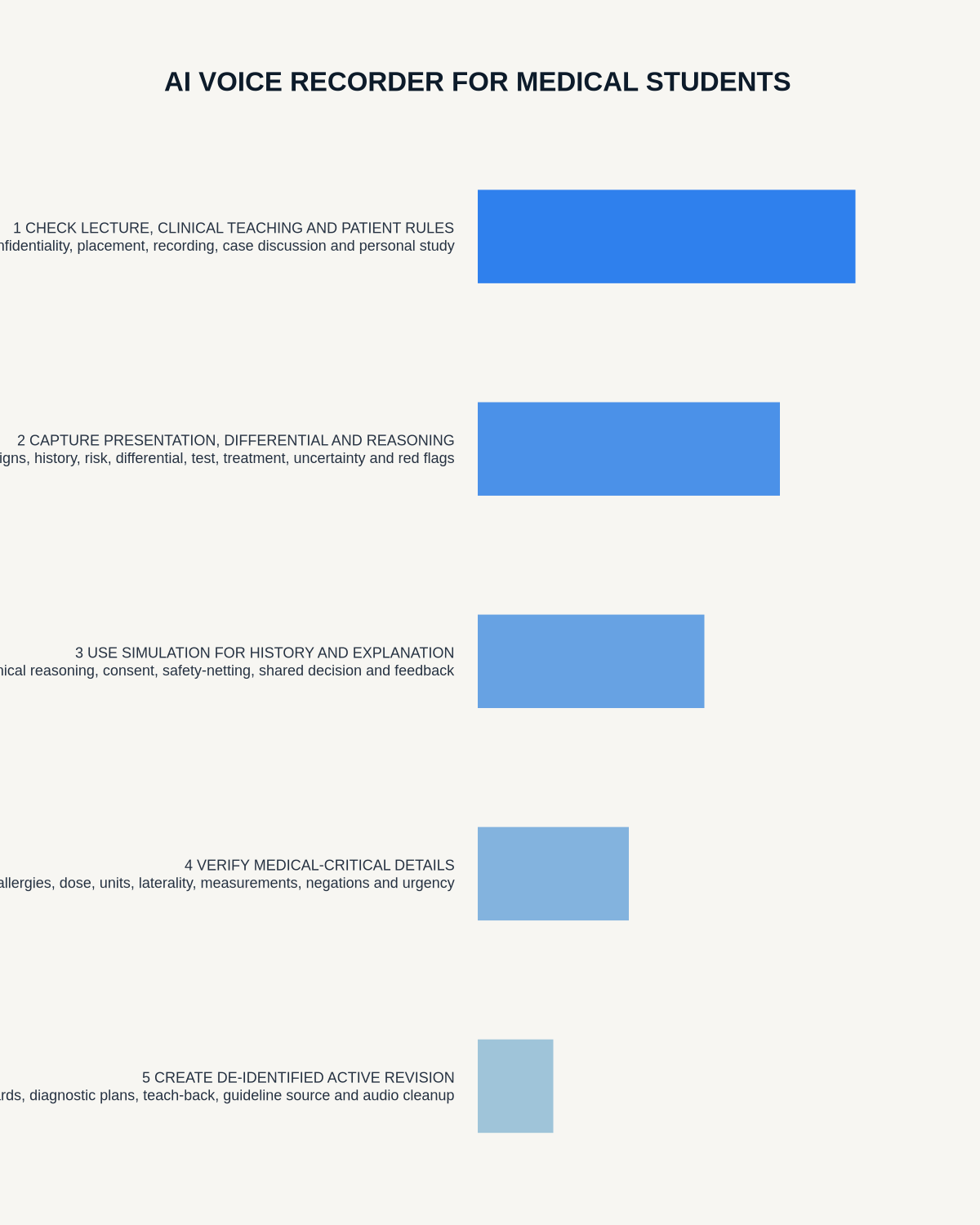
Visual map for AI Voice Recorder for Medical Students: Lectures, Clinical Teaching and Revision Notes
- Prepare the approved useDefine purpose, safe position, permission and the required formal record.
- Capture context firstState the case, asset, person, location or event identifier before detail.
- Human-verify evidenceCheck technical terms, units, names, dates, decisions and uncertainty.
- Complete the formal recordTransfer only verified information and apply access and retention controls.
On this page
Related guides
See whether Halo fits long-form study capture
After checking permission and your institution’s rules, compare Halo’s stated battery, storage and export workflow with the way you actually study.
Found an error or an out-of-date claim? Email support@neralvo.com with the article address and a supporting source.