The 60-second verdict
Veterinary students need to connect species, husbandry, clinical signs, medicines, owner communication and animal welfare. A recorder can support approved teaching and simulation, but it must not turn a placement, farm or client consultation into an unauthorised data source.
Best fit: Veterinary Students who need recoverable audio and human-verified notes in an authorised workflow. Use another method when: recording is prohibited, a participant declines or the approved process requires manual notes.
Evidence basis and limits
- Decision factors covered: The species → problem → evidence → welfare decision workflow; Use a hard placement boundary; Stage 1: Start with species and context.
- Evidence rule: The decision is based on the complete capture-to-action workflow, not a single feature or marketing accuracy percentage.
- Boundary: Examples and workflow recommendations must be tested with representative recordings, the intended users and the actual approval process before rollout.
An AI voice recorder for veterinary students can support permitted lectures, consenting role-play and private revision. It cannot examine an animal, calculate a safe treatment independently, obtain valid client consent or replace supervised clinical judgement.
The species → problem → evidence → welfare decision workflow
| Stage | Veterinary-learning question | Output |
|---|---|---|
| Species | Which species, life stage, use and husbandry context apply? | Relevant biological context |
| Problem | What pattern, risk or owner concern is being considered? | Defined clinical question |
| Evidence | Which findings, tests and current sources support or challenge it? | Verified reasoning |
| Welfare decision | What supervised action best protects the animal and client? | Accountable next step |
This workflow prevents a generic disease summary from being applied across species or real cases without the required examination and supervision.
Use a hard placement boundary
Do not record client consultations, clinical histories, handovers, farm discussions, practice-management screens or treatment conversations on a personal consumer device unless the university and placement provider have authorised the complete arrangement.
RCVS guidance requires clear, accurate and adequately detailed clinical and client records. It also requires confidentiality to be protected. A student’s personal transcript cannot replace the authorised practice record.
See the RCVS guidance on clinical and client records.
Stage 1: Start with species and context
Before discussing a condition or calculation, state:
- Species and breed where relevant.
- Age, life stage and reproductive status.
- Companion, farm, equine, wildlife or laboratory context.
- Body weight and whether it is measured or estimated.
- Husbandry, diet and environment.
- Food-chain, competition or working-animal status.
- Legal and welfare context.
A principle learned in one species may not transfer safely to another. AI should not fill missing context with assumptions.
Stage 2: Define the problem
In an approved simulated case or private revision note, separate:
| Information | Example |
|---|---|
| Owner or keeper report | Change in appetite or behaviour |
| Observed sign | Posture, gait, respiratory pattern or lesion |
| Measured finding | Weight, temperature or laboratory value |
| Student interpretation | Possible significance or differential |
| Supervisor decision | Examination, test, treatment or referral |
AI summaries may merge these layers. The final study note should show who observed or decided each material point.
Stage 3: Build and test the evidence
For each differential or management principle, ask:
- Which findings support it?
- Which findings argue against it?
- What important information is missing?
- Which test or examination would reduce uncertainty?
- What alternative explanation must remain open?
- Which current veterinary source supports the reasoning?
Do not present an unexamined animal or a short voice description as a diagnosis.
Verify medicines and calculations manually
Veterinary medicine is especially vulnerable to errors involving species, weight, concentration and decimal place. Check:
- Exact species and measured body weight.
- Medicine and formulation.
- Concentration.
- Dose and unit.
- Calculated volume or quantity.
- Route, frequency and duration.
- Contraindication or interaction.
- Authorised use, prescribing cascade or off-label status where relevant.
- Food-chain and withdrawal requirements.
Redo the calculation independently and use current approved sources. AI output must not guide real animal treatment.
Stage 4: Keep welfare central
The RCVS Code says animal health and welfare must be the first consideration. In an educational scenario, explain:
- The immediate welfare concern.
- Whether pain relief, emergency action or referral is required.
- What information the client needs.
- What uncertainty remains.
- Who is authorised to decide and act.
- What follow-up is required.
See the RCVS Code of Professional Conduct.
A recorder cannot assess pain, capacity, urgency or consent. Students must work within competence and supervision.
Practise owner communication through simulation
With consenting peers or actors and fictional information, practise:
- Explaining the problem in clear language.
- Presenting realistic options and uncertainty.
- Discussing material risks and likely costs where the scenario requires it.
- Checking understanding.
- Giving welfare and follow-up instructions.
- Escalating questions outside the student’s role.
AI can organise a transcript but cannot establish that consent was valid or that the advice was clinically appropriate.
Use current RCVS AI guidance correctly
The RCVS states that professional and clinical decision-making must not be wholly delegated to AI. Users remain responsible for the tool and must think critically about its output. Client confidentiality and data-protection obligations remain in force.
Where AI is used to create clinical records, the output should be manually verified and necessary edits made contemporaneously. See the RCVS AI advice for the profession.
This professional guidance does not authorise a student to introduce a consumer recorder into a placement independently.
Protect client, animal and business information
Removing a name may not anonymise a recording. Voice, location, species, rare condition, owner occupation, farm details and event sequence may identify a client, animal or business.
Do not dictate names, addresses, financial information, practice data or identifiable histories into an unapproved service. Commercial farm, equine and breeding information may also be sensitive.
Create authentic placement reflection
Where programme and provider rules allow it, a private reflection should focus on the student’s learning rather than reproduce the case.
Include:
- Learning theme.
- Student role and supervision.
- Communication or reasoning issue.
- Feedback source.
- What requires further reading or supervised practice.
- How improvement will be demonstrated.
Exclude identifying combinations of client, animal, location and chronology. The reflection is not a parallel clinical record.
Escalate welfare and safety concerns immediately
Urgent animal-welfare, public-health, safety or safeguarding concerns must be handled through the supervisor and provider process immediately. Do not wait for audio to upload, transcribe or summarise.
Maintain academic and professional integrity
AI must not fabricate:
- Cases or animals examined.
- Clinical findings.
- Medicine calculations.
- Client statements.
- Procedures observed or performed.
- Feedback or assessment evidence.
- References.
Portfolio entries and assessed work must remain truthful, understood and attributable.
A concise veterinary-study voice-note script
- Species: state species, life stage, use and weight.
- Problem: identify the simulated pattern or welfare concern.
- Evidence: separate report, observation, measurement and interpretation.
- Differentials: state what supports and challenges each possibility.
- Safety check: name the medicine, dose, legal or welfare detail to verify.
- Decision: identify the supervised next action and authority.
- Learning: define the next reading, calculation or practice task.
How NERALVO Halo can support veterinary study
View Halo specifications for veterinary students use can support permitted lectures, consenting simulation and private revision. It includes NOTE mode, supported CALL capture, 64GB local storage, up to 35 hours of recording and Bluetooth sync with DOWAY. DOWAY can create transcripts, summaries, speaker-separated notes, templates, translations, mind maps and exportable files, with one year of DOWAY Max included from activation.
These features do not make Halo or DOWAY approved for client, animal or practice data. The university and placement provider control the permitted devices, accounts and processors.
Veterinary-study quality check
- Was recording limited to approved teaching, simulation or private revision?
- Was all real placement and client information excluded?
- Were species, context and weight stated correctly?
- Were report, observation and interpretation separated?
- Were medicines, doses and legal details verified?
- Did animal welfare remain the first consideration?
- Was professional judgement kept with authorised people?
- Does reflection protect client, animal and business identity?
- Is assessed work authentic and attributable?
A strong veterinary-student recording workflow keeps species and welfare central while leaving real clinical records and decisions inside authorised professional systems.
Cloud software, a dedicated recorder or manual notes?
For Veterinary Students, the right answer changes with the setting. This matrix deliberately gives each method a situation where it can be the strongest choice.
| Situation | Best starting point | Reason |
|---|---|---|
| scheduled remote consultations | Cloud meeting software | Native remote-meeting workflows can be more efficient here. |
| in-person consultations or ward handovers | Dedicated recorder | A separate battery and recoverable local source improve resilience. |
| a patient declines or policy prohibits recording | Manual notes or an approved alternative | Manual notes are the correct control when recording is unavailable. |
| mixed remote and clinical work | Governed hybrid | A hybrid can combine automation with reliable physical capture. |
Related AI voice recorder guides
See the guides for veterinary nurses, veterinarians, medical students and farmers.
Related guides
Profession workflow
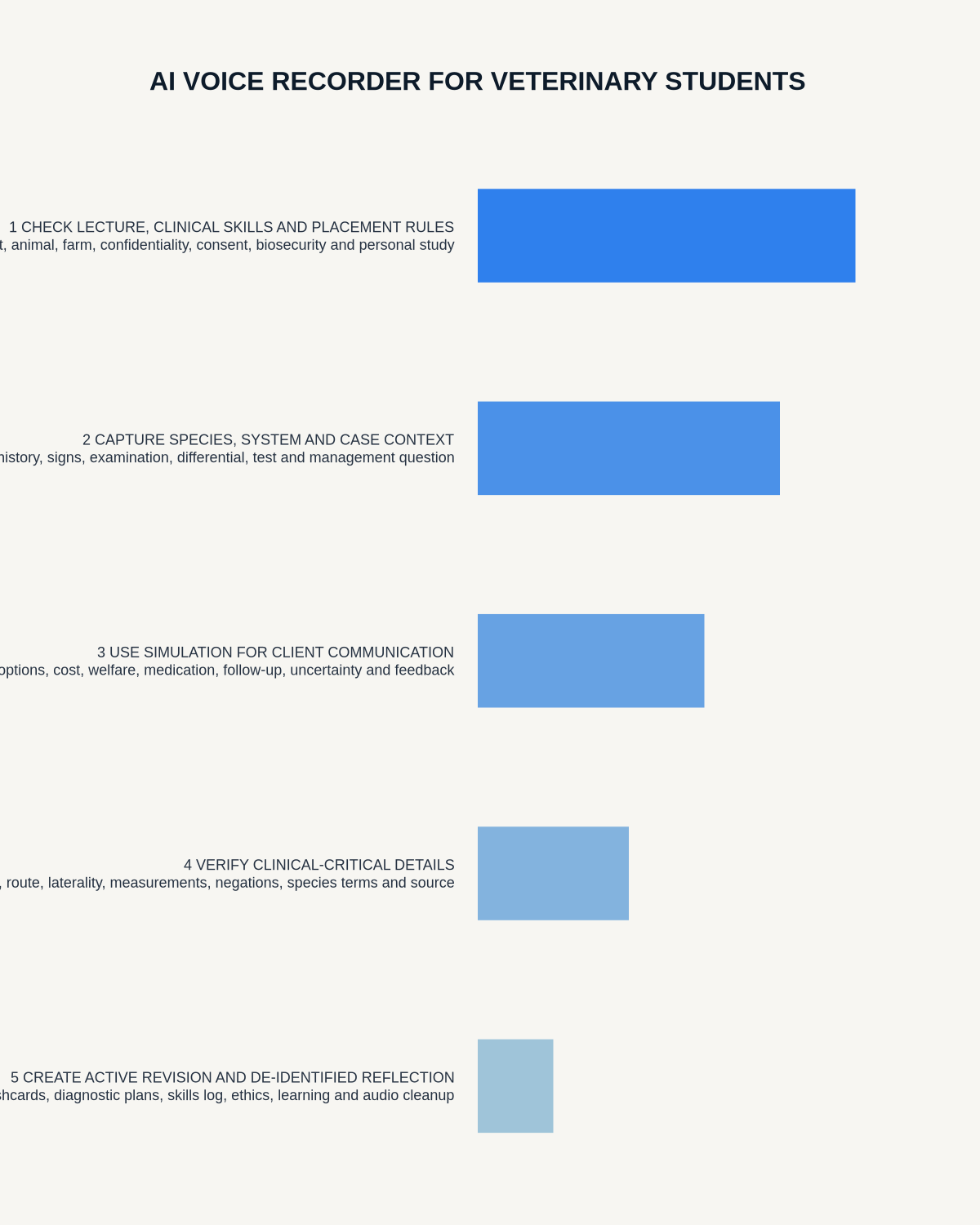
Visual map for AI Voice Recorder for Veterinary Students: Lectures, Clinical Skills and Revision Notes
- Prepare the approved useDefine purpose, safe position, permission and the required formal record.
- Capture context firstState the case, asset, person, location or event identifier before detail.
- Human-verify evidenceCheck technical terms, units, names, dates, decisions and uncertainty.
- Complete the formal recordTransfer only verified information and apply access and retention controls.
On this page
Related guides
See whether Halo fits long-form study capture
After checking permission and your institution’s rules, compare Halo’s stated battery, storage and export workflow with the way you actually study.
Found an error or an out-of-date claim? Email support@neralvo.com with the article address and a supporting source.