The 60-second verdict
Quick answer: quality managers can use an AI voice recorder for approved audits, non-conformance reviews, customer complaints, supplier-quality calls and corrective-action meetings, but every conclusion must remain traceable to a requirement and objective evidence. A transcript begins as a statement; it does not become a finding or CAPA closure automatically.
Best fit: Quality Managers who need recoverable audio and human-verified notes in an authorised workflow. Use another method when: recording is prohibited, a participant declines or the approved process requires manual notes.
Evidence basis and limits
- Decision factors covered: Use the evidence ladder; Use a requirement → evidence → finding → action → verification workflow; Write a defensible finding.
- Evidence rule: Claims are weighted by consequence: capture failure, changed meaning, access and recovery matter more than polished wording.
- Boundary: Examples and workflow recommendations must be tested with representative recordings, the intended users and the actual approval process before rollout.

Check whether NERALVO Halo fits quality managers work can support structured drafts while the quality-management system remains authoritative.
Use the evidence ladder
| Level | Example | Use |
|---|---|---|
| Statement | Process owner explains what normally happens | Lead requiring verification |
| Observation | Auditor sees the activity or condition | Direct evidence within scope and time |
| Record | Controlled system, sample, measurement or document | Traceable objective evidence |
| Conclusion | Evidence compared with requirement | Competent audit judgement |
| Effectiveness evidence | Later samples, observations or trends confirm improvement | CAPA closure support |
A transcript begins at the first level. It does not jump automatically to the fourth.
Use a requirement → evidence → finding → action → verification workflow
- Requirement: exact standard, procedure, contract or specification.
- Evidence: verified record, observation, interview or measurement.
- Finding: conformity, non-conformity, risk or opportunity.
- Action: containment, correction, cause analysis and corrective action.
- Verification: implementation and effectiveness evidence.
Write a defensible finding
Use three elements:
- Requirement: exact criterion and revision.
- Evidence: verified sample, observation or record.
- Gap: how the evidence fails to meet the requirement.
Avoid vague language such as “documentation poor” or “staff are not following procedure” unless the evidence proves that precise conclusion and scope.
Use the TRACE interview note
- T — Target: process, scope and audit criteria.
- R — Response: attributed explanation.
- A — Artefact: record, sample, system or document reference.
- C — Check: verification performed.
- E — Evaluation: conclusion or evidence still required.
Keep interview explanation, direct observation, document evidence, auditor interpretation and final finding separate.
Correction is not corrective action
| Stage | Purpose |
|---|---|
| Containment | Control possible wider exposure |
| Correction | Fix the detected item |
| Cause investigation | Explain why the problem was possible |
| Corrective action | Address the confirmed cause and reduce recurrence |
| Effectiveness review | Test whether the action actually worked |
An AI summary must not mark a case closed because the immediate item was corrected or training was delivered.
Investigate cause with discipline
Separate:
- Observed symptom or non-conformity.
- Immediate containment.
- Direct cause.
- Contributing conditions.
- Process, system, workload and organisational factors.
- Root-cause hypothesis.
- Evidence that confirms or rejects the hypothesis.
- Scope of potentially affected products, records or processes.
Do not allow AI to select the most convenient explanation without evidence.
Use the controlled CAPA workflow
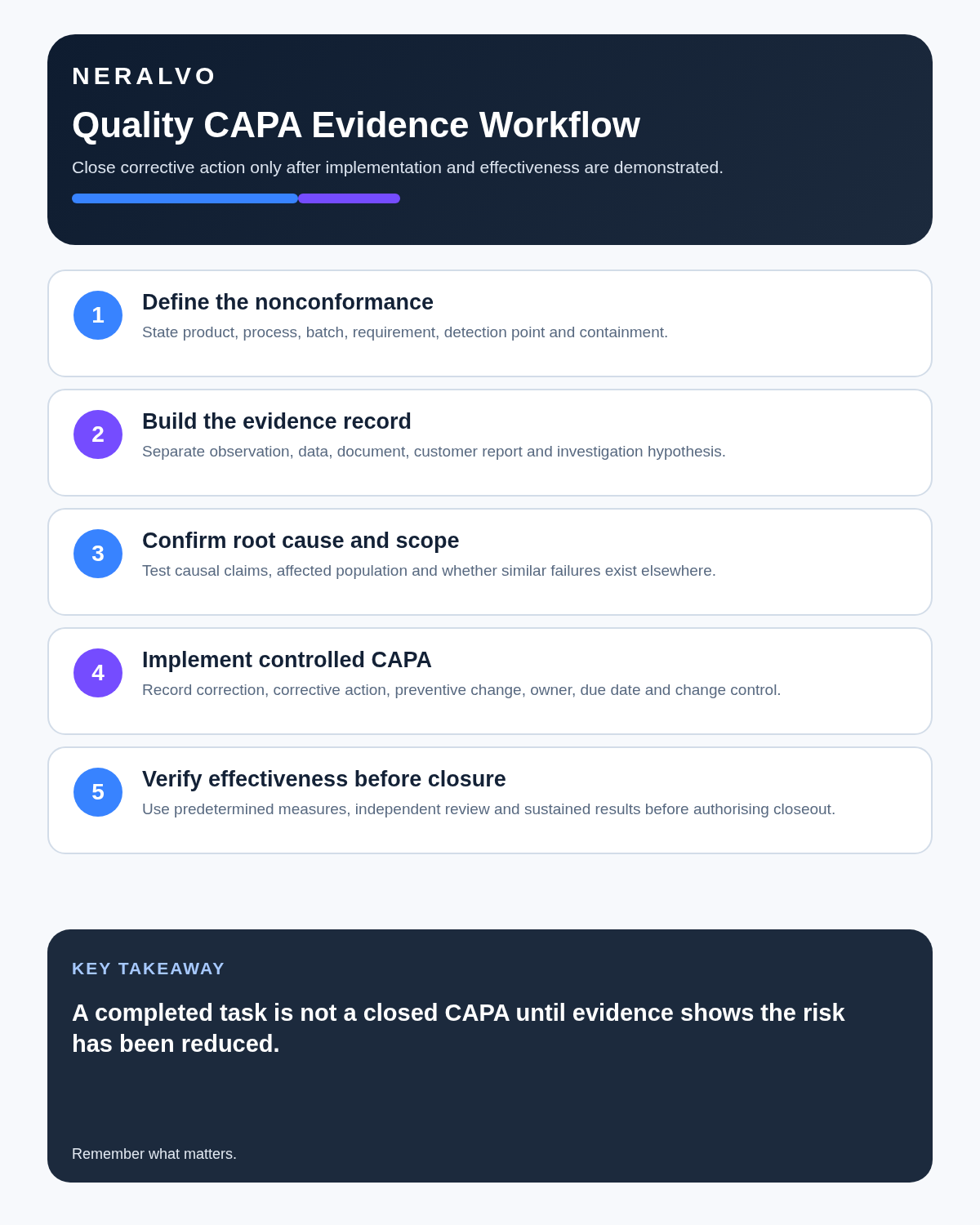
- Define audit or investigation scope and criteria.
- Confirm recording permission and confidentiality.
- Generate and correct the interview transcript.
- Collect independent objective evidence.
- Write the requirement-evidence-gap finding.
- Apply containment and correction where needed.
- Investigate technical, process, human and organisational causes.
- Assess the extent of condition and related exposure.
- Approve action with owner, deadline and intended result.
- Verify implementation.
- Run the pre-defined effectiveness test.
- Close only through the controlled QMS.
Plan the effectiveness test before approving action
Define:
- Sample size and period.
- Performance, defect or compliance measure.
- Process observation or audit method.
- Recurrence threshold.
- Unintended-effect check.
- Baseline or prior performance.
- Review date.
- Person authorised to close.
“No complaints received” may be weak evidence when the problem is not visible to customers.
Control customer-complaint evidence
Separate the customer’s account, product or service record, internal investigation, verified cause, correction, communication and broader corrective action. One complaint may reveal an isolated issue or a wider process weakness; assess scope through evidence rather than repetition alone.
Control supplier-quality discussions
Keep supplier explanation, evidence promised, containment agreed, root-cause claim, formal response, corrective action, verification and disposition authority separate. Confirm material commitments through the approved supplier-quality process.
A fluent supplier presentation does not prove implementation or effectiveness.
Protect audit independence and confidentiality
Explain recording, restrict access and avoid unnecessary personal or commercially sensitive information. Keep source audio and working drafts distinct from approved audit, complaint and CAPA records.
AI must not score honesty, attitude or competence from tone or speaking style.
How NERALVO Halo fits quality management
NERALVO Halo includes NOTE mode, supported CALL mode, 64GB local storage, up to 35 hours of recording and Bluetooth sync with DOWAY. DOWAY can create transcripts, summaries, speaker-separated notes, templates, translations, mind maps and exports, with one year of DOWAY Max included.
It may support approved audit interviews, complaint reviews and CAPA meetings. Halo is not an audit, QMS, document-control, cause-analysis or corrective-action system.
Cloud software, a dedicated recorder or manual notes?
For Quality Managers, the right answer changes with the setting. This matrix deliberately gives each method a situation where it can be the strongest choice.
| Situation | Best starting point | Reason |
|---|---|---|
| scheduled remote client meetings | Cloud meeting software | Calendar automation and shared integrations are usually the strongest advantage. |
| in-person visits and travel | Dedicated recorder | Independent capture reduces reliance on an active phone or laptop. |
| a client declines or policy requires manual notes | Manual notes or an approved alternative | The boundary takes priority over convenience. |
| mixed CRM and field work | Governed hybrid | Use each method only in the setting it actually fits. |
Frequently asked questions
Can an interview statement become objective evidence?
It may be relevant evidence, but material process claims should be verified through suitable observations, records or measurements.
Does completing an action close the CAPA?
No. Implementation and planned effectiveness evidence are separate requirements.
Can AI determine root cause?
No. It can organise evidence and hypotheses, but accountable people must test causation.
Can a supplier presentation prove corrective action?
No. Verify implementation and effectiveness through the approved supplier-quality process.
Final quality checklist
- Scope and requirement identified.
- Statements, observations and records separated.
- Evidence objective and traceable.
- Finding states requirement, evidence and gap.
- Containment and correction distinct from corrective action.
- Cause supported by evidence.
- Extent of condition assessed.
- Actions have owners, dates and intended results.
- Effectiveness test defined before closure.
- Supplier and complaint evidence status controlled.
- Confidentiality and audit independence protected.
- QMS updated and source retention controlled.
Bottom line: AI can reduce audit administration but cannot create objective evidence. Verify the statement, write the gap precisely and close CAPA only after planned effectiveness evidence supports it.
Related guides
See the guides for auditors, inspections and operations managers.
On this page
Related guides
See whether Halo fits this workflow
Review the NERALVO Halo specifications, included services, delivery information and current offer only after completing the guide.
Found an error or an out-of-date claim? Email support@neralvo.com with the article address and a supporting source.