The 60-second verdict
Quick answer: an AI voice recorder can help investment analysts capture authorised management meetings, expert calls and research discussions more accurately. Its value is not automatic judgement; it is a cleaner evidence trail linking each claim to its source, period, assumptions, verification status and effect on the investment thesis.
Best fit: Investment Analysts who need recoverable audio and human-verified notes in an authorised workflow. Use another method when: recording is prohibited, a participant declines or the approved process requires manual notes.
Evidence basis and limits
- Decision factors covered: Enter the meeting with a pre-written thesis; Separate fact, guidance, target and aspiration; Verify every denominator, period and adjustment.
- Evidence rule: The decision is based on the complete capture-to-action workflow, not a single feature or marketing accuracy percentage.
- Boundary: Examples and workflow recommendations must be tested with representative recordings, the intended users and the actual approval process before rollout.

The strongest workflow treats the recording as research input, not research output. Analysts should verify material figures against filings and approved data, preserve contradictory evidence and follow their firm’s information-barrier, market-abuse and retention rules.
Enter the meeting with a pre-written thesis
Before the discussion, record the current thesis, base, upside and downside assumptions, valuation drivers, principal risks, evidence already available and the questions that could materially change conviction.
This reduces the risk of rewriting the thesis around whichever answer was delivered most persuasively.
Use a source-labelled claim ledger
| Field | What to capture |
|---|---|
| Claim | Exact statement or close, checked paraphrase |
| Speaker and context | Who said it and in response to which question |
| Time horizon | Historical, current, next period, medium term or unspecified |
| Status | Fact, run rate, formal guidance, target, aspiration or analyst inference |
| Evidence offered | Metric, example, document or none |
| Verification source | Filing, exchange announcement, approved data, customer, supplier or other source |
| Thesis effect | Supports, weakens, contradicts or does not resolve |
| Follow-up | Specific research action, owner and review date |
Management commentary remains a source with incentives and limits. It does not become verified simply because it was captured accurately.
Separate fact, guidance, target and aspiration
- Reported historical fact: information linked to an approved source.
- Current run rate: a statement about present trading conditions.
- Formal guidance: an authorised forecast range or outlook.
- Management target: an objective the company intends to reach.
- Strategic aspiration: a long-term ambition without a firm delivery commitment.
- Analyst inference: the analyst’s interpretation of available evidence.
- Unresolved claim: a statement that still requires verification.
AI-generated summaries can turn aspiration into forecast and forecast into fact. Preserve the original status explicitly.
Verify every denominator, period and adjustment
For each metric, confirm the exact definition, reporting period, currency or unit, reported or adjusted basis, scope, exclusions, comparison period and whether the figure is audited, estimated or illustrative.
Check percentages, decimals, dates and company-specific terminology against filings, exchange announcements and approved market data. A percentage without a denominator or a metric without a period can be materially misleading.
Maintain a disconfirming-evidence column
After the meeting, ask:
- What evidence would show the thesis is wrong?
- Which answer did not address the central question?
- Which claim conflicts with published or external evidence?
- Which downside scenario remains plausible?
- Which assumption became weaker or more uncertain?
- Which evidence source is still missing?
Do not infer truthfulness, competence or credibility from tone, confidence, accent or speaking style.
Make catalysts conditional
For each proposed catalyst, record the event, expected timing, conditions required, evidence of progress, market expectation already embedded, downside if delayed or absent and the trigger for revisiting the thesis.
A management timetable is evidence of intent, not certainty.
Control expert-network and channel-check research
Record the source’s role, basis of knowledge, period covered, potential bias, sample limitations and what cannot be verified. Keep anecdote separate from representative data.
Follow the firm’s rules for expert networks, restricted information, market-sensitive information and recording. Stop or redirect the discussion where inappropriate information may arise.
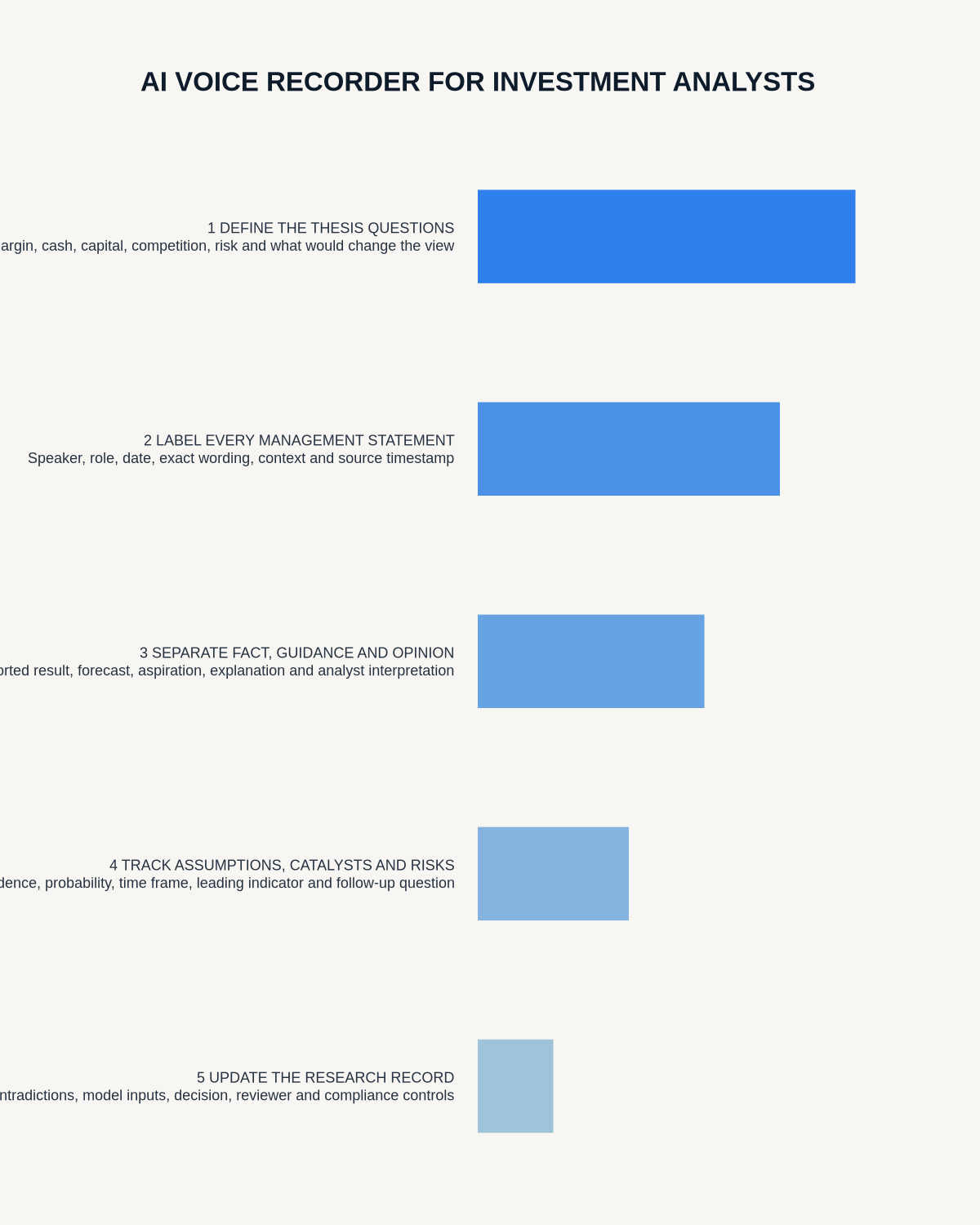
Use a controlled meeting-to-thesis workflow
- Confirm the discussion may be recorded under participant and firm rules.
- State the company, research subject and meeting context.
- Review the pre-written thesis and disconfirming questions.
- Capture claims, figures, qualifications, uncertainty and follow-ups.
- Generate the transcript only in the approved environment.
- Correct names, units, metrics, dates and speaker attribution.
- Update the claim ledger, assumption register and disconfirming-evidence list.
- Verify material points against independent approved sources.
- Revise the thesis, model and risk case through the normal research process.
- Apply information-barrier, access, compliance and retention controls.
Do not publish the transcript as research
Raw discussion may contain unsupported claims, confidential context, incomplete answers and statements requiring compliance review. Produce a source-aware research note and approved investment output instead.
The accountable analyst and firm governance process—not the transcription system—retain responsibility for any buy, sell or hold judgement.
How NERALVO Halo may support authorised research
View Halo specifications for investment analysts use provides portable NOTE recording, supported CALL capture, 64GB local storage and DOWAY transcription and structured-note tools. It may support authorised management meetings, research calls and analyst debriefs.
Investment firms should approve the full recording and processing route, particularly for market-sensitive or restricted information. Test company names, financial figures and multi-speaker calls before relying on the workflow.
Cloud software, a dedicated recorder or manual notes?
For Investment Analysts, the right answer changes with the setting. This matrix deliberately gives each method a situation where it can be the strongest choice.
| Situation | Best starting point | Reason |
|---|---|---|
| scheduled remote meetings | Cloud meeting software | Native remote-meeting workflows can be more efficient here. |
| in-person or mobile work | Dedicated recorder | A separate battery and recoverable local source improve resilience. |
| recording is refused or prohibited | Manual notes or an approved alternative | Manual notes are the correct control when recording is unavailable. |
| mixed online and offline work | Governed hybrid | A hybrid can combine automation with reliable physical capture. |
Frequently asked questions
Can AI assess management credibility?
No. Test claims through filings, data, customers, suppliers and other independent evidence.
Can the transcript be used as the final research note?
No. It may contain unsupported, confidential, incomplete or incorrectly transcribed material.
Can AI recommend buy, sell or hold?
It can organise evidence, but investment judgement remains with the accountable analyst and the firm’s governance process.
Should every management meeting be recorded?
No. Recording must be permitted by participants, firm policy and applicable legal or contractual controls.
Final research-note checklist
- Starting thesis and downside case documented.
- Material claims source-labelled.
- Facts, guidance, targets and aspirations separated.
- Metric definitions, periods and denominators verified.
- Contradictory and disconfirming evidence visible.
- Catalysts stated with conditions and failure cases.
- Expert-call provenance and limitations recorded.
- Independent sources used.
- Information-barrier and retention controls followed.
- Investment decision retained by the accountable process.
Bottom line: an AI voice recorder can help analysts retain more from high-density research conversations, but better investment work still depends on scepticism, independent verification and disciplined separation between access and evidence.
Related guides
See the guides for corporate development, programme managers and fraud analysts.
On this page
Related guides
See whether Halo fits this workflow
Review the NERALVO Halo specifications, included services, delivery information and current offer only after completing the guide.
Found an error or an out-of-date claim? Email support@neralvo.com with the article address and a supporting source.