The 60-second verdict
Quick answer: claims handlers can use an AI voice recorder to preserve an authorised first notification of loss and draft a chronology, but every material fact, identifier, evidence source and commitment must be checked before entering the claim file. AI must not decide coverage, liability, fraud or settlement.
Best fit: Claims Handlers who need recoverable audio and human-verified notes in an authorised workflow. Use another method when: recording is prohibited, a participant declines or the approved process requires manual notes.
Evidence basis and limits
- Decision factors covered: The highest-value use: first notification of loss; Build the chronology before writing the narrative; Use different outputs for different people.
- Evidence rule: Claims are weighted by consequence: capture failure, changed meaning, access and recovery matter more than polished wording.
- Boundary: Examples and workflow recommendations must be tested with representative recordings, the intended users and the actual approval process before rollout.
Claims handlers work with spoken information at the moment it is least organised: a first notification of loss, an upset customer, an incomplete chronology and several parties describing the same event differently. A recorder can preserve that first account and help draft structured notes, but every material fact still needs checking.
The highest-value use: first notification of loss
During FNOL, the handler must listen, reassure, ask targeted questions and document details at the same time. Continuous typing can interrupt rapport and encourage premature conclusions.
A recorder-first workflow can preserve:
- date, time and location of the incident
- people and property involved
- the policyholder’s own description
- immediate damage or injury information
- witnesses and third parties
- emergency action already taken
- documents or photographs expected
- agreed next contact
The transcript should be treated as a source for a checked claim note—not copied blindly into the file.
Build the chronology before writing the narrative
Claims become difficult when events are recorded in the order they were mentioned rather than the order they happened. After the call, extract a simple chronology:
| Time or date | Event | Source | Status |
|---|---|---|---|
| Before incident | Relevant circumstances or prior condition | Policyholder account | To verify |
| Incident | What reportedly happened | Recorded FNOL | Initial account |
| Immediately after | Actions, calls and mitigation | Policyholder or documents | Partially verified |
| Current position | Damage, access and next steps | Handler note | Working status |
This separates spoken recollection from verified evidence and reduces the risk of presenting an allegation as established fact.
Use different outputs for different people
- Internal claim note: facts, uncertainty, actions and evidence gaps.
- Customer update: clear next steps without unnecessary internal commentary.
- Supplier instruction: scope, access, urgency and contact details.
- Handover: current position, outstanding evidence and deadlines.
Templates save time when they match the purpose. They create risk when internal interpretation leaks into customer-facing communication.
What must be checked manually
- policy and claim references
- names, addresses and vehicle registrations
- dates and times
- amounts and excess figures
- who said what
- whether a point is fact, allegation or assumption
- promises about next contact or settlement
AI should not decide coverage, liability, fraud concerns or settlement. It can organise the conversation for the authorised person to review.
A practical FNOL workflow
- Follow the organisation’s approved recording and participant-information process.
- Start with the claim reference and purpose.
- Let the customer give an uninterrupted first account.
- Ask clarifying questions in chronological order.
- End by repeating agreed next steps and timescale.
- Confirm the complete source file.
- Generate a transcript and chronology draft.
- Check critical identifiers, dates and commitments.
- Store the approved note in the claim system.
- Apply the required retention decision to audio and duplicates.
Follow-up calls and changing accounts
A later account may add detail or differ from the first. Do not overwrite the original note. Record new information as a dated update and identify its source.
An AI comparison can highlight changed dates, new witnesses or different descriptions, but the handler must assess significance rather than accepting an automated conclusion.
Evidence calls with suppliers and witnesses
When speaking with repairers, engineers, medical providers or witnesses, separate:
- observed fact
- professional opinion
- estimate
- customer-reported information
- action agreed
This structure makes later review clearer than a general conversation summary.
Where NERALVO Halo fits
Check whether NERALVO Halo fits claims handlers work can provide a separate source recording for approved claim calls, interviews and internal handovers. Its current specification includes 64GB local storage, NOTE and CALL modes, up to 35 hours of recording and Bluetooth transfer to DOWAY.
DOWAY can generate transcripts, summaries, speaker-separated notes, templates, translations and mind maps. CALL mode compatibility varies by phone, operating system and call route. Test the exact claims telephony setup and use only within the insurer’s approved recording and data-handling process.
Claim-note quality check
- Is the initial account clearly attributed?
- Are fact, allegation and assumption separated?
- Does the chronology make sense?
- Are evidence gaps visible?
- Are actions assigned with dates?
- Can important wording be checked against the source?
- Has unnecessary sensitive detail been removed?
Cloud software, a dedicated recorder or manual notes?
For Claims Handlers, the right answer changes with the setting. This matrix deliberately gives each method a situation where it can be the strongest choice.
| Situation | Best starting point | Reason |
|---|---|---|
| scheduled remote meetings | Cloud meeting software | Calendar automation and shared integrations are usually the strongest advantage. |
| in-person or mobile work | Dedicated recorder | Independent capture reduces reliance on an active phone or laptop. |
| recording is refused or prohibited | Manual notes or an approved alternative | The boundary takes priority over convenience. |
| mixed online and offline work | Governed hybrid | Use each method only in the setting it actually fits. |
Related guides
Bottom line: the value of an AI recorder is a faster route from a complex spoken account to a checked chronology, clear evidence gaps and reliable next actions. Human judgement remains responsible for the claim decision.
Profession workflow
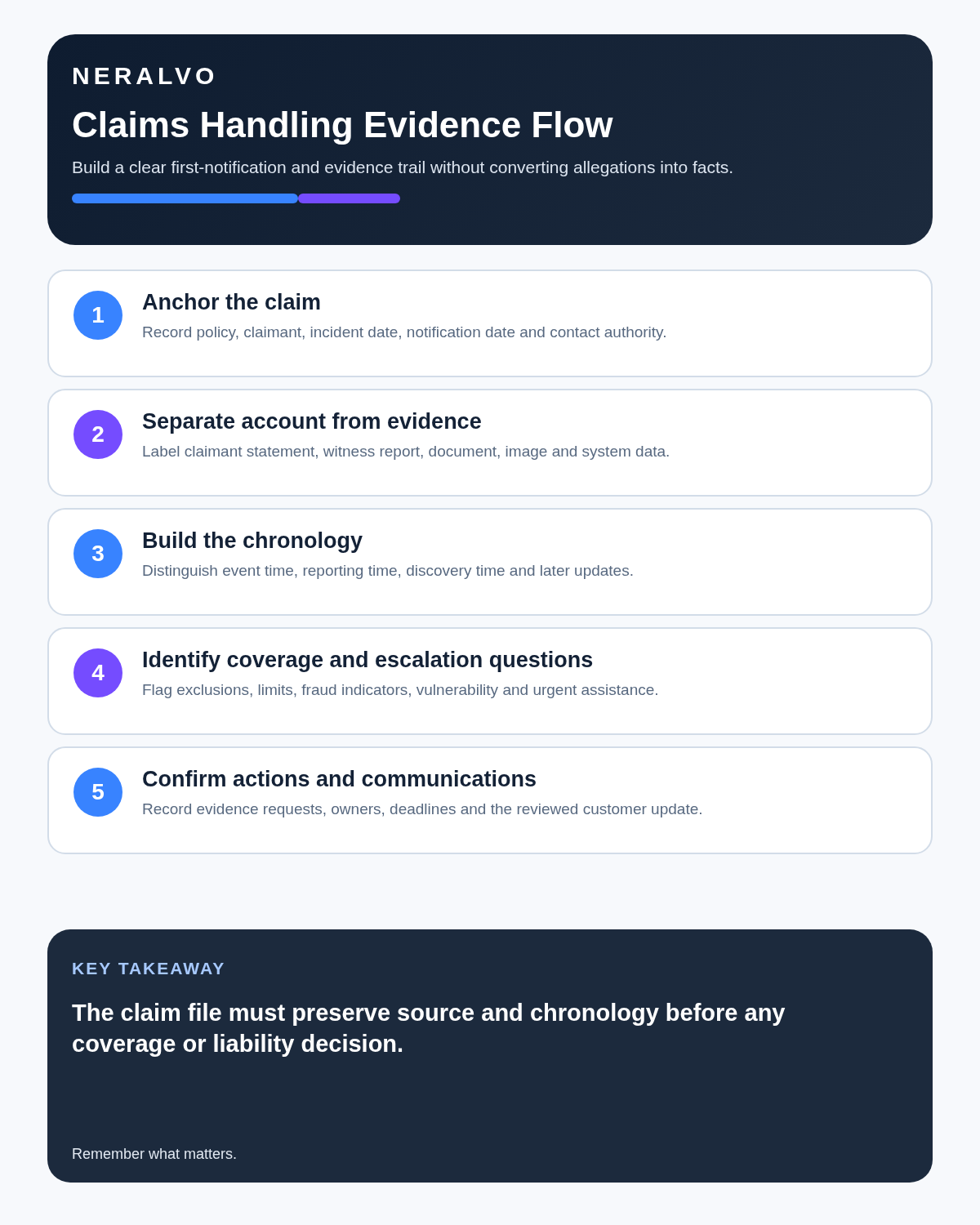
Visual map for AI Voice Recorder for Claims Handlers: Better FNOL Notes and Evidence Trails
- Prepare the approved useDefine purpose, safe position, permission and the required formal record.
- Capture context firstState the case, asset, person, location or event identifier before detail.
- Human-verify evidenceCheck technical terms, units, names, dates, decisions and uncertainty.
- Complete the formal recordTransfer only verified information and apply access and retention controls.
On this page
Related guides
See whether Halo fits this workflow
Review the NERALVO Halo specifications, included services, delivery information and current offer only after completing the guide.
Found an error or an out-of-date claim? Email support@neralvo.com with the article address and a supporting source.