Reviewed and improved: 4 August 2026.
The 60-second verdict
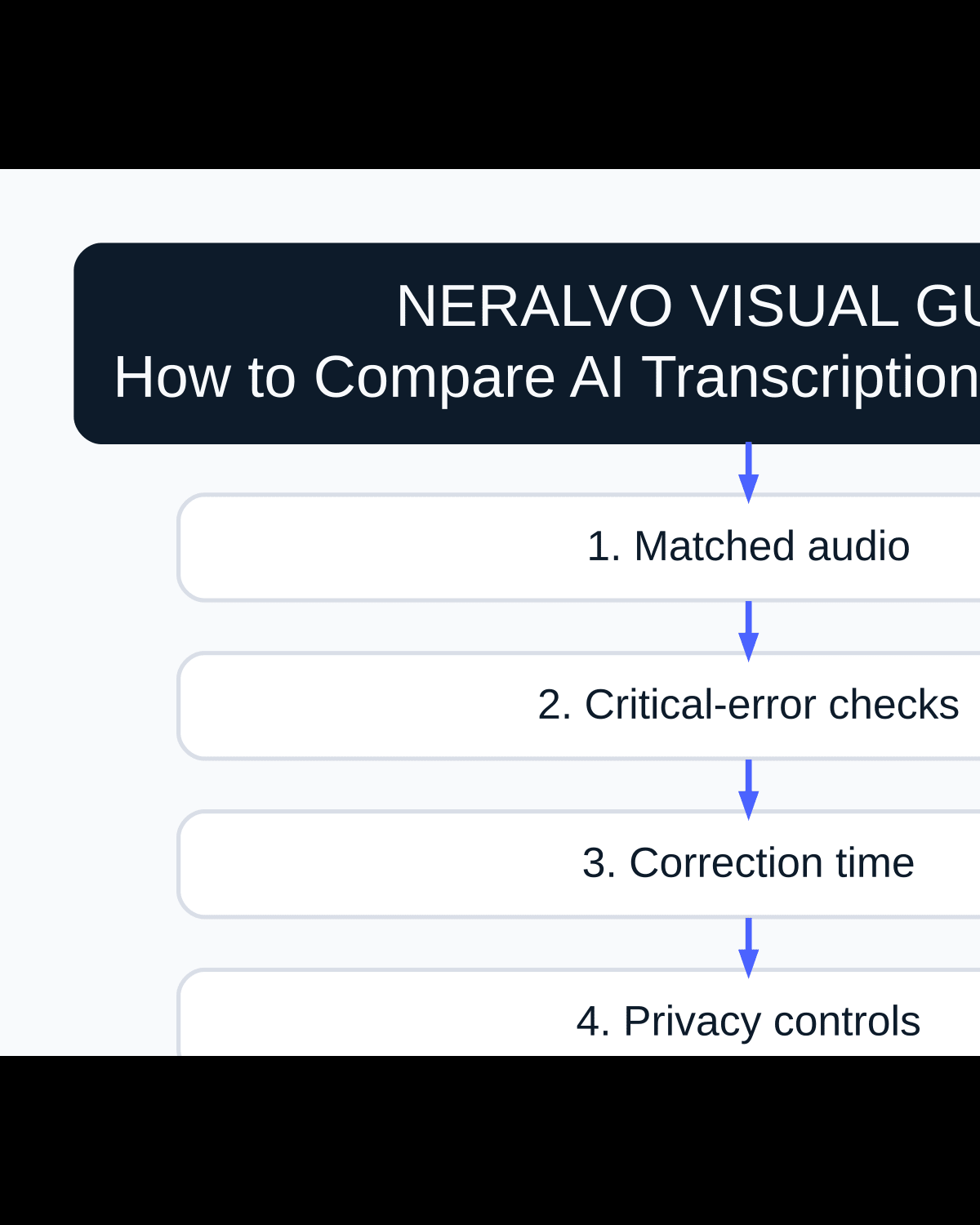
Quick answer: compare AI transcription systems with the same authorised recordings, locked configurations, identical reviewer instructions and one predefined quality threshold. Measure capture reliability, critical-detail accuracy, speaker attribution, correction time, summary faithfulness, exports, privacy controls, recovery and total operating cost. Apply mandatory pass-or-fail gates before calculating any weighted score.
Best fit: choose the option that passes your capture, recovery, privacy and total-cost gates. Do not decide on: price or a single accuracy claim in isolation.
Headline accuracy percentages rarely show which system will perform best in a real organisation. The fair question is not “Which transcript looks most polished?” It is “Which complete workflow produces an approved, usable result for our recordings, people and systems with the least risk and total effort?”
Evidence basis and limits
- Decision factors covered: Define the purchasing or approval decision first; Use a registered benchmark plan; Lock every configuration.
- Evidence rule: A claim earns weight only when the source, date, configuration and limitation are clear enough for a reader to check.
- Boundary: Examples and workflow recommendations must be tested with representative recordings, the intended users and the actual approval process before rollout.
NERALVO sells the Halo AI voice recorder. This guide provides a neutral comparison method and does not assume that Halo or any competing system will win. Test every candidate against the same evidence and approval criteria.

Define the purchasing or approval decision first
Write down exactly what the comparison must decide. Examples include choosing a system for internal meetings, research interviews, customer calls, site visits or personal spoken drafts. Define the approved users, environments, information types, monthly recording volume and expected outputs.
List non-negotiable requirements before reviewing results. These may include recoverable source audio, offline capture, organisation-managed accounts, named export formats, deletion controls, compatible phones, a maximum correction time or an annual cost ceiling. A candidate that fails a mandatory requirement should not win because its ordinary prose looks slightly cleaner.
Use a registered benchmark plan
Before processing any audio, record:
- the decision and intended use;
- candidate systems and exact configurations;
- sample manifest and inclusion rules;
- mandatory gates;
- quality measures and formulas;
- reviewer instructions and stopping rule;
- scoring weights;
- how disagreements will be resolved;
- the rule for failed or missing outputs.
This prevents the test from being redesigned after one candidate appears stronger.
Lock every configuration
Document the product, hardware, phone, operating system, recording mode, microphone placement, application version, language, glossary, speaker settings, subscription tier, processing allowance, summary template, integrations and export format. A material setting change creates a new test configuration and should be labelled separately.
Build a representative source set
Both systems should process the same authorised recordings wherever technically possible. Include the conditions that determine performance in practice:
- quiet one-to-one speech;
- normal multi-speaker meetings;
- room echo and background noise;
- overlapping, quiet and distant speakers;
- names, dates, amounts, percentages and reference numbers;
- specialist terminology and acronyms;
- the accents and languages used by the intended audience;
- short and long recordings;
- offline capture, interrupted transfer and processing failure.
Assign each recording a neutral sample ID. If products require their own hardware capture, recreate the room, seating, agenda, speaker distance and timing as closely as possible and disclose that the sources were matched rather than identical.
Preserve untouched outputs
Save the first transcript, summary, action list and processing log before anybody edits them. Record retries, warnings, failures and manual interventions. Do not rerun only the weaker candidate until it produces a better answer.
Label candidates System A and System B during review where practical. Separate the person administering the test from the person scoring content to reduce brand, price and familiarity bias.
Create a checked reference
Prepare a human-checked reference for the passages that matter. It should preserve decisions, actions, conditions, dissent, quotations and critical details. Mark genuinely unclear or inaudible passages rather than forcing certainty. A system should not be penalised for declining to invent words that a careful reviewer cannot recover.
Measure the complete workflow
Balanced comparison matrix
Balanced decision rule: a cloud tool should win where automation and collaboration matter most; a dedicated recorder should win where independent capture and mobility matter most; manual notes should win when recording is inappropriate.
| Dimension | Measure | Failure to expose |
|---|---|---|
| Capture reliability | Completed and recoverable files ÷ attempted files | Missing or damaged source audio |
| Critical details | Correct names, figures, dates, negations, owners and deadlines | Small errors with large consequences |
| Speaker attribution | Correct, wrong and missing labels | Actions assigned to the wrong person |
| Correction effort | Active minutes to the common quality gate | Hidden labour behind a fast draft |
| Summary faithfulness | Omissions, unsupported additions and changed meaning | Fluent but misleading summaries |
| Recovery | Time and steps required after predictable failures | Unsafe workarounds or lost work |
| Workflow completion | Export, approval, filing and action routing | Outputs trapped in the recording app |
Score critical errors separately
List important fields before review. For each one, record whether it is correct, incorrect, omitted, unsupported or assigned to the wrong speaker. Do not allow hundreds of correct ordinary words to hide a changed amount, removed condition or reversed negative.
Useful formulas include:
- Critical-detail accuracy: correct critical fields ÷ all scorable critical fields.
- Capture success: recoverable completed recordings ÷ attempted recordings.
- Summary omission rate: missing required items ÷ all required items.
- Unsupported-addition rate: unsupported material claims ÷ all material claims.
- Active-effort ratio: active review minutes ÷ source-audio minutes.
Always publish the raw numerator and denominator alongside percentages.
Time correction fairly
Give reviewers the same instructions and stopping rule. The timer should stop only when the transcript reaches the agreed quality standard and is exported or filed in the required destination. Include setup, active listening, text correction, speaker-label repair, terminology checks, quality assurance, routing and later rework.
Report active labour separately from automated processing wait. Rotate review order because a person who hears the same recording twice may complete the second review faster from memory.
Audit summaries as separate products
A strong transcript can still generate a weak summary. Compare each summary with a required-information register containing decisions, actions, owners, deadlines, conditions, risks, dissent and unresolved questions.
- Omission: required information is absent.
- Unsupported addition: the output introduces a claim not supported by the source.
- Changed meaning: a proposal becomes a decision, a condition disappears or an owner changes.
Measure reviewer agreement
Have at least two reviewers independently score a risk-based subset. Record where they agree, where they differ and how disputes are adjudicated. Low agreement may reveal vague rules, an uncertain source or a scoring category that needs clearer definitions.
Test predictable failures and recovery
Include interrupted transfer, weak connectivity, low storage, application restart, expired allowance, failed transcription, lost phone, account removal and supplier cancellation. Record whether the original audio remains available, whether the warning is understandable, whether recovery is authorised and how much time it requires.
Compare privacy and administration
Map the complete data path for each candidate:
- Where is audio created?
- When and where is it transferred?
- Who processes it?
- Who can access audio and text?
- Which copies appear through downloads, backups or integrations?
- How are users and devices removed?
- How is deletion performed and evidenced?
- What remains after cancellation?
Do not award a generic “secure” score from marketing language. Judge whether the tested configuration satisfies the organisation’s real requirements.
Calculate total operating cost
Use the same expected monthly volume. Include hardware, subscriptions, allowances, accessories, correction labour, quality assurance, administration, training, recovery, storage, integrations, replacement devices and renewal costs. A cheaper subscription may become the more expensive workflow when staff spend substantially longer checking and routing its output.
Apply hard gates before weighted scoring
Typical mandatory gates include:
- no unrecoverable source-audio loss;
- critical-error rates within the approved limit;
- required export formats available;
- participant, access and deletion controls approved;
- compatibility with intended devices and environments;
- cost within the approved ceiling.
Only candidates that pass every mandatory gate should receive a weighted score.
Example weighted scorecard
| Criterion | Example weight | Evidence |
|---|---|---|
| Critical-detail accuracy | 30% | Checked field register |
| Correction effort | 20% | Timed review logs |
| Capture and recovery | 15% | Failure test results |
| Summary faithfulness | 15% | Source-to-summary audit |
| Administration and privacy | 10% | Control assessment |
| Total cost | 10% | Volume-based cost model |
Weights should reflect the intended use and must be fixed before final results are calculated. Do not let a strong aggregate score conceal a failed mandatory gate.
Allow different winners by use case
System A may perform best for online meetings while System B performs better in noisy rooms. A defensible outcome may approve different systems for different conditions, require human verification for both or reject both for a high-risk record type.
Where NERALVO Halo fits
Use the How to Compare AI Transcription Systems Fairly criteria to assess NERALVO Halo provides local-first NOTE capture, supported CALL capture, 64GB local storage, up to 35 hours of recording and Bluetooth transfer to DOWAY for transcription and structured outputs. One year of DOWAY Max is included from activation.
These specifications should become test inputs, not assumed conclusions. Compare the exact Halo, phone, application, account and export configuration against every alternative using the same source set, quality gate and cost model.
Write a reproducible comparison report
The final report should include the decision, benchmark plan, system configurations, source manifest, mandatory gates, untouched outputs, checked reference, failure log, critical-detail results, correction times, summary audit, reviewer disagreement, privacy assessment, total cost, approved scope, limitations and retest triggers.
Retest after a material change to hardware, phone compatibility, operating system, application, processing model, subscription plan, export format, account controls or intended use.
Is cloud software or a physical recorder right for this workflow?
- Choose the software-led option when automated remote-meeting capture and collaboration remove more work than they add.
- Choose the dedicated-recorder option when independent in-person capture, mobility and source recovery matter more.
- A governed hybrid can be best when the same team works both online and in person.
How community feedback is used
Public reviews can reveal recurring friction, but an anonymous anecdote is not treated as measured proof. A pull-quote should appear only when it links to the original post, identifies the relevant product version or date and is presented as one user’s experience—not as universal fact.
Frequently asked questions
What is the fairest way to compare transcription accuracy?
Use the same authorised recordings, locked settings and common review standard. Check critical details against the source instead of relying only on a single overall percentage.
Should correction time be included?
Yes. The useful measure is the effort required to produce an approved result, not how quickly a machine generates its first draft.
Can a good transcript create a bad summary?
Yes. Summary generation can omit conditions, add unsupported conclusions or change decision status, so it needs a separate source-based audit.
How many recordings are needed?
Enough to represent the intended environments, speakers, terminology, durations and failure conditions. Report the number of files and audio minutes rather than claiming that one universal sample size fits every use.
Should reviewers know which brand they are scoring?
Not where blinding is practical. Neutral labels can reduce brand and price bias.
Can the highest weighted score still lose?
Yes. A failed mandatory requirement should disqualify a system even when its aggregate score is higher.
Related guides
- How to Measure AI Transcript Correction Time Properly
- How to Audit AI Meeting Summaries for Missing Details
- AI Voice Recorder Acceptance Testing Checklist
Useful resources
Final checklist
- Decision and mandatory requirements defined
- Benchmark plan registered before results
- Configurations locked
- Representative matched audio used
- Untouched outputs preserved
- Critical details and summaries checked separately
- Correction time, failures and recovery measured
- Reviewer agreement assessed
- Privacy, administration and total cost included
- Hard gates applied before weighted scores
- Approval limited to the evidence-supported use
Software-first route
Need Zoom, Teams, calendar or CRM automation?
Choose cloud software for that job. This page completes the software workflow and evidence first. NERALVO Halo remains an optional later route only when offline, in-person or phone-attached capture matters more than native integrations.
On this page
Related guides
Keep the solution aligned with your original intent
- Choose the reviewed cloud software when Zoom, Teams, calendar automation, CRM workflows or unattended bot capture are essential.
- Consider dedicated hardware later only when offline, in-person, mobile or phone-attached capture is the actual requirement.
- Use neither when permission, governance, compatibility or retention requirements cannot be met.
Verify the cloud workflow before comparing hardware
Use the official platform sources below for native Zoom, Teams, calendar, CRM and transcription capabilities. Consider Halo separately only when the workflow also needs offline or in-person capture.
Found an error or an out-of-date claim? Email support@neralvo.com with the article address and a supporting source.