The 60-second verdict
Quick answer: exit an AI transcription supplier without losing records by inventorying every source and derivative file, classifying what must be retained or deleted, rehearsing exports before notice is served, reconciling the migrated data and preserving provenance between audio, transcript, corrections and final records.
Decision focus: use the method below only where it produces a recoverable source, a verifiable output and a clear next action. If one of those fails, change the workflow rather than trusting a polished summary.
Evidence basis and limits
- Decision factors covered: Create a complete exit inventory; Classify what must move, remain or be deleted; Run a portability rehearsal.
- Evidence rule: The decision is based on the complete capture-to-action workflow, not a single feature or marketing accuracy percentage.
- Boundary: Examples and workflow recommendations must be tested with representative recordings, the intended users and the actual approval process before rollout.
A supplier exit planned only when the contract ends is already late. Portability and deletion should be tested before important records depend on the service.

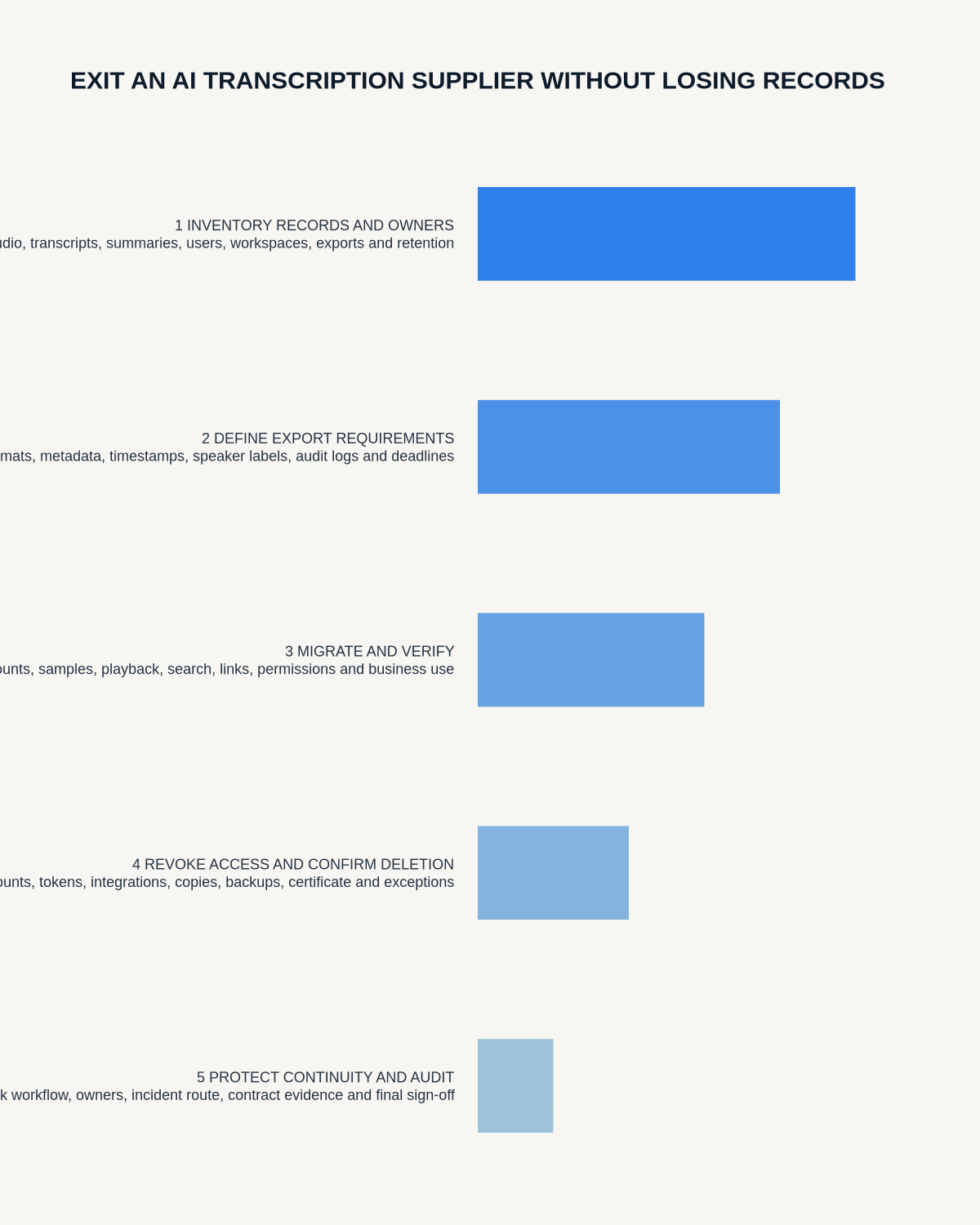
Create a complete exit inventory
- source audio;
- raw and corrected transcripts;
- summaries, templates and mind maps;
- speaker profiles and custom vocabulary;
- account, access and audit logs;
- shared links and integrations;
- backups and subprocessed copies;
- approval status and correction history.
Classify what must move, remain or be deleted
Separate authoritative records, source audio still needed for verification, useful configuration or taxonomy, temporary drafts whose purpose has ended, material under legal hold or special retention, and data that should be deleted rather than migrated.
Run a portability rehearsal
Export a representative sample before notice is served and test whether audio opens in ordinary software, transcripts remain readable, timestamps and speaker labels survive, filenames are useful without exposing excessive data, metadata can be reconstructed and the destination can search and control access.
| Test | Pass condition |
|---|---|
| Audio portability | Files open in approved ordinary software |
| Transcript fidelity | Text, timestamps and speakers remain usable |
| Metadata | Source, owner, status and dates can be reconstructed |
| Access | Destination permissions match approved roles |
Plan the cutover
- Freeze or parallel period: set the final date for new work.
- Export: move approved records and required source files.
- Validate: reconcile counts and open samples.
- Repoint: update integrations, templates and instructions.
- Disable: remove users, links and automated access.
- Delete: obtain supplier-side evidence where required.
Preserve provenance
Keep enough context to show which recording created which transcript, who corrected it and which output was approved. A folder of disconnected files is not a reliable migration.
Reconcile before deletion
Count records by type and status, compare source and destination totals and open a risk-based sample. Resolve missing, corrupt or unreadable items before the supplier account is closed.
Close external access
Revoke links, API keys, service accounts, automations and user sessions. Update support routes and internal instructions so staff do not continue sending data to the old system.
Protect continuity
Define the temporary capture and transcription route during cutover, identify who supports failed exports and retain a rollback decision until the destination has passed validation.
Workflow choice matrix for How to Exit an AI Transcription Supplier Without Losing Records
Choose the method that protects the source and reduces downstream correction. The table makes the non-hardware options explicit.
| Condition | Preferred route | Why |
|---|---|---|
| High-risk or mixed work | Governed hybrid | Separate capture, review, approval and retention rather than trusting one tool. |
| Recording is refused, prohibited or unnecessary | Manual notes / no recording | Respecting the boundary is the correct workflow, not a product failure. |
| In-person, mobile or unreliable-connectivity work | Dedicated recorder | Independent capture and a recoverable local source are usually more resilient. |
| Repeatable remote work with approved integrations | Cloud software | Automation and central collaboration may outweigh device independence. |
Frequently asked questions
Should every file be migrated?
No. Apply purpose, retention and legal-hold rules rather than exporting everything blindly.
What is provenance?
The trace connecting source audio, transcript, corrections, approval and final record.
When can supplier data be deleted?
After required records are exported, validated and controlled in the destination.
Should deletion evidence be requested?
Where required by the organisation's risk, contract or records process, retain suitable supplier evidence and internal approval.
What if speaker labels disappear during export?
Treat that as a portability defect and agree a reconstruction or alternative export route before closing the source service.
Authoritative guidance and related reading
- ICO accountability and governance guidance
- How to Audit AI Voice Recorder Access and Sharing
- How to Offboard Employees Who Used AI Voice Recorders
Final supplier-exit checklist
- Full inventory created
- Retention classes applied
- Portability rehearsed
- Required records reconciled
- Provenance preserved
- Users, links and integrations disabled
- Deletion evidence obtained where required
- Continuity route tested
Related AI voice recorder guides
On this page
Related guides
See whether Halo fits this workflow
Review the NERALVO Halo specifications, included services, delivery information and current offer only after completing the guide.
Found an error or an out-of-date claim? Email support@neralvo.com with the article address and a supporting source.