The 60-second verdict
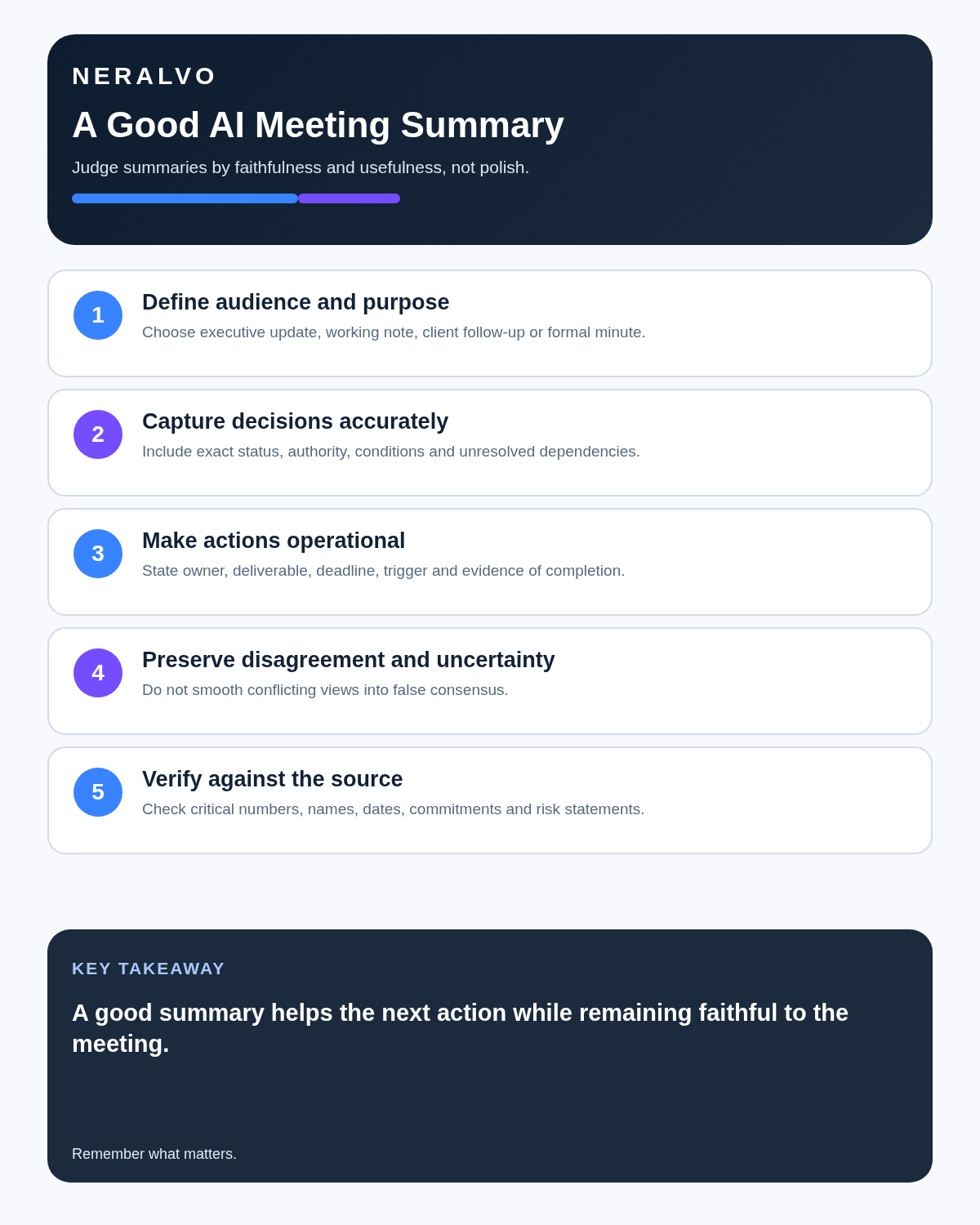
A good AI meeting summary is not a shorter transcript. It is a checked working record that separates decisions, actions, risks and unresolved questions without inventing certainty that was not present in the conversation.
Decision focus: use the method below only where it produces a recoverable source, a verifiable output and a clear next action. If one of those fails, change the workflow rather than trusting a polished summary.
Evidence basis and limits
- Decision factors covered: The six parts of a useful meeting summary; Summary, minutes and transcript are different; The fastest quality check.
- Evidence rule: A claim earns weight only when the source, date, configuration and limitation are clear enough for a reader to check.
- Boundary: Examples and workflow recommendations must be tested with representative recordings, the intended users and the actual approval process before rollout.
The best summaries save people from replaying an hour of audio while still allowing important details to be verified. The worst summaries sound polished but merge speakers, omit conditions and turn suggestions into commitments.
The six parts of a useful meeting summary
- Purpose: why the meeting happened.
- Context: the essential background needed to understand the discussion.
- Decisions: what was actually agreed.
- Actions: task, owner and deadline.
- Risks and blockers: what could prevent progress.
- Open questions: what remains unresolved.
Not every meeting needs all six. A short stand-up may need only actions and blockers. A client discovery call may need objectives, constraints and next steps.
Summary, minutes and transcript are different
| Output | Purpose | Main risk |
|---|---|---|
| Transcript | Detailed searchable representation of speech | Too long and still subject to errors |
| Summary | Condensed understanding for follow-up | Important qualifications may be omitted |
| Minutes | Approved record following an organisation’s convention | AI draft may be mistaken for an official record |
| Action list | Moves agreed work forward | Owner or deadline may be inferred incorrectly |
The fastest quality check
Read only the summary and ask four questions:
- Could someone who missed the meeting understand what changed?
- Can every action be completed without asking who owns it?
- Are decisions clearly separated from ideas and proposals?
- Can a disputed statement be traced back to the transcript or audio?
If any answer is no, the summary is not finished.
Common AI summary errors
Turning discussion into agreement
“We could launch in September” may become “The team agreed to launch in September.” The reviewer must distinguish suggestion, preference and decision.
Dropping conditions
“Proceed if legal approves the revised wording” may be reduced to “Proceed with the revised wording.” The condition is the most important part.
Assigning the wrong owner
Speaker identification errors can attach a task to the person who mentioned it rather than the person who accepted it.
Ignoring uncertainty
A good summary preserves phrases such as “unconfirmed,” “subject to approval” and “requires further testing.” Removing them makes the record look cleaner but less accurate.
Overweighting the final minutes
Models may focus on the end of a meeting and underrepresent an important objection raised earlier.
A reliable review method
- Check the meeting purpose. Remove background that does not help the intended reader.
- Highlight every decision. Confirm it was genuinely agreed.
- Check each action. Verify task, owner and date.
- Search for numbers and names. Compare them with the source.
- Restore conditions and uncertainty. Do not simplify away important limits.
- Remove unnecessary sensitive detail. Keep the final record proportionate to its purpose.
- Mark approval status. Draft, reviewed and approved should not be confused.
Use a template based on meeting type
Client discovery call
- Objectives.
- Current situation.
- Constraints.
- Questions requiring follow-up.
- Agreed next steps.
Project review
- Progress since last review.
- Decisions made.
- Risks and blockers.
- Actions with owners.
- Changes to timeline or scope.
Interview
- Key themes.
- Verified quotations.
- Contradictions or uncertainty.
- Follow-up questions.
- Source timestamps.
Lecture or training
- Learning objectives.
- Main concepts.
- Examples.
- Terms to verify.
- Revision questions.
How long should a summary be?
Length should match purpose, not meeting duration. A 90-minute meeting may produce a one-page action-focused summary, while a 20-minute technical review may require more detail.
Use a layered format when several audiences are involved:
- Three-line executive outcome.
- Decisions and actions.
- Supporting detail.
- Links or timestamps for verification.
A scorecard for AI meeting summaries
| Measure | Pass standard |
|---|---|
| Decision accuracy | No proposal is presented as an agreement |
| Action completeness | Every action has an owner or is marked unassigned |
| Critical details | Names, figures and dates are checked |
| Traceability | Important points can be located in the source |
| Proportion | Unnecessary detail is removed |
| Usefulness | The summary reaches the system or person who needs it |
When not to rely on an AI summary
Do not use an unreviewed summary as the sole record when legal rights, safety, regulated decisions, formal governance or significant financial commitments are involved. AI can assist drafting, but responsibility for the final record remains human.
Where NERALVO Halo fits
Apply this guide before assessing NERALVO Halo captures the source audio and transfers recordings to DOWAY, which can generate summaries alongside transcripts, speaker-separated notes, templates, translations and mind maps.
The current device specification includes 64GB local storage, NOTE and CALL modes and up to 35 hours of recording. CALL mode compatibility varies by phone, operating system and call route, so test the exact setup.
An AI-generated summary should always be checked against the transcript or audio before it is filed or circulated as an important record.
Workflow choice matrix for What Makes a Good AI Meeting Summary? A Quality Framework
Choose the method that protects the source and reduces downstream correction. The table makes the non-hardware options explicit.
| Condition | Preferred route | Why |
|---|---|---|
| Repeatable remote work with approved integrations | Cloud software | Automation and central collaboration may outweigh device independence. |
| In-person, mobile or unreliable-connectivity work | Dedicated recorder | Independent capture and a recoverable local source are usually more resilient. |
| Recording is refused, prohibited or unnecessary | Manual notes / no recording | Respecting the boundary is the correct workflow, not a product failure. |
| High-risk or mixed work | Governed hybrid | Separate capture, review, approval and retention rather than trusting one tool. |
Frequently asked questions
Can an AI summary replace meeting minutes?
It can provide a draft, but formal minutes require the organisation’s normal review and approval process.
Should every summary include the full discussion?
No. Include only the context needed to understand decisions, actions, risks and open questions.
How can hallucinations be reduced?
Use a complete source recording, check the transcript and verify every critical claim. Do not ask the system to fill missing information.
What is the best summary format?
The format should match the meeting’s purpose. Decisions, actions, owners and deadlines are the most useful core for operational meetings.
Related guides
Bottom line
A good AI meeting summary is concise, traceable and honest about uncertainty. It separates decisions from proposals, gives every action an owner and preserves important conditions. Treat AI as the first drafter and the recording as the source for human verification.
Workflow map
Visual map for What Makes a Good AI Meeting Summary? A Quality Framework
- Define the decisionState the question, required output and acceptance rule.
- Capture the sourceUse the approved route and preserve context, identity and limitations.
- Verify material detailsReplay or check names, numbers, negatives, decisions and actions.
- Move into the real recordAssign an owner, retain evidence and apply the deletion rule.
On this page
Related guides
See whether Halo fits this workflow
Review the NERALVO Halo specifications, included services, delivery information and current offer only after completing the guide.
Found an error or an out-of-date claim? Email support@neralvo.com with the article address and a supporting source.