The 60-second verdict
Quick answer: reliable interview transcription with AI depends on the complete workflow from participant information and audio capture to correction, quotation checking and controlled retention. Define the transcript’s purpose before recording, obtain the required agreement, create clear source audio, correct the transcript against the recording and verify every quotation, name, number and material statement before use.
Decision focus: use the method below only where it produces a recoverable source, a verifiable output and a clear next action. If one of those fails, change the workflow rather than trusting a polished summary.

AI can create a fast first transcript from an interview, but fluent text can still contain wrong names, missing negatives, mixed speakers, invented words or altered levels of certainty. A transcript created from Check whether NERALVO Halo fits this workflow should remain a draft until the details that matter to publication, research, recruitment or professional records have been checked.
Evidence basis and limits
- Decision factors covered: Choose the transcript type before the interview; Agree the recording and use terms; Prepare the audio setup.
- Evidence rule: Claims are weighted by consequence: capture failure, changed meaning, access and recovery matter more than polished wording.
- Boundary: Examples and workflow recommendations must be tested with representative recordings, the intended users and the actual approval process before rollout.
Choose the transcript type before the interview
Different uses require different editing rules. If those rules are not decided in advance, reviewers may remove words inconsistently or accidentally change meaning.
| Transcript type | Typical use | Main rule |
|---|---|---|
| Full verbatim | Detailed research, evidence review or linguistic analysis | Preserve repetitions, false starts and relevant non-speech features according to a defined convention |
| Clean verbatim | Professional interviews, internal records and readable archives | Remove distracting speech habits only where meaning and tone remain intact |
| Edited publication transcript | Articles, podcasts and public Q&As | Edit for readability without changing substance, attribution or certainty |
| Summary | Navigation, briefing or follow-up | Treat as a separate derivative document, not a replacement for the checked transcript |
Agree the recording and use terms
Before recording, explain the purpose in language the participant can understand. Depending on the context, clarify:
- Who is conducting the interview.
- Why audio is being recorded.
- Whether the interview is attributable, anonymous, pseudonymous or confidential.
- Who will hear the audio and read the transcript.
- Whether an external transcription or AI processor is involved.
- How quotations, clips or extracts may be used.
- How long audio and working files will be kept.
- How the participant can ask questions, stop or follow the agreed withdrawal process.
Recording permission, permission to quote and permission to publish audio are distinct questions. Do not assume that agreement to one grants all three.
Prepare the audio setup
| Check | Why it matters |
|---|---|
| Environment | Echo, traffic, ventilation and nearby conversations can reduce intelligibility |
| Placement | Both interviewer and participant need usable volume |
| Battery | A long interview should not depend on an untested charge estimate |
| Storage | Confirm sufficient local capacity before starting |
| Device and app | Use only the approved recording and processing route |
| Backup method | Keep structured notes in case audio fails |
| Test recording | Listen to a short sample with the actual room or call setup |
How NERALVO Halo may support interview capture
NERALVO Halo is an ultra-slim, phone-mounted AI voice recorder with NOTE mode for suitable in-person interviews, supported CALL mode for lawful and disclosed phone or social-app interviews, 64GB local storage, up to 35 hours of recording and Bluetooth sync with the DOWAY app. DOWAY can generate transcripts, summaries, speaker-separated notes, templates, translations, mind maps and exports. One year of DOWAY Max is included.
Compatibility varies by phone, app, case and speaker volume. A lawful test using the exact setup should be completed before relying on CALL mode. For studio production, evidential recording or highly sensitive work, specialist equipment or an authorised system may be more appropriate.
Make speech easier to transcribe without scripting the participant
- Ask one question at a time.
- Avoid interrupting or speaking over the participant.
- Confirm unfamiliar names, organisations and specialist terms.
- Repeat critical dates, figures or references where appropriate.
- Use verbal signposts when moving to a new subject.
- Ask what an unclear pronoun or abbreviation refers to.
- Do not finish the participant’s sentence simply to improve the recording.
- Record contextual notes separately when visual behaviour or documents matter.
Create a speaker map
AI speaker labels such as “Speaker 1” and “Speaker 2” should not be accepted blindly. At the beginning, record or note:
- Participant identifier.
- Interviewer and observer roles.
- Any person joining or leaving.
- Whether a quotation is from the participant or repeated from somebody else.
- Changes in microphone or call connection.
Wrong attribution can be more damaging than a misspelled word because it assigns a statement, instruction or opinion to the wrong person.
Use a multi-pass correction method
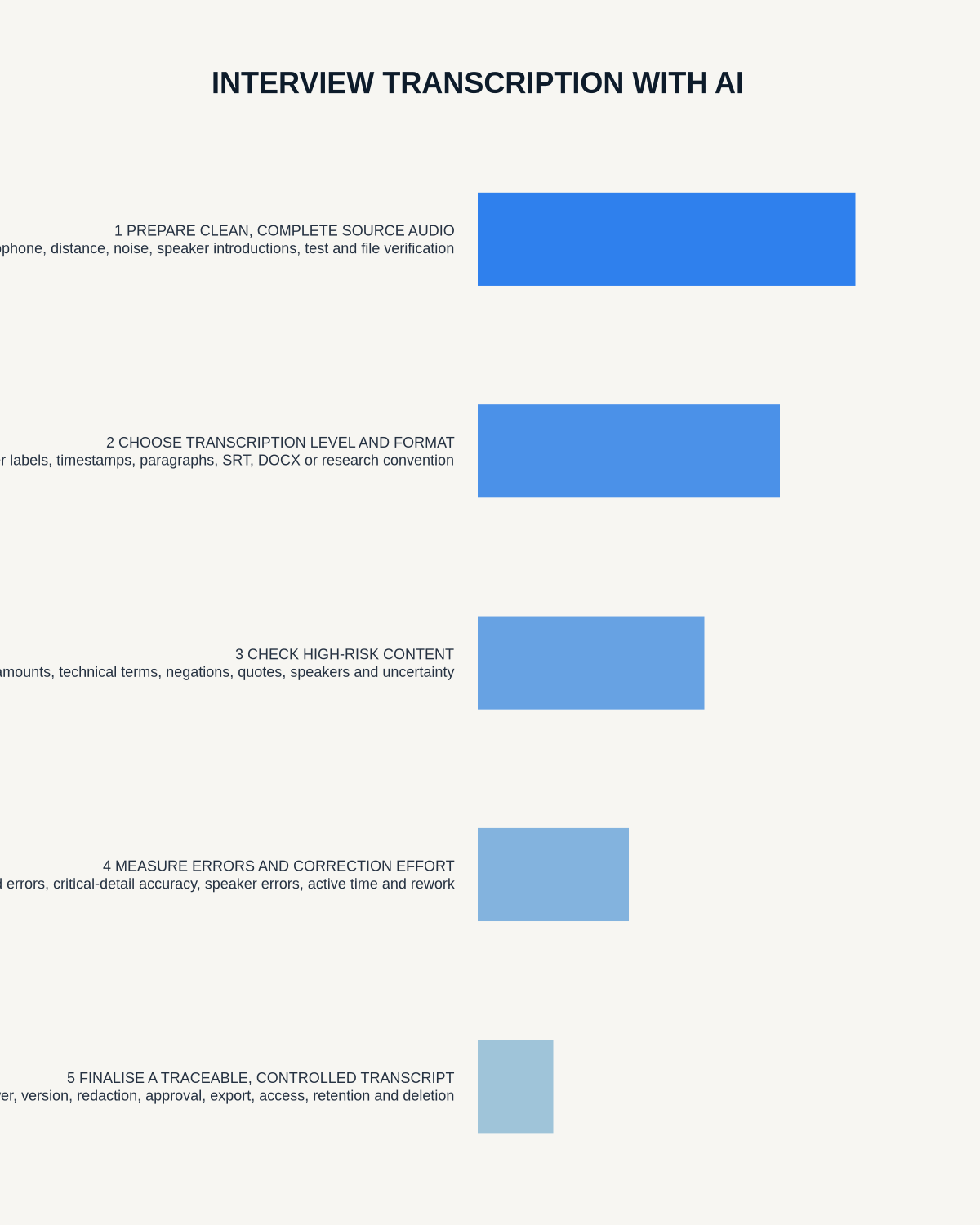
- Structure pass: confirm the file, participant, date, speaker order and major sections.
- Accuracy pass: listen against the audio and correct words, omissions and speaker labels.
- High-risk pass: check names, numbers, dates, currencies, technical terms, negatives and conditional wording.
- Meaning pass: preserve uncertainty, humour, quotation, hesitation or emphasis where it changes interpretation.
- Publication pass: apply only the agreed editing, anonymisation and formatting rules.
- Final verification: check every extract that will be quoted, reported or used in a decision.
Mark uncertainty instead of guessing
Do not silently invent words when the audio is unclear. Use a consistent convention such as:
- [inaudible 00:14:22] where speech cannot be understood.
- [unclear: “fifteen” or “fifty”] where alternatives remain possible.
- [overlapping speech] where attribution cannot be established.
- [name spelling to confirm] where an entity requires verification.
- [laughs] or another non-speech marker only where it helps preserve meaning.
Timestamps make uncertain passages and quotations easier to audit against the audio.
Prioritise high-consequence errors
| Error | Risk | Required response |
|---|---|---|
| Wrong speaker | Misattributes a statement or commitment | Check the audio and speaker map |
| Missing “not” | Reverses meaning | Correct before any summary or use |
| Wrong number or date | Changes evidence, timing or cost | Verify against audio and source documents |
| Guessed specialist term | Creates a plausible but false statement | Check terminology with an authorised source |
| Removed qualification | Makes tentative speech appear certain | Restore conditional wording |
| Incorrect quotation | Misrepresents the participant publicly | Verify word-for-word against audio |
Verify quotations separately
Before publishing or reporting a direct quotation:
- Listen to the complete surrounding passage.
- Confirm the speaker and exact wording.
- Check whether an edit changes tone or meaning.
- Preserve material qualifications.
- Confirm attribution, anonymity and publication terms.
- Check names, claims and statistics independently where required.
- Use ellipses or editorial insertions transparently.
A polished quotation should not make a participant sound more confident, concise or favourable than they were.
Do not confuse anonymity with confidentiality
Removing a name may not prevent identification. A role, location, rare event or combination of details can reveal the participant. Review the transcript for indirect identifiers and keep any identity key separately with stricter access where pseudonyms are used.
Keep the transcript and summary separate
A summary can omit contradiction, minority views and uncertainty. Label files clearly:
- Original audio.
- Raw machine transcript.
- Human-corrected transcript.
- Edited publication transcript.
- AI or human summary.
- Approved final output.
This prevents a shortened derivative document from being mistaken for the source record.
Privacy, security and retention
Interview files may contain personal, confidential or commercially sensitive information. Use approved accounts and processors, restrict access, collect only what the purpose requires and set deletion points for audio, raw transcripts and duplicate exports. The final approved document may have a different retention period from temporary working files.
Weighted transcript QA and release toolkit
Prioritise errors by consequence rather than treating every word equally. A transcript with excellent overall word accuracy can still be unsafe if it changes a speaker, number, negative or condition.
| Error class | Example | Release rule |
|---|---|---|
| Critical meaning error | “Did not approve” becomes “did approve” | Block release and recheck surrounding audio |
| Attribution error | Instruction assigned to the wrong speaker | Resolve or mark speaker unclear |
| Entity error | Wrong person, product, organisation or medicine | Verify against an authoritative source |
| Numeric error | 15 becomes 50 | Check audio and supporting document |
| Qualification loss | “Possibly” removed | Restore the speaker’s uncertainty |
| Cosmetic error | Harmless punctuation difference | Correct according to style |
Five-pass review
- Identity pass: file, participant, date, permissions and completeness.
- Speaker pass: labels, joins, leaves, overlap and quoted third parties.
- Meaning pass: negatives, conditions, uncertainty and chronology.
- Detail pass: names, numbers, dates, terminology and references.
- Release pass: confidentiality, quotation rights, formatting and approved use.
Quotation verification card
Record the quotation, speaker, timestamp, surrounding context, permitted attribution, exact wording check, factual claims requiring separate verification and final editor approval.
Measure quality honestly
Track critical errors per transcript, speaker-label accuracy, high-risk detail corrections, percentage of unclear passages and reviewer time. Do not present one headline “accuracy percentage” without explaining the sample and error definition.
NERALVO Halo workflow
Improve source quality with a short room or call test, suitable placement and clear speaker introductions. After DOWAY generates a draft, preserve the audio, correct the transcript through the multi-pass process and export only the approved version. Halo and DOWAY accelerate capture and navigation; they do not remove the need for review.
Final release gate
- Source and consent record match.
- Speakers and critical details are verified.
- Uncertainty is visible rather than guessed.
- Every public quotation has been checked.
- Personal information is minimised.
- The final version is clearly distinguished from machine drafts.
- Retention and deletion dates are assigned.
Workflow choice matrix for Interview Transcription with AI
Choose the method that protects the source and reduces downstream correction. The table makes the non-hardware options explicit.
| Condition | Preferred route | Why |
|---|---|---|
| Repeatable remote work with approved integrations | Cloud software | Automation and central collaboration may outweigh device independence. |
| In-person, mobile or unreliable-connectivity work | Dedicated recorder | Independent capture and a recoverable local source are usually more resilient. |
| Recording is refused, prohibited or unnecessary | Manual notes / no recording | Respecting the boundary is the correct workflow, not a product failure. |
| High-risk or mixed work | Governed hybrid | Separate capture, review, approval and retention rather than trusting one tool. |
Related guides
- How to Choose an AI Voice Recorder for Transcript Export
- How to Create Accurate Attendance Notes from Client Meetings
- How to Draft Better Case Notes from Recorded Conversations
Final accuracy checklist
- Purpose and transcript type defined.
- Recording and use terms confirmed.
- Audio test completed.
- Speaker labels verified.
- Names and specialist terms checked.
- Numbers, dates and negatives checked.
- Unclear passages marked.
- Quotations checked against audio.
- Anonymisation reviewed.
- Access and retention applied.
Frequently asked questions
How accurate is automatic interview transcription?
There is no universal accuracy rate. Results vary with noise, accent, overlap, vocabulary, distance, connection quality and the type of error being measured. Human review remains necessary.
Can an AI summary replace the transcript?
No. It can help navigation, but it may omit context, contradiction or uncertainty.
Should filler words always be removed?
No. The decision depends on the transcript’s purpose and agreed convention. Editing must not change meaning.
Does a participant need to approve every quotation?
That depends on the agreed editorial, research or contractual process. The use terms should be clear before publication.
Can Halo record an interview without internet access?
Halo stores audio locally and can sync later for app-based processing. The complete security and approval process still matters.
Bottom line: AI provides speed, not automatic authority. Clear terms, usable audio, disciplined correction and quotation verification create a transcript that can be trusted.
On this page
Related guides
See whether Halo fits this workflow
Review the NERALVO Halo specifications, included services, delivery information and current offer only after completing the guide.
Found an error or an out-of-date claim? Email support@neralvo.com with the article address and a supporting source.