The 60-second verdict
Quick answer: build a requirements traceability matrix from workshops by assigning stable IDs, linking each requirement to its source and rationale, recording status and authority, defining measurable acceptance criteria and maintaining links through design, implementation, testing and change control.
Decision focus: use the method below only where it produces a recoverable source, a verifiable output and a clear next action. If one of those fails, change the workflow rather than trusting a polished summary.
Evidence basis and limits
- Decision factors covered: Define the scope and requirement types; Separate workshop statement types; Assign stable identifiers.
- Evidence rule: Claims are weighted by consequence: capture failure, changed meaning, access and recovery matter more than polished wording.
- Boundary: Examples and workflow recommendations must be tested with representative recordings, the intended users and the actual approval process before rollout.
Workshop transcripts contain problems, wishes, assumptions, constraints and decisions together. A traceability matrix prevents unapproved ideas from becoming requirements and exposes approved requirements that have no implementation or test evidence.

Define the scope and requirement types
State the product, service, process or project boundary. Classify functional, non-functional, legal, security, accessibility, data, operational and transition requirements separately where useful.
Separate workshop statement types
- Problem: current pain or unmet outcome.
- Requirement: necessary capability or constraint.
- Preference: desirable but not mandatory.
- Assumption: belief requiring validation.
- Solution idea: possible implementation.
- Decision: approved direction.
- Question: information still needed.
Assign stable identifiers
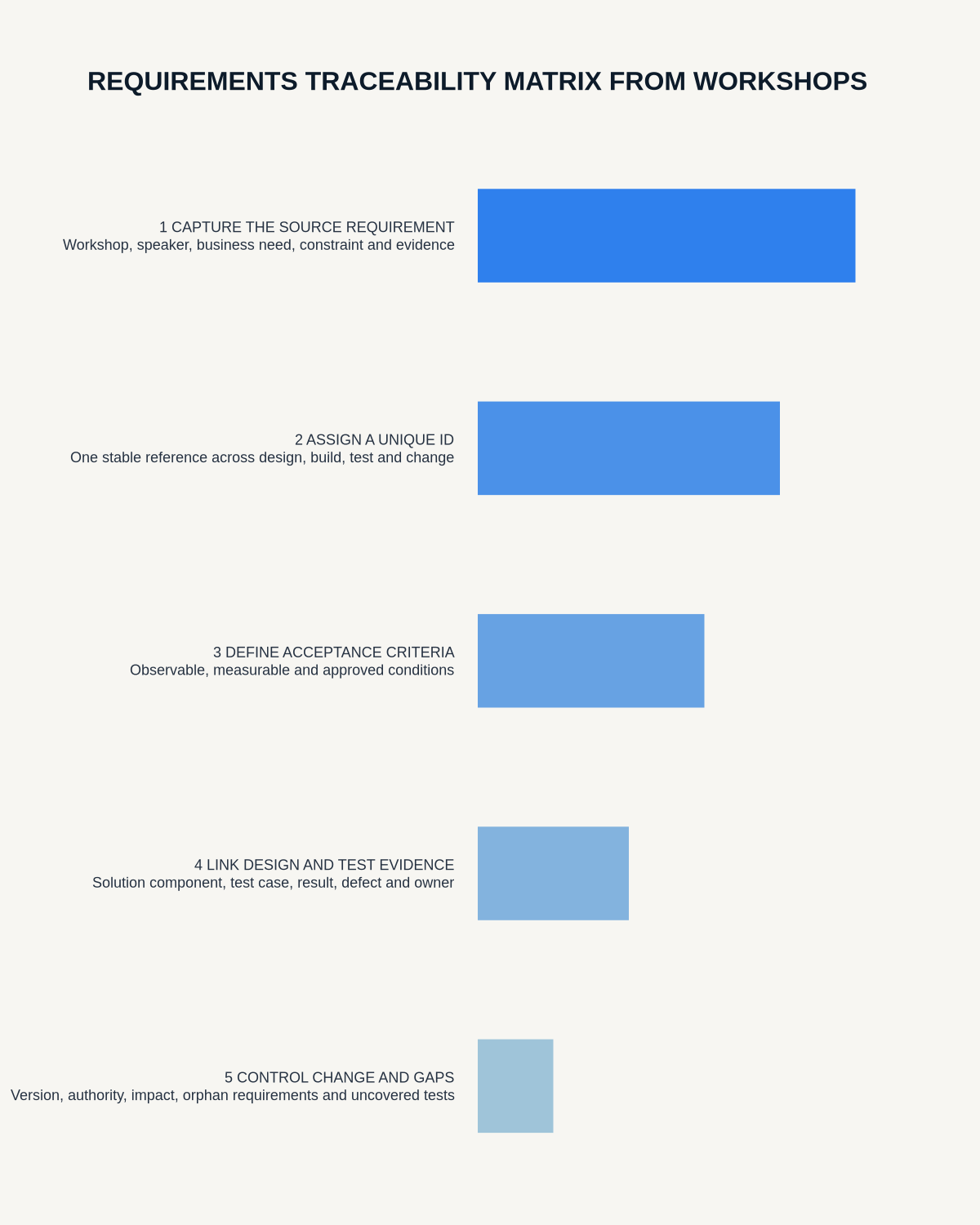
Give each candidate and approved requirement a unique ID that does not change when the wording is clarified. Use the ID across workshop notes, backlog, design, tests, change requests and acceptance evidence.
Use a complete matrix row
- Requirement ID and clear statement
- Source, timestamp and stakeholder
- Rationale and user or business outcome
- Priority and current status
- Authority and approval date
- Dependencies and constraints
- Acceptance criteria
- Design or solution reference
- Implementation item
- Test case and result
- Change history and final disposition
Write measurable requirements
State what the system or process must achieve without embedding an unnecessary solution. Acceptance criteria should be observable, testable and linked to the intended outcome.
Control source and authority
A stakeholder request is not automatically an approved requirement. Record the decision-maker, approval route and any condition. Preserve rejected and deferred items with rationale.
Expose traceability gaps
Look for requirements with no design, implementation or test; tests with no requirement; implemented features with no approved source; and changes that did not update related artefacts.
Integrate change control
When a requirement changes, record the reason, affected dependencies, approval and new tests. Preserve previous versions and link the change request instead of overwriting history silently.
Use workshops as evidence, not final authority
Verify names, figures, terminology and material statements against the audio and supporting documents. Resolve conflicts and missing information through the governance process.
Workflow choice matrix for How to Build a Requirements Traceability Matrix from Workshops
Choose the method that protects the source and reduces downstream correction. The table makes the non-hardware options explicit.
| Condition | Preferred route | Why |
|---|---|---|
| Repeatable remote work with approved integrations | Cloud software | Automation and central collaboration may outweigh device independence. |
| In-person, mobile or unreliable-connectivity work | Dedicated recorder | Independent capture and a recoverable local source are usually more resilient. |
| Recording is refused, prohibited or unnecessary | Manual notes / no recording | Respecting the boundary is the correct workflow, not a product failure. |
| High-risk or mixed work | Governed hybrid | Separate capture, review, approval and retention rather than trusting one tool. |
Frequently asked questions
Should every workshop idea become a requirement?
No. Classify the statement and obtain the appropriate approval.
Can one requirement have several tests?
Yes. Link every necessary test and record the result.
What happens to rejected requirements?
Keep their source, status and rationale so they are not repeatedly reintroduced without context.
Useful resources
- GOV.UK project delivery functional standard
- AI Voice Recorder for Workshops
- How to Draft Change Requests
- How to Build a Decision Audit Trail
Final traceability checklist
- Requirements classified and uniquely identified
- Source and rationale preserved
- Authority and status visible
- Acceptance criteria measurable
- Design, implementation and tests linked
- Changes preserve history
On this page
Related guides
See whether Halo fits this workflow
Review the NERALVO Halo specifications, included services, delivery information and current offer only after completing the guide.
Found an error or an out-of-date claim? Email support@neralvo.com with the article address and a supporting source.