The 60-second verdict
Quick answer: fire investigators can use an authorised AI voice recorder for scene narration, witness interviews and technical debriefs. The record must separate direct observation, supplied information and hypothesis so a provisional idea never becomes an unsupported origin or cause conclusion.
Best fit: Fire Investigators who need recoverable audio and human-verified notes in an authorised workflow. Use another method when: recording is prohibited, a participant declines or the approved process requires manual notes.
Evidence basis and limits
- Decision factors covered: Use a spoken scene slate; Narrate from general to specific; Use three evidence labels.
- Evidence rule: The decision is based on the complete capture-to-action workflow, not a single feature or marketing accuracy percentage.
- Boundary: Examples and workflow recommendations must be tested with representative recordings, the intended users and the actual approval process before rollout.

Fire scenes change as they are made safe and examined. Debris moves, access improves and early explanations are revised. A trustworthy record must show what was observed at each stage, what witnesses reported and how competing hypotheses were treated.
Use a spoken scene slate
State the incident and scene reference, date and time, investigator, location, people present, scene status, safety restrictions and recording purpose. Create a new location and time marker whenever the recording resumes elsewhere.
Narrate from general to specific
- External approach and building context.
- Entry route and condition.
- Room or area sequence.
- Patterns and physical effects.
- Potential ignition sources.
- Fuel and ventilation factors.
- Electrical, mechanical or appliance evidence.
- Photographs, samples and exhibits.
- Limitations and areas not examined.
Use three evidence labels
| Label | Meaning |
|---|---|
| Observation | Condition directly seen or measured |
| Information | Fact or account supplied by another person or record |
| Hypothesis | Possible explanation requiring testing |
Maintain a hypothesis tree
For each credible explanation, record the proposed origin, ignition mechanism, fuel and development account, supporting evidence, inconsistent evidence, tests required, alternatives and current status: active, weakened, excluded or unresolved.
Connect spoken observations to evidence references
Read out photograph and video numbers, sketches, plans, sample and exhibit identifiers, measurement records, documents and specialist examination requests. Repeat identifiers and verify them against the evidence register.
Preserve witness sensory detail and uncertainty
Establish the witness’s location, timing and line of sight. Separate what the person saw, heard, smelled or did from what they thought caused the fire. Record estimates, information learned from others and confidence in timing or wording.
Document scene alteration
Record changes caused by firefighting, rescue, making safe, weather, structural failure, investigative access and removal of exhibits. Where possible, state who made the change, why and when.
Use a source-to-report workflow
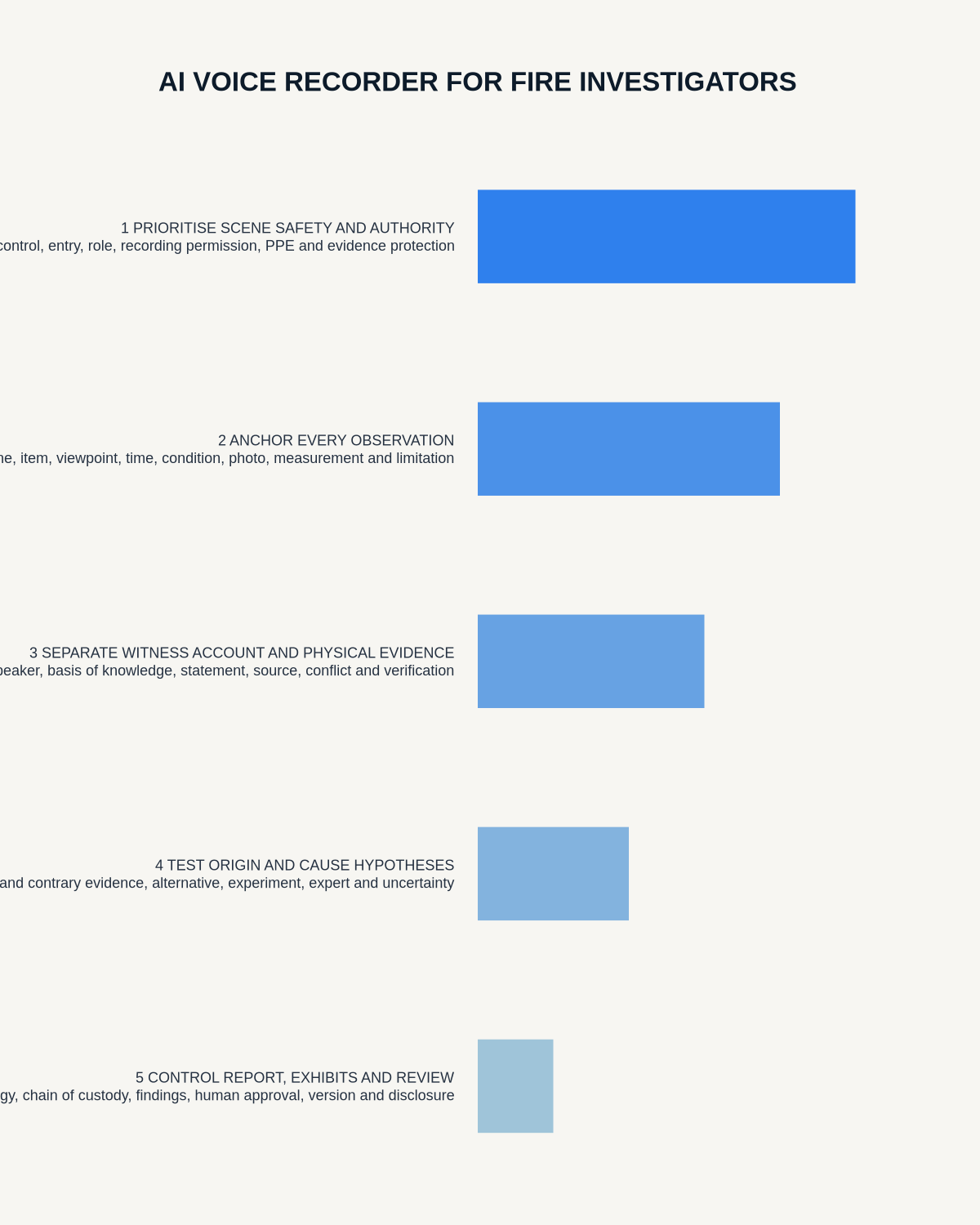
- Confirm recording authority and scene safety.
- Create the scene slate.
- Narrate observation before interpretation.
- Reference evidence identifiers.
- Maintain the hypothesis tree.
- Record limitations and alterations.
- Generate the transcript through the approved route.
- Correct technical terms and identifiers.
- Compare with images, plans, tests and witness material.
- Prepare the formal report with explicit reasoning and uncertainty.
Do not let recording outrun safety
The device must not distract from PPE, structural hazards, contamination controls or scene communication. In unsuitable areas, use brief identifiers and complete a structured debrief in a safe location.
Where NERALVO Halo fits
View Halo specifications for fire investigators use can support approved scene narration, witness interviews and post-scene debriefs with NOTE mode, 64GB local storage and DOWAY transcription. Evidence handling and file naming must be defined before use.
Cloud software, a dedicated recorder or manual notes?
For Fire Investigators, the right answer changes with the setting. This matrix deliberately gives each method a situation where it can be the strongest choice.
| Situation | Best starting point | Reason |
|---|---|---|
| scheduled remote case meetings | Cloud meeting software | Native remote-meeting workflows can be more efficient here. |
| authorised interviews or field discussions | Dedicated recorder | A separate battery and recoverable local source improve resilience. |
| privilege, procedure or an objection prevents recording | Manual notes or an approved alternative | Manual notes are the correct control when recording is unavailable. |
| mixed casework | Governed hybrid | A hybrid can combine automation with reliable physical capture. |
Frequently asked questions
Can AI identify the fire’s origin or cause?
No. It can organise notes, but conclusions require tested evidence and professional methodology.
Should a witness’s interpretation be recorded?
Yes, but separately from direct sensory observation.
Can an exhibit identifier be corrected from context?
No. Verify it against the evidence register.
Should every scene area be recorded?
Only where safe, authorised and useful. Safety and evidence control take priority.
What if a hypothesis changes?
Preserve the earlier status and document the evidence that weakened or excluded it.
Authoritative guidance and related reading
- AI Voice Recorder for Structural Engineers
- AI Voice Recorder for Private Investigators
- AI Voice Recorder for Financial Crime Investigators
Final investigation checklist
- Every recording has a scene slate
- Observation, information and hypothesis are separate
- Evidence identifiers verified
- Alternative hypotheses visible
- Witness interpretation separated from observation
- Scene changes and limitations documented
- Conclusion follows tested evidence
On this page
More in this topic: Property, inspections and investigations
Show 7 closely related guides
- AI Voice Recorder for Building Control Inspectors: Better Site Evidence and Clearer Decisions
- AI Voice Recorder for Domestic Energy Assessors: Better Survey Evidence and Data Provenance
- AI Voice Recorder for Property Developers: Better Decision Logs and Project Handover
- AI Voice Recorder for Auctioneers: Better Lot Notes, Provenance and Seller Instructions
- AI Voice Recorder for Private Investigators: Better Interviews, Chronologies and Evidence Control
- AI Voice Recorder for Fire Risk Assessors: Better Evidence, Actions and Review
- AI Voice Recorder for Loss Adjusters: Better Site Evidence and Damage Notes
Related guides
See whether Halo fits this workflow
Review the NERALVO Halo specifications, included services, delivery information and current offer only after completing the guide.
Found an error or an out-of-date claim? Email support@neralvo.com with the article address and a supporting source.