The 60-second verdict
Private-investigation files often depend on small details: a route, a time, a description, an exact phrase or the difference between what was observed and what was inferred. Those details can lose value quickly when they are reconstructed from memory hours later.
Best fit: Private Investigators who need recoverable audio and human-verified notes in an authorised workflow. Use another method when: recording is prohibited, a participant declines or the approved process requires manual notes.
Evidence basis and limits
- Decision factors covered: Begin with an authority gate; Use the recorder after an observation, not as a substitute for observation; The observation–inference split.
- Evidence rule: Claims are weighted by consequence: capture failure, changed meaning, access and recovery matter more than polished wording.
- Boundary: Examples and workflow recommendations must be tested with representative recordings, the intended users and the actual approval process before rollout.
An AI voice recorder for private investigators can support authorised interviews and prompt post-observation dictation. The device does not create permission to record, enter a location, capture a private conversation or collect personal data. Legality, client authority, necessity and proportionality must be assessed before capture begins.
Begin with an authority gate
Before using any recorder, answer four questions:
- Client authority: does the instruction legitimately cover this work?
- Legal authority: is the proposed recording or collection method permitted in the setting?
- Operational necessity: is audio needed, or would a written note achieve the purpose with less intrusion?
- Evidence plan: how will the source file, transcript, corrections and final report be controlled?
If any answer is unclear, do not record until the position has been resolved through the investigator’s approved process.
Use the recorder after an observation, not as a substitute for observation
During field work, attention should remain on lawful, safe observation and accurate contemporaneous timing. Operating a device can distract the investigator or create unnecessary collection.
A structured debrief made immediately after the observation can capture:
- case and task reference
- date and exact time range
- location and viewing position
- weather, lighting and visibility
- people, vehicles or objects observed
- sequence of events
- photograph or video references
- limitations and breaks in observation
- facts requiring verification
The observation–inference split
Observation: “At 15:42 the individual entered the east entrance carrying a black hard-sided case.”
Inference: “The case may have contained work equipment.”
The first is a direct observation. The second is a hypothesis. AI summaries may merge them into “the individual delivered equipment”, which is not supported by the observation alone.
Use explicit verbal markers:
- observed
- heard directly
- reported by
- appeared to
- could not confirm
- working hypothesis
- to verify
Build chronology from anchored events
A useful chronology does not merely list sentences in transcript order. Each event should contain an anchor:
| Field | Required detail |
|---|---|
| Time | Clock source and exact or approximate status |
| Location | Address, public place, route or observation point |
| Event | Neutral description of what occurred |
| Source | Direct observation, interview, document or other evidence |
| Media link | Photograph, video or exhibit reference |
| Limitation | Obstruction, distance, lost sight or uncertainty |
| Next check | Document, witness or record needed |
Where timing is approximate, keep it approximate. Do not allow transcription software to create false precision.
Authorised interviews require source discipline
Where an interview is permitted and the participant process has been followed, establish:
- the interviewee’s identity and connection to the matter
- which events they experienced directly
- which information came from another person
- documents, messages or photographs they mention
- areas of uncertainty
- corrections made during the interview
- any follow-up evidence promised
Ask open questions before testing detail. Do not use AI to assess truthfulness from confidence, emotion, accent or hesitation.
Preserve the original source and document changes
If the recording forms part of the evidential or case material, maintain a clear chain:
- create a unique file reference
- preserve the original audio and metadata as required
- create a working copy for transcription
- record the transcription service and date
- correct names, dates and material wording against the audio
- document redactions or edits
- link the checked transcript to the source file
- produce the final report from reviewed evidence
Do not overwrite the only source file or silently change a transcript in a way that hides material context.
Report language should reveal evidence strength
Use wording that shows how the investigator knows the point:
- “I observed…”
- “The interviewee stated…”
- “The document records…”
- “The available material did not establish…”
- “This remains to be verified…”
A report should not borrow certainty from an AI-generated sentence. Conclusions must follow the evidence and the investigator’s professional review.
Minimise unrelated personal data
Field recordings and interviews may capture bystanders, family information, addresses and conversations unrelated to the instruction. Collect only what is necessary and relevant. Restrict access, control exports and apply the organisation’s retention and deletion process.
Where direct audio capture would collect excessive third-party information, use a factual post-event note instead.
A practical recording workflow
- Complete the authority and necessity check.
- Choose direct recording or post-event dictation based on the setting.
- State the case, task and time source.
- Separate observation, report and inference aloud.
- Reference photographs, video and documents.
- Record interruptions and limitations.
- Generate the transcript through the approved route.
- Correct material details and speaker attribution.
- Build the chronology and evidence index.
- Prepare the final report with source-labelled conclusions.
How NERALVO Halo may support approved investigations
Check whether NERALVO Halo fits private investigators work provides portable NOTE recording, supported CALL capture, 64GB local storage and DOWAY transcription tools. It may support authorised interviews, private post-observation dictation and case debriefs.
Its compact design does not create authority for covert or intrusive use. Practices should approve the situations in which recording is permitted, the data path and the evidence-handling process. Investigators working on financial matters may also use the related financial crime investigator guide.
Evidence-quality review
- Was the recording lawful, necessary and within instruction?
- Are direct observations separated from inference?
- Can each event be tied to time, location and source?
- Are limitations and gaps visible?
- Are original audio and transcript versions controlled?
- Has unrelated personal information been minimised?
- Do conclusions reflect reviewed evidence rather than AI confidence?
An AI voice recorder can reduce memory loss and improve chronology in an authorised investigation. The trustworthy result comes from lawful collection, neutral language, source control and a report that never claims more than the evidence establishes.
Cloud software, a dedicated recorder or manual notes?
For Private Investigators, the right answer changes with the setting. This matrix deliberately gives each method a situation where it can be the strongest choice.
| Situation | Best starting point | Reason |
|---|---|---|
| scheduled remote case meetings | Cloud meeting software | Calendar automation and shared integrations are usually the strongest advantage. |
| authorised interviews or field discussions | Dedicated recorder | Independent capture reduces reliance on an active phone or laptop. |
| privilege, procedure or an objection prevents recording | Manual notes or an approved alternative | The boundary takes priority over convenience. |
| mixed casework | Governed hybrid | Use each method only in the setting it actually fits. |
Related guides
Profession workflow
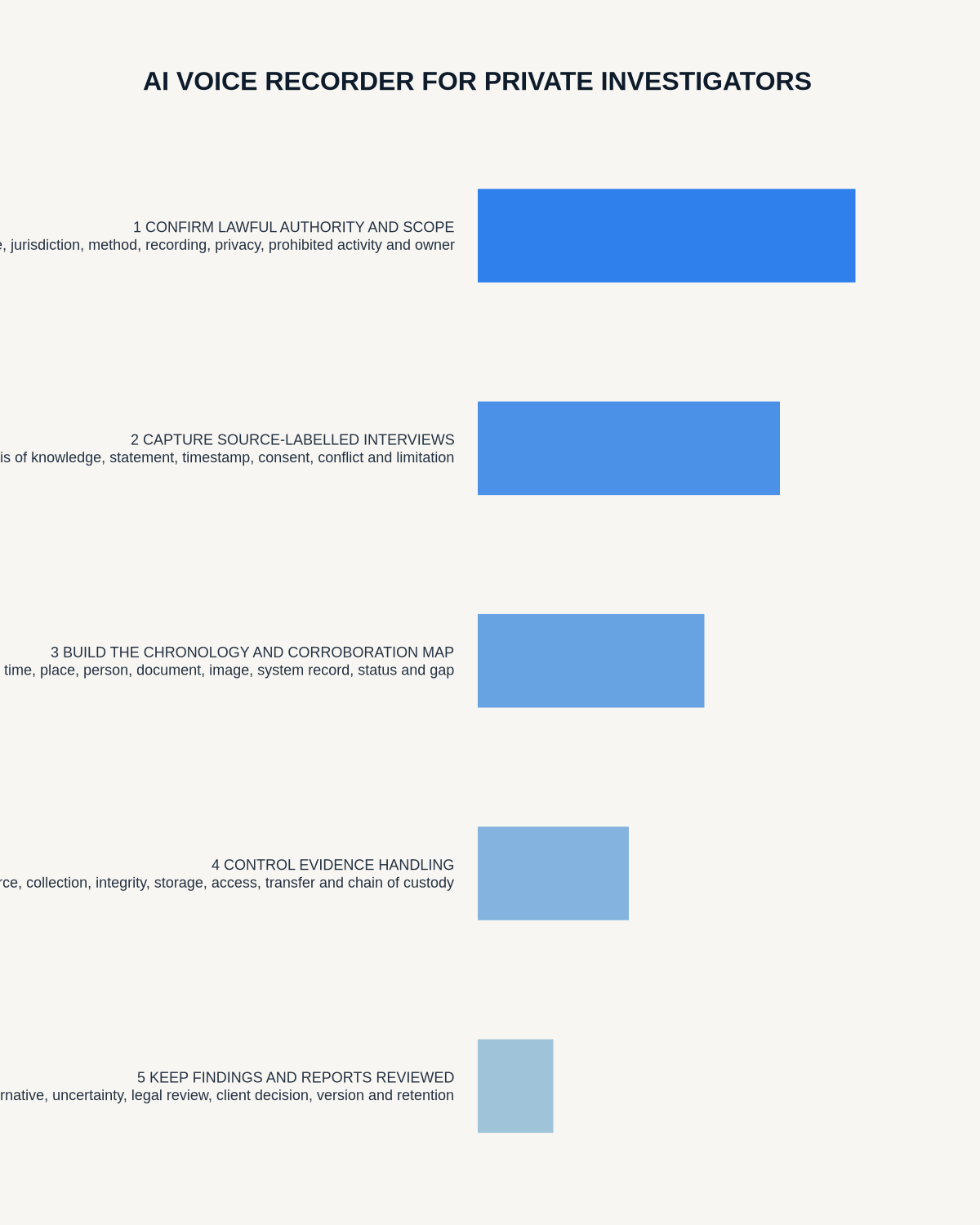
Visual map for AI Voice Recorder for Private Investigators: Better Interviews, Chronologies and Evidence Control
- Prepare the approved useDefine purpose, safe position, permission and the required formal record.
- Capture context firstState the case, asset, person, location or event identifier before detail.
- Human-verify evidenceCheck technical terms, units, names, dates, decisions and uncertainty.
- Complete the formal recordTransfer only verified information and apply access and retention controls.
On this page
More in this topic: Property, inspections and investigations
Show 7 closely related guides
- AI Voice Recorder for Fire Investigators: Stronger Scene Notes, Interviews and Evidence
- AI Voice Recorder for Building Control Inspectors: Better Site Evidence and Clearer Decisions
- AI Voice Recorder for Domestic Energy Assessors: Better Survey Evidence and Data Provenance
- AI Voice Recorder for Property Developers: Better Decision Logs and Project Handover
- AI Voice Recorder for Auctioneers: Better Lot Notes, Provenance and Seller Instructions
- AI Voice Recorder for Fire Risk Assessors: Better Evidence, Actions and Review
- AI Voice Recorder for Loss Adjusters: Better Site Evidence and Damage Notes
Related guides
See whether Halo fits this workflow
Review the NERALVO Halo specifications, included services, delivery information and current offer only after completing the guide.
Found an error or an out-of-date claim? Email support@neralvo.com with the article address and a supporting source.