The 60-second verdict
Quick answer: create a lessons-learned report by linking each lesson to the expected outcome, actual result, supporting evidence, contributing conditions, applicability and a specific system change. A lesson is not complete until the change is embedded and its effectiveness reviewed.
Decision focus: use the method below only where it produces a recoverable source, a verifiable output and a clear next action. If one of those fails, change the workflow rather than trusting a polished summary.
Evidence basis and limits
- Decision factors covered: Define the learning scope; Collect evidence across the lifecycle; Use a structured lesson record.
- Evidence rule: Claims are weighted by consequence: capture failure, changed meaning, access and recovery matter more than polished wording.
- Boundary: Examples and workflow recommendations must be tested with representative recordings, the intended users and the actual approval process before rollout.
A useful lessons-learned report shows future teams what to repeat, change or test. It should not merely collect frustrations or use hindsight to blame people for decisions made with limited information.

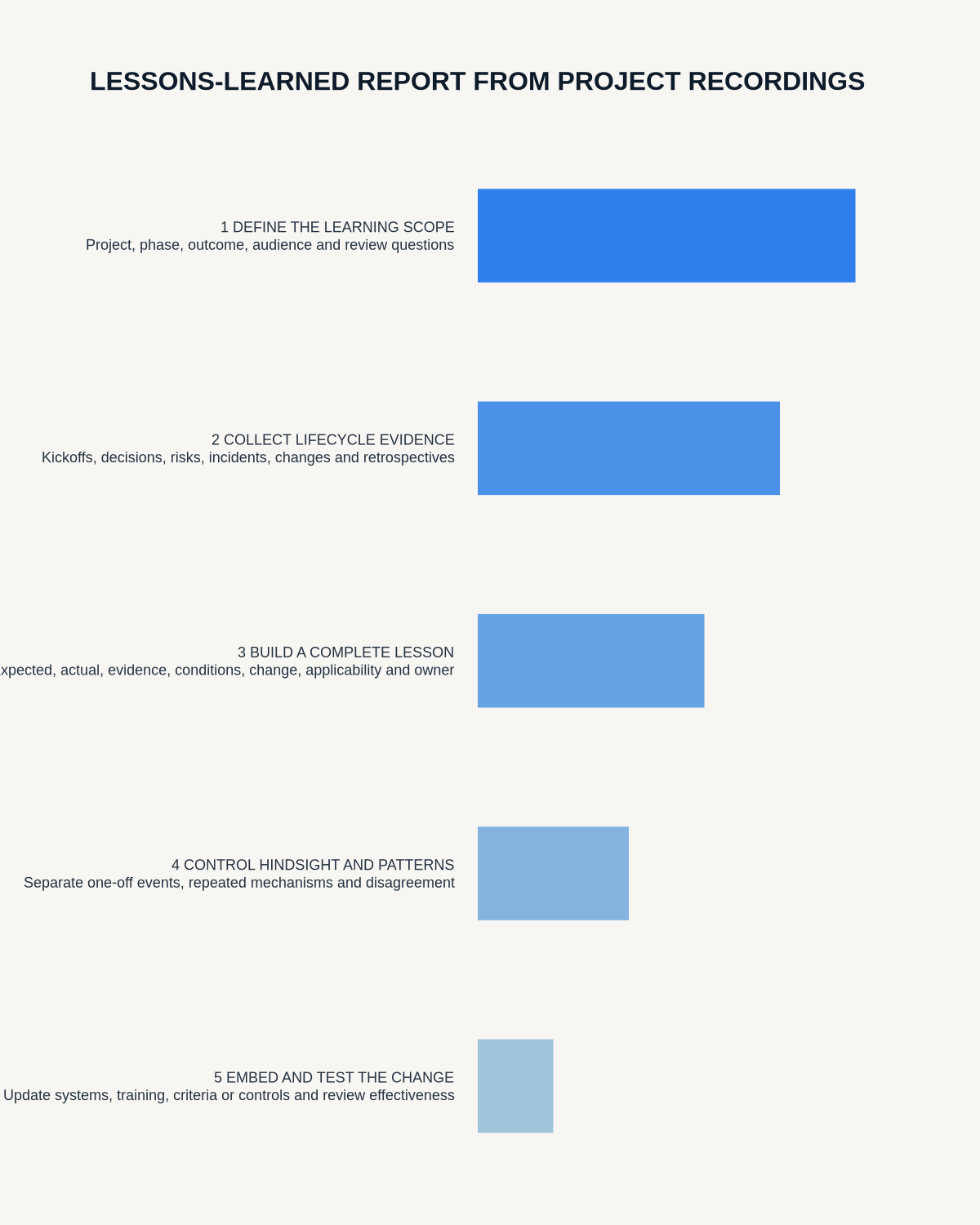
Define the learning scope
State the project, phase, outcome and audience. Decide whether the review covers delivery, governance, suppliers, customer impact, technical design, change control or another defined area.
Collect evidence across the lifecycle
Use kickoffs, decision meetings, risk reviews, incidents, change records, delivery data and retrospectives. Record source, project stage, date and access status. Do not rely only on the final retrospective, where memory is influenced by the outcome.
Use a structured lesson record
- Expected outcome: what the plan intended.
- Actual result: what occurred.
- Evidence: source and project context.
- Contributing conditions: factors influencing the result.
- What worked: practice worth repeating.
- What should change: specific improvement.
- Applicability: where the lesson does and does not apply.
- Owner: person responsible for embedding change.
Control hindsight and blame
Ask what information, authority, resources and constraints existed when the decision was made. Separate weak process from an unfavourable outcome that could not reasonably have been predicted.
Separate one-off events from patterns
One unusual supplier or incident may not justify a universal rule. Record frequency, conditions and confidence. Where several sources show the same mechanism, show the evidence rather than relying on repetition alone.
Preserve disagreement
Different teams may draw different lessons from the same event. Record the material views, evidence and final governance decision. Do not allow the summary to manufacture consensus.
Turn learning into a system change
- Template or checklist update
- Training or competence assessment
- Decision criterion or approval gate
- Contract or supplier control
- System configuration
- Risk indicator or audit test
- Future exercise or review
Define completion evidence and an effectiveness-review date. Publishing the report is not implementation.
Validate with affected teams
Share the draft with people who experienced the process and those expected to use the lesson. Correct factual errors, add missing limitations and confirm that the proposed change is practical.
Workflow choice matrix for How to Create a Lessons-Learned Report from Project Recordings
Choose the method that protects the source and reduces downstream correction. The table makes the non-hardware options explicit.
| Condition | Preferred route | Why |
|---|---|---|
| Repeatable remote work with approved integrations | Cloud software | Automation and central collaboration may outweigh device independence. |
| In-person, mobile or unreliable-connectivity work | Dedicated recorder | Independent capture and a recoverable local source are usually more resilient. |
| Recording is refused, prohibited or unnecessary | Manual notes / no recording | Respecting the boundary is the correct workflow, not a product failure. |
| High-risk or mixed work | Governed hybrid | Separate capture, review, approval and retention rather than trusting one tool. |
Frequently asked questions
Should lessons focus only on failures?
No. Practices that produced good outcomes should also be identified and repeated.
Can AI decide the root cause?
No. It can organise evidence and views, but root-cause conclusions require human review.
When is a lesson complete?
When the improvement is embedded and its effectiveness checked.
Useful resources
- Association for Project Management lessons-learned guidance
- How to Build an Incident Chronology
- How to Create a Benefits Map
- How to Create an Issue Log
Final report checklist
- Every lesson tied to evidence and context
- Hindsight and blame controlled
- One-off events separated from patterns
- Disagreement visible
- Improvement has mechanism and owner
- Effectiveness review scheduled
On this page
Related guides
See whether Halo fits this workflow
Review the NERALVO Halo specifications, included services, delivery information and current offer only after completing the guide.
Found an error or an out-of-date claim? Email support@neralvo.com with the article address and a supporting source.