The 60-second verdict
Quick answer: barristers can use a private post-hearing voice note to preserve urgent memory after leaving any restricted setting, but they must not record court proceedings without authority. Recollection must remain clearly labelled and be verified against the official order, attendance note and case documents.
Best fit: Barristers who need recoverable audio and human-verified notes in an authorised workflow. Use another method when: recording is prohibited, a participant declines or the approved process requires manual notes.
Evidence basis and limits
- Decision factors covered: The absolute courtroom boundary; Why the first minutes after a hearing matter; The exit → anchor → recall → prioritise → verify → file workflow.
- Evidence rule: A claim earns weight only when the source, date, configuration and limitation are clear enough for a reader to check.
- Boundary: Examples and workflow recommendations must be tested with representative recordings, the intended users and the actual approval process before rollout.

The absolute courtroom boundary
Unauthorised audio recording of court proceedings is prohibited and can amount to contempt. The same risk applies to remote proceedings: access to a live link does not create permission to record it.
Disable automatic recording and meeting-assistant features before joining a hearing. Do not rely on muting, minimising or placing a device face down. Use the current judiciary contempt-of-court guidance and the exact rules and directions applying to the relevant court or tribunal.
Assess Halo against the barristers workflow matrix can support authorised private dictation after the hearing. Firm or chambers policy, court rules, privilege and matter security govern the workflow.
Why the first minutes after a hearing matter
Orders, undertakings, reasons, concessions and deadlines can be numerous and time-sensitive. Waiting until the end of the day increases reconstruction risk. The solution is not unauthorised courtroom recording; it is a disciplined memory note made in a private permitted location.
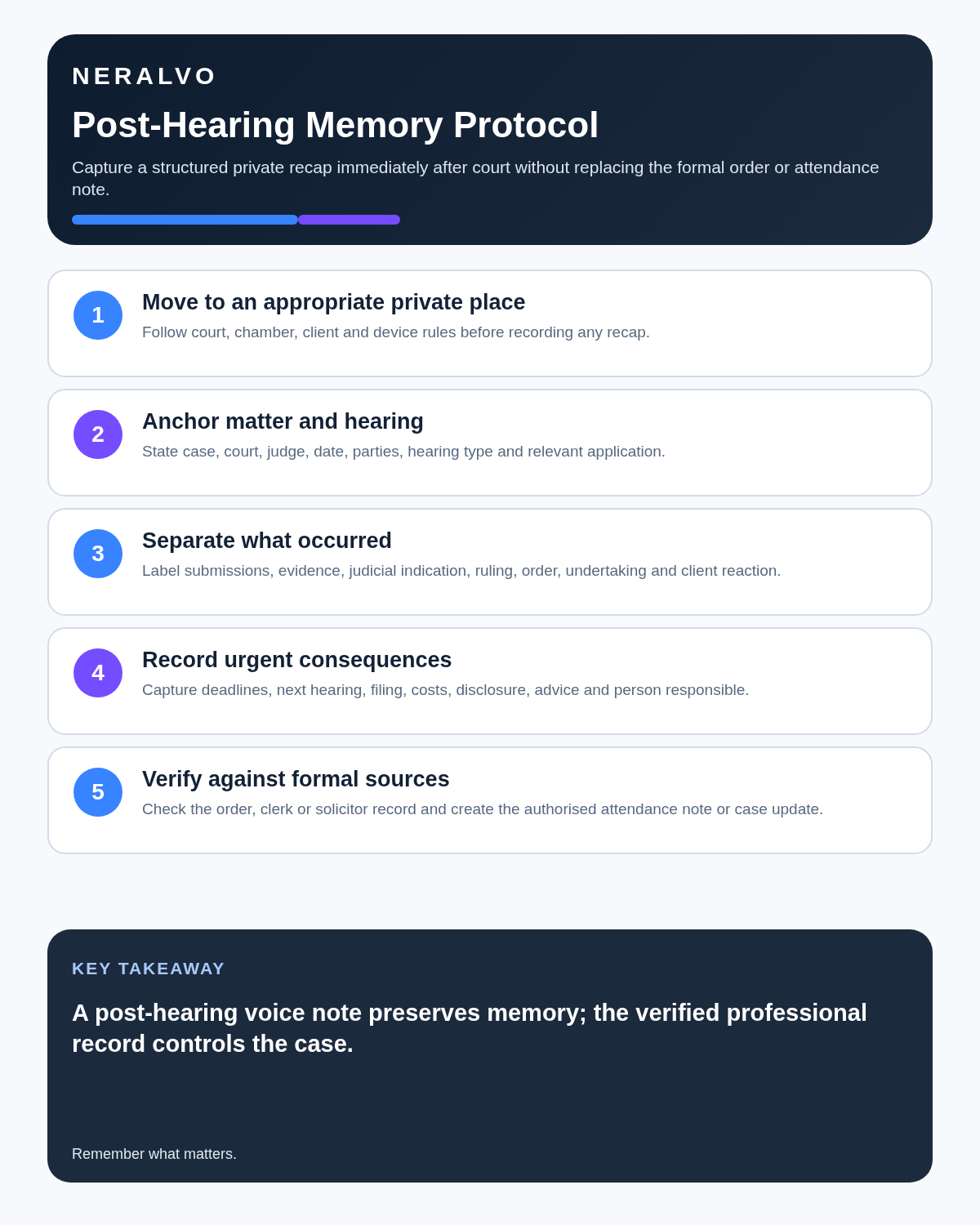
The exit → anchor → recall → prioritise → verify → file workflow
| Stage | Action | Output |
|---|---|---|
| Exit | Leave the restricted environment and protect confidentiality | Permitted setting |
| Anchor | State case, court, judge, date and hearing type | Stable identity |
| Recall | Dictate chronology and material points | Memory source |
| Prioritise | Identify urgent orders, undertakings and deadlines | Immediate action |
| Verify | Compare with order, notes and documents | Confirmed record |
| File | Create authorised attendance note and diary actions | Matter record |
Use explicit memory labels
- Recollection: remembered point not yet confirmed.
- Exact wording remembered: still requires source verification.
- Confirmed by own contemporaneous note.
- Confirmed by colleague’s attributed note.
- Confirmed by sealed or approved order.
- Requires verification.
Never allow an AI summary to remove these distinctions.
Use a structured post-hearing dictation
- Case, court, judge and parties.
- Purpose and applications before the court.
- Appearances and material representation issues.
- Chronology of submissions and judicial interventions.
- Decision and reasons as recalled.
- Orders made.
- Undertakings or concessions.
- Costs and payment provisions.
- Deadlines and listing directions.
- Evidence, drafting or client instructions required.
- Points requiring official verification.
Use an urgent-consequence table
| Item | Required detail |
|---|---|
| Order | Exact effect, person bound and verification status |
| Undertaking | Wording, giver, recipient and performance date |
| Deadline | Date, time, time zone and responsible person |
| Hearing date | Confirmed or provisional status |
| Evidence | What must be filed, served or obtained |
| Client action | Instruction, approval or practical step |
Diarise before polishing the prose
Move time-critical dates and undertakings into the authorised diary or matter system immediately, with a second-person check where required. A beautifully formatted transcript is less important than preventing a missed deadline.
Verify the official legal meaning
Check the sealed or approved order, transcript where available, court notice, legislation, rules, authorities, written submissions and counsel or solicitor notes. Pay particular attention to negative wording, conditions, jurisdiction, amounts and dates.
Authority-verification protocol
Never rely on a generated citation or quotation. For every legal authority:
- Open the judgment, legislation, rule or official guidance.
- Confirm court, date and citation.
- Read the relevant passage in context.
- Check later treatment or amendment.
- Remove any quotation that cannot be found in the source.
Technology and AI duties
The Bar Standards Board published AI and emerging-technology guidance in May 2026. It applies existing professional duties to technology use and emphasises risk assessment, technology awareness, data governance, transparency and protection of confidential information.
Review the current BSB AI guidance and chambers policy before using a recorder or companion AI service.
Protect privilege and confidentiality
Use chambers- or firm-approved devices, accounts and matter identifiers. Before case material is uploaded, assess processing location, subprocessors, model-training terms, workspace access, retention, deletion and export. Do not use a personal consumer AI account for client strategy, legal advice or sensitive evidence.
Create the final attendance note
The approved note should identify the hearing, attendees, applications, material submissions, decision, order, reasons, undertakings, deadlines, advice, client instructions, actions and verification status. It should not copy every speculative post-hearing thought.
How NERALVO Halo fits barristers
NERALVO Halo includes NOTE mode, supported CALL mode, 64GB local storage, up to 35 hours of recording and Bluetooth sync with DOWAY. DOWAY can create transcripts, summaries, speaker-separated notes, templates, translations, mind maps and exports, with one year of DOWAY Max included. Use remains subject to court, chambers, firm and professional controls.
Cloud software, a dedicated recorder or manual notes?
For Barristers, the right answer changes with the setting. This matrix deliberately gives each method a situation where it can be the strongest choice.
| Situation | Best starting point | Reason |
|---|---|---|
| scheduled remote case meetings | Cloud meeting software | Auto-join and central collaboration can remove routine admin. |
| authorised interviews or field discussions | Dedicated recorder | Dedicated hardware suits movement, variable rooms and offline source capture. |
| privilege, procedure or an objection prevents recording | Manual notes or an approved alternative | A clear alternative respects policy and participant choice. |
| mixed casework | Governed hybrid | One governed process prevents gaps between desk and field work. |
Frequently asked questions
Can Halo record a court hearing?
Not without the required authority. Court recording rules must be followed.
Can the post-hearing note be treated as exact?
No. Label recollection and verify material points against formal sources.
What should be done first after the hearing?
Protect urgent deadlines and undertakings, then complete verification and the formal note.
Final barrister checklist
- No unauthorised court recording.
- Private permitted location used.
- Case and hearing anchors complete.
- Recollection labelled visibly.
- Orders, undertakings and deadlines prioritised.
- Official wording and legal authorities verified.
- Diary and matter system updated.
- Privilege, access and retention controlled.
Bottom line: the post-hearing voice note is a disciplined bridge from fresh memory to the verified matter record, not a substitute for the official order.
Related guides
See the guides for solicitors, mediators and legal professionals.
On this page
Related guides
See whether Halo fits this workflow
Review the NERALVO Halo specifications, included services, delivery information and current offer only after completing the guide.
Found an error or an out-of-date claim? Email support@neralvo.com with the article address and a supporting source.