The 60-second verdict
Quick answer: solicitors can use an AI voice recorder for authorised client meetings and calls, but the final attendance note must separate client instructions, reported facts, documentary evidence, legal advice, decisions and actions. The matter system—not the recording app—remains authoritative.
Best fit: Solicitors who need recoverable audio and human-verified notes in an authorised workflow. Use another method when: recording is prohibited, a participant declines or the approved process requires manual notes.
Evidence basis and limits
- Decision factors covered: Why legal summaries can change meaning; Define the legal record type; Do not confuse transcript, attendance note and witness statement.
- Evidence rule: A claim earns weight only when the source, date, configuration and limitation are clear enough for a reader to check.
- Boundary: Examples and workflow recommendations must be tested with representative recordings, the intended users and the actual approval process before rollout.

Assess Halo against the solicitors workflow matrix can support approved legal workflows. Firm policy, professional obligations, privilege, court rules and client confidentiality govern use.
Why legal summaries can change meaning
A small error in a date, amount, admission, offer, condition or instruction can affect the matter. AI may also make exploratory advice sound final or merge the client’s belief with a verified fact.
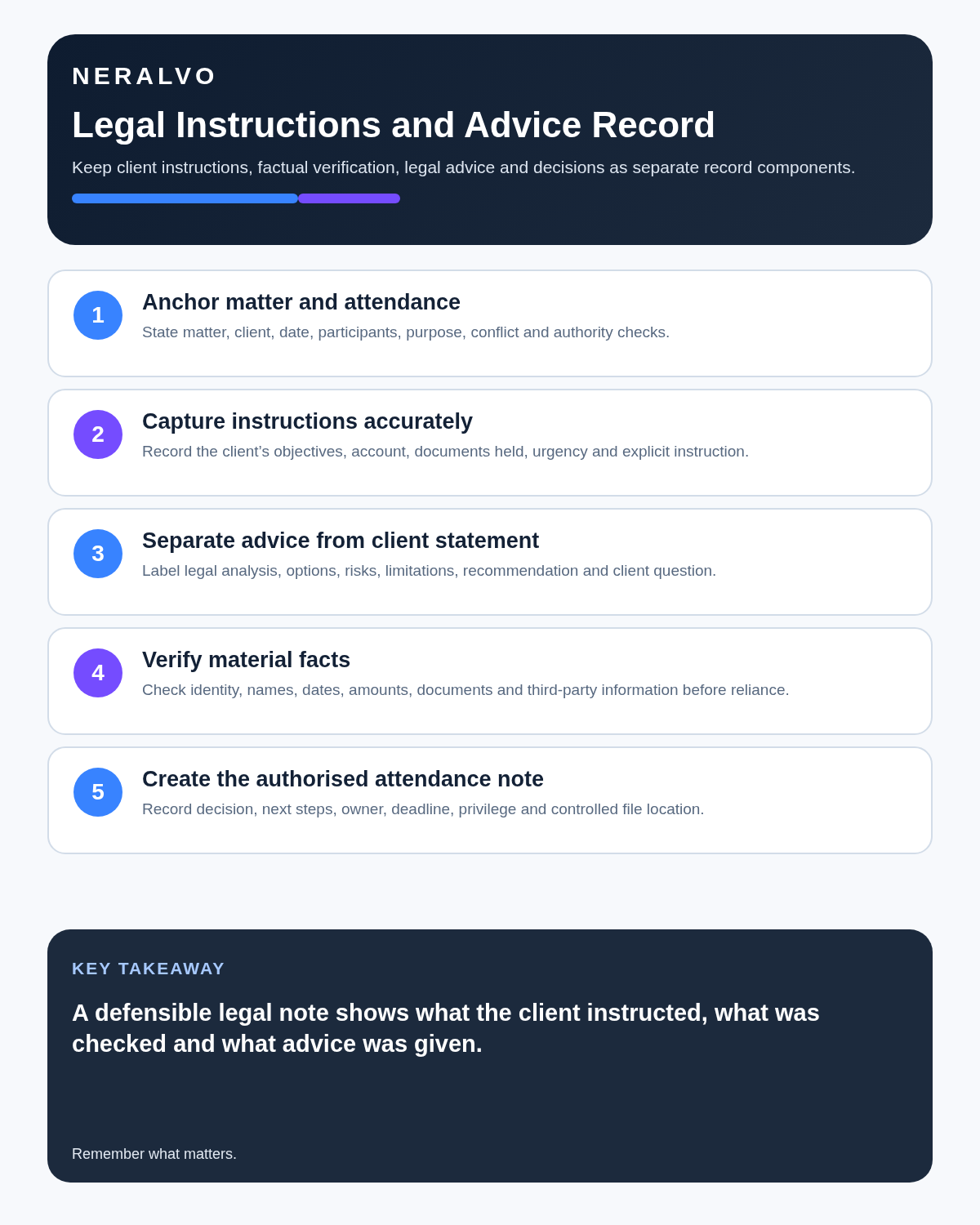
The matter → source → fact → advice → instruction → action → verification workflow
| Stage | Question | Output |
|---|---|---|
| Matter | Which client, file and purpose? | Stable anchor |
| Source | Who supplied each statement? | Attribution |
| Fact | What is reported and what is documented? | Evidence status |
| Advice | What legal analysis and options were explained? | Professional record |
| Instruction | What does the client authorise? | Client decision |
| Action | What must happen, by whom and when? | Execution |
| Verification | Which material wording and deadlines were checked? | Reliable file |
Define the legal record type
- Attendance note.
- Client instruction.
- Case conference.
- Witness or factual account.
- Negotiation or settlement call.
- Hearing debrief.
- Internal legal decision.
Each has different confidentiality, evidential and procedural implications.
Do not confuse transcript, attendance note and witness statement
A transcript is a machine-generated representation of speech. An attendance note is the solicitor’s professional file record. A witness statement is a formal document prepared and approved through a separate evidential process.
Recording may support all three in different ways, but it does not collapse them into the same document.
Separate information states
| Status | Meaning |
|---|---|
| Client reported | Client’s account, not yet independently verified |
| Document verified | Supported by identified source |
| Solicitor observation | Direct professional observation |
| Legal advice | Analysis and options explained |
| Client instruction | Authorised decision or action |
| Undertaking or commitment | Requires exact wording and authority |
| Action and deadline | Diarised task and owner |
Decide whether recording is proportionate
Recording may help with a long factual history, detailed instructions or a meeting where the solicitor needs to concentrate fully on the client. It may be unnecessary for a short update or unsuitable where sensitivity, venue, participants or normal contemporaneous notes make the extra copy unjustified.
Use the firm’s approved process. Personal convenience is not enough to introduce a new copy of confidential information.
Where recording is often unsuitable
- Another participant refuses or cannot make an informed choice.
- The discussion includes several unrelated matters.
- Court, police-station, prison, hospital or third-party venue rules prohibit it.
- The firm has not approved the device or AI processor.
- The material involves especially sensitive third parties.
- A normal contemporaneous written note is sufficient.
Explain the complete process
The client should understand which part is recorded, that AI processing is involved, who may access audio and text, where processing occurs, how long working files remain and what alternative is available if recording is declined.
Verify high-risk wording
Check offers, admissions, settlement positions, undertakings, authority, limitation dates, court deadlines, notice periods, amounts, identities, property or company references and conditional wording against the source and controlling documents.
Protect privilege and confidentiality
Use firm-approved devices, accounts and processors. Restrict raw audio more tightly than the final note where appropriate. Review cross-border processing, subprocessors, model-training terms, access, incident handling, export and deletion.
The SRA requires solicitors to keep current and former clients’ affairs confidential unless disclosure is required or permitted by law or the client consents. Review the current SRA confidentiality guidance and Code of Conduct.
Preserve client understanding
Record the issue, options, material risks, likely process, costs, uncertainty, advice, client questions and final instruction. Do not allow a summary to imply the client understood a point that was not discussed or checked.
Create the final attendance note
- Client, matter, date and participants.
- Purpose and relevant background.
- Client’s material account.
- Evidence received and outstanding.
- Advice and options explained.
- Client instruction and authority.
- Actions, owners and deadlines.
- Verification and review status.
- Source retention decision.
Move deadlines immediately
Do not wait for a polished transcript before diarising limitation, filing, service, completion or response dates. Use the authorised system and required checking process.
Call recording requires its own test
A supported CALL mode does not make every call recordable. Check technical compatibility and the legal, regulatory, contractual and firm process for the exact phone, application and participant arrangement. People should understand that the call is recorded, why and how the information is handled.
The ICO’s current guidance on call and worker monitoring explains that recording all call content is not usually proportionate and that people should be told when calls are recorded, why and how the information is used.
Run supplier due diligence before use
- Does the device retain local audio when the internet is unavailable?
- Can processing be limited to approved accounts?
- Where are audio and transcripts processed?
- Are providers prohibited from training on client data?
- Which subprocessors and international transfers apply?
- Can the firm set retention and delete all copies?
- Can files be exported in common formats?
- What happens when the subscription or provider ends?
- How are lost devices, compromised accounts and incidents handled?
How NERALVO Halo fits solicitors
NERALVO Halo includes NOTE mode, supported CALL mode, 64GB local storage, up to 35 hours of recording and Bluetooth sync with DOWAY. CALL mode is not universal, so test the exact phone, case and route. DOWAY provides transcripts, summaries, speaker-separated notes, templates, translations, mind maps and exports, with one year of DOWAY Max included. These functions do not confer legal authority or compliance.
Cloud software, a dedicated recorder or manual notes?
For Solicitors, the right answer changes with the setting. This matrix deliberately gives each method a situation where it can be the strongest choice.
| Situation | Best starting point | Reason |
|---|---|---|
| scheduled remote case meetings | Cloud meeting software | Auto-join and central collaboration can remove routine admin. |
| authorised interviews or field discussions | Dedicated recorder | Dedicated hardware suits movement, variable rooms and offline source capture. |
| privilege, procedure or an objection prevents recording | Manual notes or an approved alternative | A clear alternative respects policy and participant choice. |
| mixed casework | Governed hybrid | One governed process prevents gaps between desk and field work. |
Frequently asked questions
Can a transcript become the attendance note?
It can support drafting, but the authorised legal professional must verify and approve the final record.
Can AI identify the client’s legal instruction?
It may suggest one, but the solicitor must confirm exact wording and authority.
Should privileged audio be kept indefinitely?
No. Apply the firm’s matter-specific retention and necessity decision.
Final solicitor checklist
- Matter and record type identified.
- Use approved by firm process.
- Client report separated from evidence.
- Advice and instruction distinct.
- High-risk wording verified.
- Deadlines diarised immediately.
- Call-recording necessity, notice and proportionality assessed.
- Supplier and processor due diligence completed.
- Matter system updated.
- Privilege, access and retention controlled.
Bottom line: AI can reduce drafting effort, but the solicitor remains responsible for the meaning, authority and consequences recorded on the file.
Related guides
See the guides for barristers, mediators and legal professionals.
On this page
Related guides
Check permission, retention and access before choosing hardware
Once the policy requirements in this guide are satisfied, compare Halo’s specifications, local storage, included services and current offer against your approved workflow.
Found an error or an out-of-date claim? Email support@neralvo.com with the article address and a supporting source.