The 60-second verdict
Care-home management records must preserve the resident’s wishes, current condition, risk, medicines, family communication and action ownership. The danger with a meeting summary is that it can imply agreement where disagreement remains or leave a safeguarding concern inside a general action list.
Best fit: Care Home Managers who need recoverable audio and human-verified notes in an authorised workflow. Use another method when: recording is prohibited, a participant declines or the approved process requires manual notes.
Evidence basis and limits
- Decision factors covered: Use a resident action board; Separate resident, family and professional views; Use a safeguarding fast lane.
- Evidence rule: The decision is based on the complete capture-to-action workflow, not a single feature or marketing accuracy percentage.
- Boundary: Examples and workflow recommendations must be tested with representative recordings, the intended users and the actual approval process before rollout.
An AI voice recorder for care home managers may support a provider-approved private meeting or management draft. It cannot assess a resident, decide capacity, administer medicines or replace care plans, MAR records, safeguarding systems and the authorised care-management record.
Use a resident action board
| Board area | What must be clear |
|---|---|
| Resident voice | Preferences, concerns, communication support and desired outcome |
| Current change | Health, behaviour, function, mood or routine change |
| Immediate risk | Safeguarding, deterioration, medicine, staffing or environmental concern |
| Decision status | Proposed, agreed, authorised, completed or under review |
| Record impact | Care plan, risk assessment, MAR, incident or other system update |
| Action | Named owner, deadline and communication required |
The board should be resident-specific. Do not combine several residents into one transcript or task list.
Separate resident, family and professional views
Family meetings may contain different perspectives. Record:
- Resident view: expressed preference or response.
- Family view: attributed concern or request.
- Professional advice: information and recommendation provided.
- Legal or organisational authority: who can make the relevant decision.
- Decision: what was agreed, deferred or disputed.
An AI summary should not invent consensus.
Use a safeguarding fast lane
Concerns about abuse, neglect, self-neglect, coercion, unexplained injury, financial exploitation or inappropriate restraint must leave the normal meeting workflow immediately.
Record the factual concern, immediate protection, person contacted, referral and decision in the correct restricted system. Do not leave safeguarding information waiting in a transcript for later review.
Create a medicine-record boundary
Meeting notes may identify a medicine concern, but administration and omission must be verified through the authorised MAR or eMAR. Check resident, medicine, dose, route, time, administration outcome and required follow-up.
AI must not infer that medicine was administered because it was offered or discussed.
Build family updates around commitments
After a family meeting, issue a checked summary containing:
- purpose of the discussion
- resident wishes and involvement
- material information shared
- decisions and unresolved issues
- actions, owners and dates
- next update point
Keep confidential staff, resident or safeguarding information out of the family-facing version unless sharing is authorised and necessary.
Use an incident chronology after immediate care
| Chronology field | Required detail |
|---|---|
| Event | What was directly observed or reported |
| Time | Occurrence, discovery and response times |
| Impact | Resident condition and immediate risk |
| Response | Care, emergency, safeguarding and notifications |
| Evidence | Records, observations and people involved |
| Follow-up | Review, learning, owner and deadline |
AI should not assign blame or decide whether a regulatory notification is required.
Convert meetings into controlled record updates
For every agreed action, state which authorised record must change: care plan, risk assessment, communication plan, behaviour support, nutrition, mobility, medicines, staffing, maintenance or governance log. Meeting audio is not the care system.
Protect privacy and avoid ambient recording
Communal areas, corridors and shared offices contain information about multiple people. Continuous ambient recording is not an appropriate default. Use a planned private meeting or a limited post-meeting draft through the provider-approved process.
How NERALVO Halo may fit a governed care-home workflow
View Halo specifications for care home managers use provides 64GB local storage, up to 35 hours of recording and Bluetooth sync with DOWAY. DOWAY can create transcripts, summaries, templates, translations, mind maps and exports, with one year of DOWAY Max included from activation.
Halo is a consumer AI voice recorder. Care-provider use would require assessment of the device, application, data flow, privacy, safeguarding, record governance and staff process before use.
Governance-release check
- Is the resident’s own voice visible?
- Are family and professional views attributed?
- Does the decision show the correct authority and status?
- Were safeguarding concerns moved to the restricted process?
- Are medicine details verified through the MAR or eMAR?
- Does each action have an owner and deadline?
- Have care plans and risk records been updated?
- Has source audio been handled under provider policy?
The strongest care-home meeting note protects the resident’s voice while making every risk, decision and responsibility traceable. Recording can support the draft; dignity, safeguarding and authorised records determine the care response.
Cloud software, a dedicated recorder or manual notes?
For Care Home Managers, the right answer changes with the setting. This matrix deliberately gives each method a situation where it can be the strongest choice.
| Situation | Best starting point | Reason |
|---|---|---|
| scheduled remote consultations | Cloud meeting software | Native remote-meeting workflows can be more efficient here. |
| in-person consultations or ward handovers | Dedicated recorder | A separate battery and recoverable local source improve resilience. |
| a patient declines or policy prohibits recording | Manual notes or an approved alternative | Manual notes are the correct control when recording is unavailable. |
| mixed remote and clinical work | Governed hybrid | A hybrid can combine automation with reliable physical capture. |
Related care guides
See home-care visit notes, nursing handovers and social-work case records.
Related guides
Profession workflow
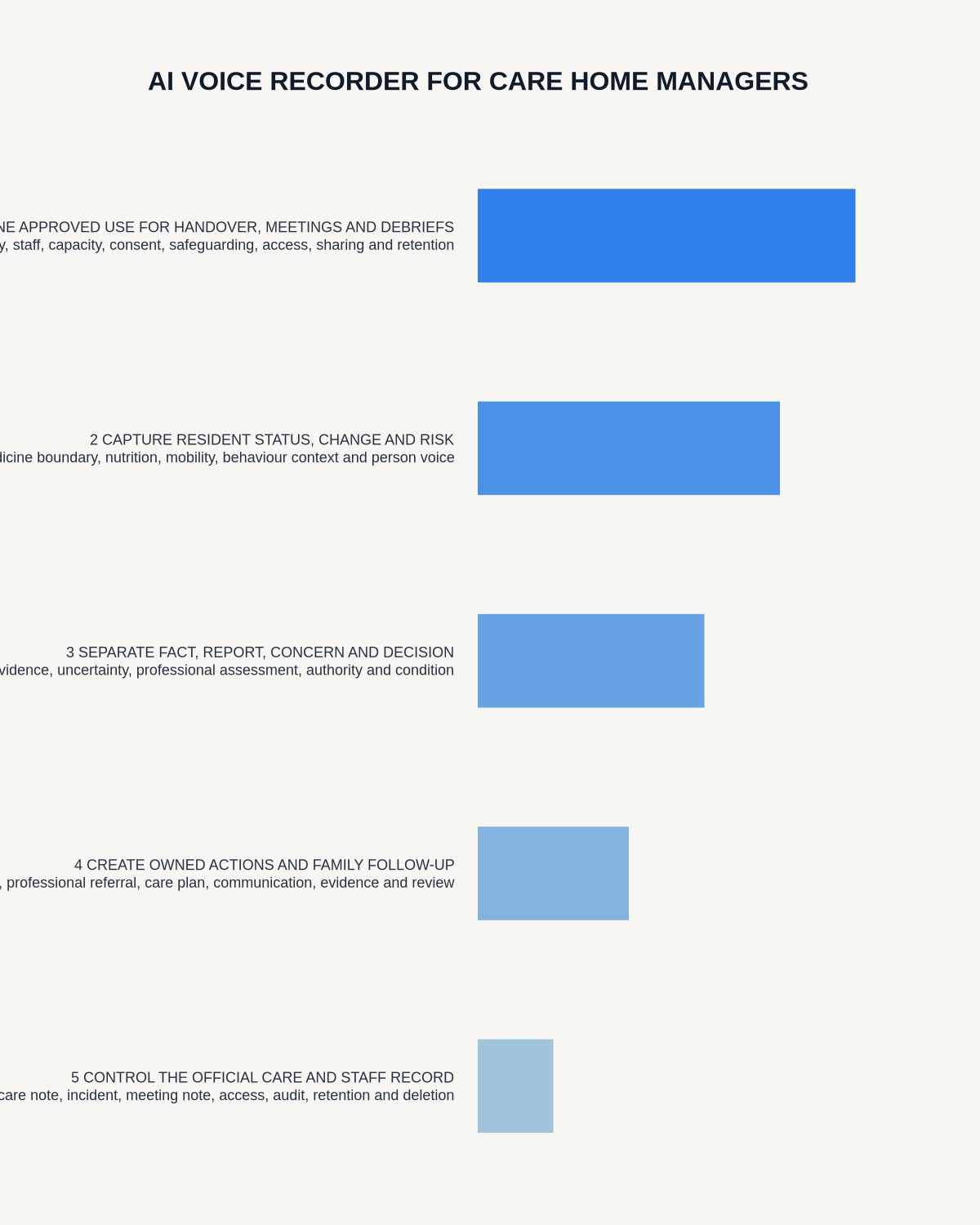
Visual map for AI Voice Recorder for Care Home Managers: Shift Handover, Family Meetings and Resident Actions
- Prepare the approved useDefine purpose, safe position, permission and the required formal record.
- Capture context firstState the case, asset, person, location or event identifier before detail.
- Human-verify evidenceCheck technical terms, units, names, dates, decisions and uncertainty.
- Complete the formal recordTransfer only verified information and apply access and retention controls.
On this page
Related guides
See whether Halo fits this workflow
Review the NERALVO Halo specifications, included services, delivery information and current offer only after completing the guide.
Found an error or an out-of-date claim? Email support@neralvo.com with the article address and a supporting source.