The 60-second verdict
Occupational-therapy notes must connect the person, the activity and the environment. A generated summary becomes misleading when it blends what the person reported, what a carer said and what the therapist directly observed into one confident statement.
Best fit: Occupational Therapists who need recoverable audio and human-verified notes in an authorised workflow. Use another method when: recording is prohibited, a participant declines or the approved process requires manual notes.
Evidence basis and limits
- Decision factors covered: Use a person–occupation–environment map; Create a home-visit privacy boundary; Use a measurement confidence register.
- Evidence rule: A claim earns weight only when the source, date, configuration and limitation are clear enough for a reader to check.
- Boundary: Examples and workflow recommendations must be tested with representative recordings, the intended users and the actual approval process before rollout.
An AI voice recorder for occupational therapists may support an organisation-approved assessment or a private post-visit draft. It cannot observe task performance, assess capacity, choose equipment or replace measured surveys, safeguarding action and the authorised health or social-care record.
Use a person–occupation–environment map
| Area | Questions to preserve |
|---|---|
| Person | Strengths, symptoms, cognition, communication, preferences and support |
| Occupation | What the person wants or needs to do and why it matters |
| Environment | Physical, social, sensory, cultural and organisational conditions |
| Performance | What happens during the task, including assistance and strategy |
| Risk | Hazard, likelihood, consequence, choice and current control |
| Intervention | Adaptation, equipment, practice, support or referral |
This prevents the note from reducing the person to a list of deficits.
Label every source of information
Separate:
- Person reported: experience, priorities and perceived ability.
- Carer or family reported: attributed information from another person.
- Therapist observed: actual task performance under stated conditions.
- Measured: checked dimension, score or equipment detail.
- Professional interpretation: reasoning, uncertainty and recommendation.
A summary should not state “independent with dressing” when the task was not observed or substantial prompting was required.
Create a home-visit privacy boundary
Homes expose family conversations, documents, finances, medication, security and unrelated household activity. Direct ambient recording is often more intrusive than a short private post-visit draft.
Use the least intrusive approved method. Explain any planned recording, consider everyone who may be captured and avoid alarm codes, unrelated rooms or personal information outside the assessment purpose.
Use a measurement confidence register
| Status | Meaning |
|---|---|
| Verified | Measured directly with a clear datum and suitable method |
| Provisional | Measured but dependent on position, finish or further check |
| Supplied | Provided by another person and not yet confirmed |
| Unknown | Inaccessible or not established |
Never order equipment or approve an adaptation from transcribed measurements alone. Verify dimensions, model, size, weight limit, compatibility, installation and review arrangements through the service process.
Balance risk with autonomy
A useful risk note shows:
- the activity the person wants to complete
- the specific hazard and evidence
- the person’s view and acceptable trade-offs
- existing strengths and controls
- reasonable options
- the agreed proportionate action
- review and escalation conditions
AI should not frame every risk as a reason to remove independence.
Keep capacity decision-specific
Do not allow a summary to apply a broad label such as “lacks capacity.” Record the specific decision, information and support provided, the person’s responses and the authorised process used where relevant. Capacity and safeguarding decisions remain human professional responsibilities.
Create an intervention status board
| Status | Examples |
|---|---|
| Recommended | Option discussed but not yet accepted or approved |
| Agreed | Person and team have accepted the intervention |
| Ordered or referred | Formal request submitted |
| Delivered | Equipment, adaptation or support provided |
| Reviewed | Fit, use, outcome and continuing need checked |
This stops a recommendation from appearing as completed support.
How NERALVO Halo may fit a governed occupational-therapy workflow
Assess Halo against the occupational therapists workflow matrix provides 64GB local storage, up to 35 hours of recording and Bluetooth sync with DOWAY. DOWAY can create transcripts, summaries, templates, translations, mind maps and exports, with one year of DOWAY Max included from activation.
Halo is a consumer AI voice recorder. Health or social-care use would require organisational assessment of the device, application, data flow, safeguarding, privacy, clinical risk and record workflow.
Assessment-record check
- Are person, activity and environment all represented?
- Is every information source attributed?
- Are direct observations separate from reported ability?
- Are measurements and equipment details verified?
- Does risk reasoning preserve autonomy and preference?
- Is capacity recorded for the specific decision?
- Does every intervention show its current status?
- Has the checked note entered the authorised system?
The strongest occupational-therapy record explains the fit between the person, the activity and the environment. Recording can preserve complex context, but direct observation and person-centred reasoning determine the intervention.
Cloud software, a dedicated recorder or manual notes?
For Occupational Therapists, the right answer changes with the setting. This matrix deliberately gives each method a situation where it can be the strongest choice.
| Situation | Best starting point | Reason |
|---|---|---|
| scheduled remote consultations | Cloud meeting software | Auto-join and central collaboration can remove routine admin. |
| in-person consultations or ward handovers | Dedicated recorder | Dedicated hardware suits movement, variable rooms and offline source capture. |
| a patient declines or policy prohibits recording | Manual notes or an approved alternative | A clear alternative respects policy and participant choice. |
| mixed remote and clinical work | Governed hybrid | One governed process prevents gaps between desk and field work. |
Related care and rehabilitation guides
See physiotherapy progress notes, home-care visit records and care-home action notes.
Related guides
Profession workflow
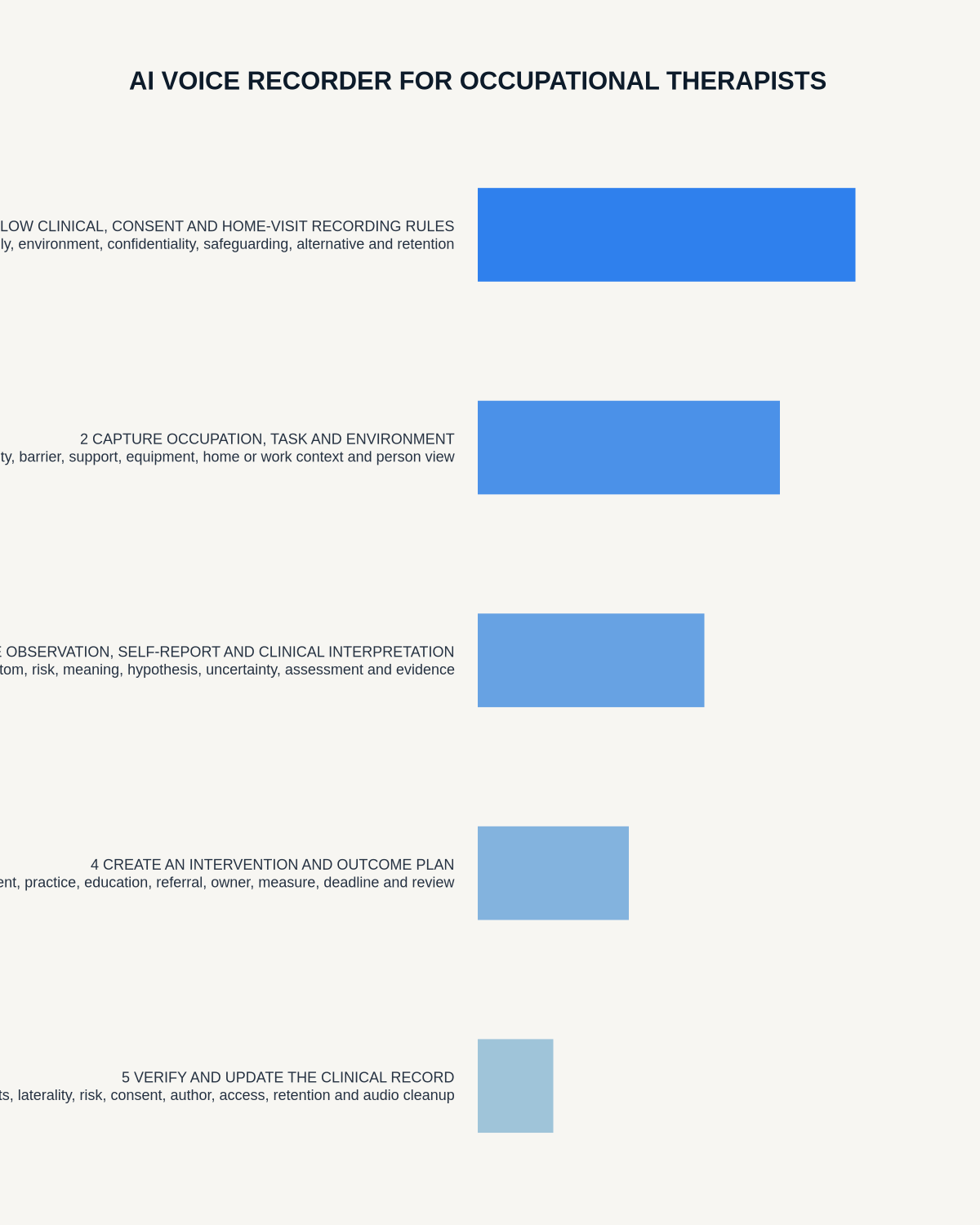
Visual map for AI Voice Recorder for Occupational Therapists: Functional Assessments, Home Visits and Intervention Notes
- Prepare the approved useDefine purpose, safe position, permission and the required formal record.
- Capture context firstState the case, asset, person, location or event identifier before detail.
- Human-verify evidenceCheck technical terms, units, names, dates, decisions and uncertainty.
- Complete the formal recordTransfer only verified information and apply access and retention controls.
On this page
Related guides
See whether Halo fits this workflow
Review the NERALVO Halo specifications, included services, delivery information and current offer only after completing the guide.
Found an error or an out-of-date claim? Email support@neralvo.com with the article address and a supporting source.