The 60-second verdict
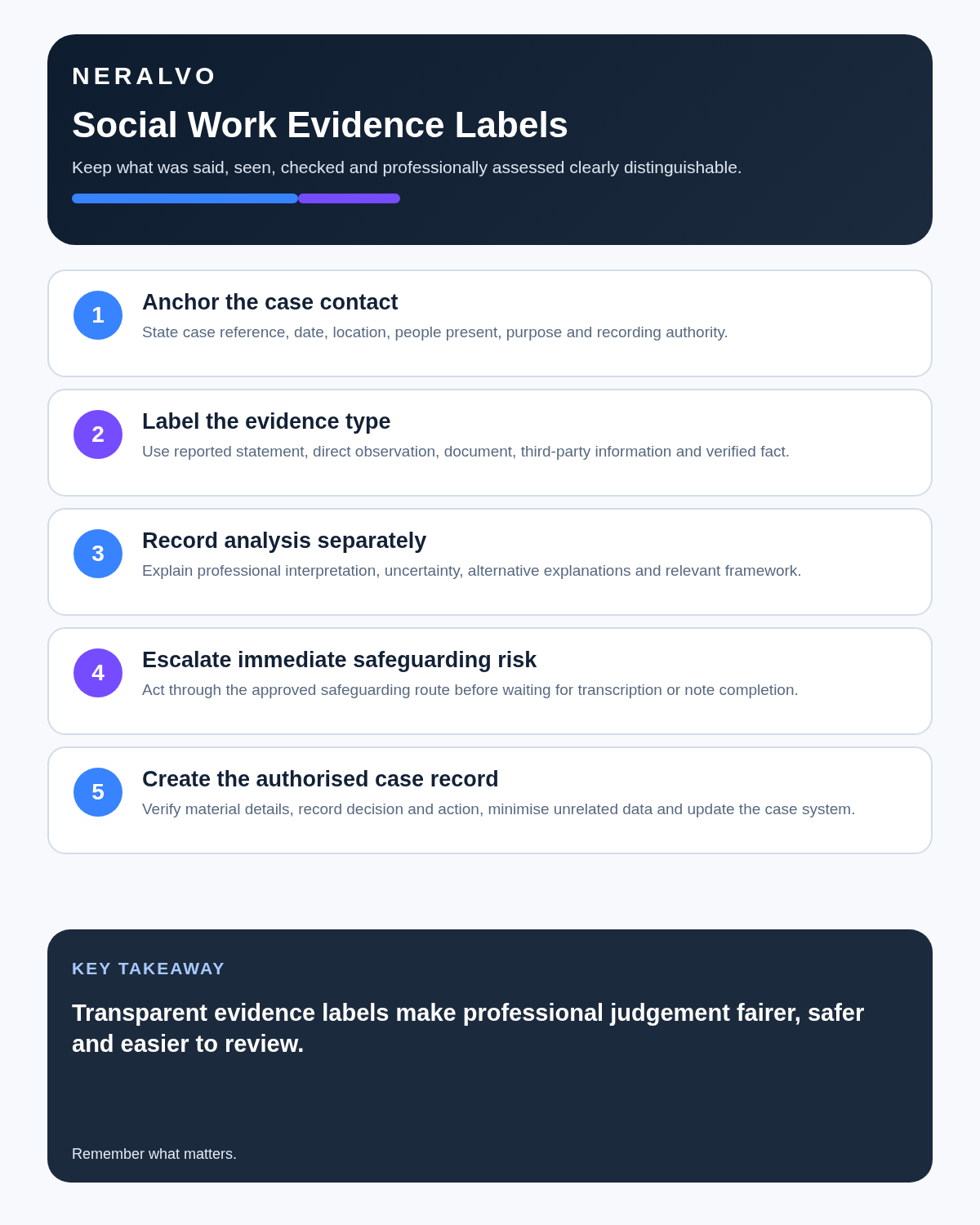
Quick answer: social workers may use an AI voice recorder only through their organisation’s approved safeguarding, professional and information-governance process. Any final case note must distinguish direct observation, attributed report, documentary evidence, professional analysis, decision and action.
Best fit: Social Workers who need recoverable audio and human-verified notes in an authorised workflow. Use another method when: recording is prohibited, a participant declines or the approved process requires manual notes.
Evidence basis and limits
- Decision factors covered: Act on safeguarding before documenting; Use a post-visit timeline; Use a case-note evidence table.
- Evidence rule: The decision is based on the complete capture-to-action workflow, not a single feature or marketing accuracy percentage.
- Boundary: Examples and workflow recommendations must be tested with representative recordings, the intended users and the actual approval process before rollout.

View Halo specifications for social workers use is not automatically suitable for case information. The employer or commissioning organisation controls whether the hardware, account and processing route are permitted.
Why source labels matter
Social-work records can influence protection, support, family arrangements and legal decisions. A fluent AI summary can merge a person’s account, professional observation and analytical conclusion into one apparently certain narrative.
Use three core source labels
| Label | Example | Recording rule |
|---|---|---|
| OBSERVED | The worker saw an empty medicine packet on the table | Describe only what was directly seen or heard |
| REPORTED | A family member said medication had been missed | Attribute the statement to the speaker |
| ANALYSIS | The information may indicate increased risk | Explain reasoning, uncertainty and action |
Say the label aloud during approved private dictation. It helps prevent AI from turning allegation into fact or professional concern into certainty.
The safety → source → context → analysis → decision → action workflow
| Stage | Question | Output |
|---|---|---|
| Safety | Does anyone require immediate protection? | Urgent response |
| Source | Who said, observed or documented this? | Attribution |
| Context | When, where and under what conditions? | Meaningful chronology |
| Analysis | What professional interpretation follows and with what uncertainty? | Transparent reasoning |
| Decision | Who has authority and what was decided? | Accountable outcome |
| Action | What happens next, by whom and when? | Follow-up |
Act on safeguarding before documenting
Immediate danger, abuse, neglect, exploitation, self-neglect or serious welfare concerns require the organisation’s authorised response without waiting for upload, transcription or summary. Preserve the person’s words accurately and do not conduct an unauthorised investigation.
Once the correct response is underway, move to a secure private location and create the case note promptly. A private voice note is not an adequate safeguarding report.
Use a post-visit timeline
- Reference: approved case identifier and visit purpose.
- Attendance: date, location and people present.
- Chronology: material events in order.
- Observed: direct observations.
- Reported: attributed statements.
- Documented: verified records and source dates.
- Analysis: risk, strengths, uncertainty and alternatives.
- Action taken: consultation, escalation and immediate response.
- Next action: owner, deadline and review point.
Use a case-note evidence table
| Information | Source | Reliability or limitation | Action |
|---|---|---|---|
| Child appeared tired | Worker observation | Single visit; reason unknown | Record context and consider wider evidence |
| Neighbour reports shouting | Third-party statement | Not independently verified | Follow procedure and assess relevance |
| School attendance reduced | School record | Period and reason need confirmation | Obtain authorised detail |
Why private post-visit dictation is often safer
Continuous recording inside a home can capture children, unrelated family conversation, health details and third parties who cannot meaningfully agree. It can also change how people speak to the social worker.
A short private note after leaving may preserve chronology and exact wording without creating a complete audio record of family life. Direct recording requires organisational authority, necessity, appropriate transparency, capacity and refusal considerations, controlled access and a defined retention decision.
Do not conceal recording
Explain the purpose, technology, access, use and retention in a way the person can understand. Consider capacity, communication, advocacy, language, distress and power imbalance. A small device should never be used to make recording less visible.
Preserve the person’s voice fairly
Use meaningful quotations where necessary and keep them in context. Avoid translating ordinary uncertainty into certainty or reducing complex experience to a generic theme. Record disagreement and the person’s preferred outcome.
Minimise third-party information
Case conversations frequently mention relatives, neighbours, professionals and alleged perpetrators. Include only what is relevant and fair for the authorised purpose. Restrict highly sensitive details and re-identification risk.
Write professional analysis transparently
A useful analysis identifies material evidence and source, protective factors and strengths, risk and uncertainty, alternative explanations, contradictory information, the person’s views, relevant legal or policy framework and why the proposed action is proportionate.
Prepare supervision records carefully
Approved recording or private dictation may support supervision actions, but the final supervision record should identify the case or workload issue, analysis challenged, decision or direction, support required, action owner and deadline, and review point.
Do not allow a reflective recording to become an uncontrolled duplicate case file.
Handle multi-agency meetings through the approved process
A transcript may assist draft minutes, but the formal record should distinguish information shared and its source, professional assessment, decision and authority, safeguarding action, owner and timescale, and information requiring restricted distribution.
Verify names, dates and attribution
Check identities, relationships, dates, locations, direct quotations, who was present, speaker labels and whether a statement was witnessed or reported. Mark inaudible or uncertain passages rather than guessing.
If the transcript conflicts with contemporaneous notes or other evidence, investigate the discrepancy rather than asking AI to choose the most plausible version.
Route the final record correctly
- Complete urgent action.
- Review the source promptly.
- Create the concise case note.
- Separate safeguarding, complaint, HR or incident routes where needed.
- Record decisions and authority.
- Assign actions and review dates.
- Restrict access.
- Apply retention to audio and transcript separately.
Professional and technology standards
Social Work England’s professional standards require accurate, clear, objective and up-to-date records and lawful, ethical use of technology. Review the current professional standards guidance alongside employer policy and the law applying to the case.
Privacy and temporary source material
Social-work notes can include health, disability, finances, immigration and criminal allegations. Use approved devices and accounts, minimise identifiers, restrict access and move verified information into the authorised case system promptly.
Delete temporary audio under the employer’s retention process once its purpose ends.
How NERALVO Halo fits social work
Where explicitly approved, NERALVO Halo offers NOTE mode, supported CALL mode, 64GB local storage, up to 35 hours of recording and Bluetooth sync with DOWAY. DOWAY can create transcripts, summaries, speaker-separated notes, templates, translations, mind maps and exports, with one year of DOWAY Max included.
The most proportionate use may be approved private post-visit dictation, supervision and professional reflection rather than routine recording of service users. These functions do not make the workflow compliant or suitable for case information by default.
Cloud software, a dedicated recorder or manual notes?
For Social Workers, the right answer changes with the setting. This matrix deliberately gives each method a situation where it can be the strongest choice.
| Situation | Best starting point | Reason |
|---|---|---|
| scheduled remote meetings | Cloud meeting software | Native remote-meeting workflows can be more efficient here. |
| in-person or mobile work | Dedicated recorder | A separate battery and recoverable local source improve resilience. |
| recording is refused or prohibited | Manual notes or an approved alternative | Manual notes are the correct control when recording is unavailable. |
| mixed online and offline work | Governed hybrid | A hybrid can combine automation with reliable physical capture. |
Frequently asked questions
Can AI write the final social-work analysis?
It may support drafting, but the accountable practitioner must verify evidence, reasoning, fairness and decision authority.
Can a recording replace a case note?
No. The reviewed case note belongs in the authorised system.
Should immediate safeguarding concerns wait for transcription?
No. Follow the designated route immediately.
Should home visits be recorded continuously?
Usually not. Private approved post-visit dictation is often more proportionate.
Final social-work checklist
- Organisational approval confirmed.
- Person informed accessibly.
- Urgent safeguarding action completed.
- Observation, report and document sources labelled.
- Professional analysis separate and transparent.
- Contradictions and uncertainty preserved.
- Supervision and multi-agency outputs routed correctly.
- Case system and actions updated.
- Professional standards, access, retention and deletion controlled.
Bottom line: act on safeguarding first, dictate privately where approved, label every source clearly and move the verified record into the authorised case system.
Related guides
See the guides for charity managers, school leaders and care home managers.
On this page
Related guides
See whether Halo fits this workflow
Review the NERALVO Halo specifications, included services, delivery information and current offer only after completing the guide.
Found an error or an out-of-date claim? Email support@neralvo.com with the article address and a supporting source.