The 60-second verdict
Quick answer: construction site managers can use an AI voice recorder from a safe position to preserve location-specific observations, coordination decisions, temporary controls and follow-up actions. The recording must never replace permits, inspections, method statements, drawings, formal instructions or the site safety process.
Best fit: Construction Site Managers who need recoverable audio and human-verified notes in an authorised workflow. Use another method when: recording is prohibited, a participant declines or the approved process requires manual notes.
Evidence basis and limits
- Decision factors covered: Why site voice notes can create false authority; The safety → location → requirement → observation → status → authority → closeout workflow; Record only from a safe stationary position.
- Evidence rule: The decision is based on the complete capture-to-action workflow, not a single feature or marketing accuracy percentage.
- Boundary: Examples and workflow recommendations must be tested with representative recordings, the intended users and the actual approval process before rollout.

View Halo specifications for construction site managers use can support approved site debriefs and coordination notes. It is not a permit, safety device, inspection tool or contractual instruction system.
Why site voice notes can create false authority
A superintendent, subcontractor and designer may discuss a possible solution while standing near the work. An AI summary can turn that discussion into “agreed instruction” even though design review, commercial authority or formal issue is still required.
The safety → location → requirement → observation → status → authority → closeout workflow
| Stage | Question | Controlled output |
|---|---|---|
| Safety | Can the note be made without distracting from the task or hazard? | Safe recording boundary |
| Location | Which project, level, grid, room or element? | Traceable site anchor |
| Requirement | Which drawing, specification, method or inspection point applies? | Current baseline |
| Observation | What was directly seen, measured or reported? | Evidence record |
| Status | Is it compliant, a query, hold point, defect or temporary condition? | Correct route |
| Authority | Who can instruct, accept or release? | Named decision-maker |
| Closeout | What evidence proves correction and acceptance? | Verified completion |
Record only from a safe stationary position
Do not operate a recorder while walking through plant routes, climbing, working at height, entering excavations, directing lifting, handling live services or performing another task requiring full attention. Stop, move to a safe location and follow site controls first.
Use precise site anchors
- Project and work package.
- Building, block, level, grid and room.
- Elevation, face or element.
- Drawing, model or specification reference and revision.
- Trade, subcontractor and activity.
- Inspection, RFI, non-conformance or permit reference.
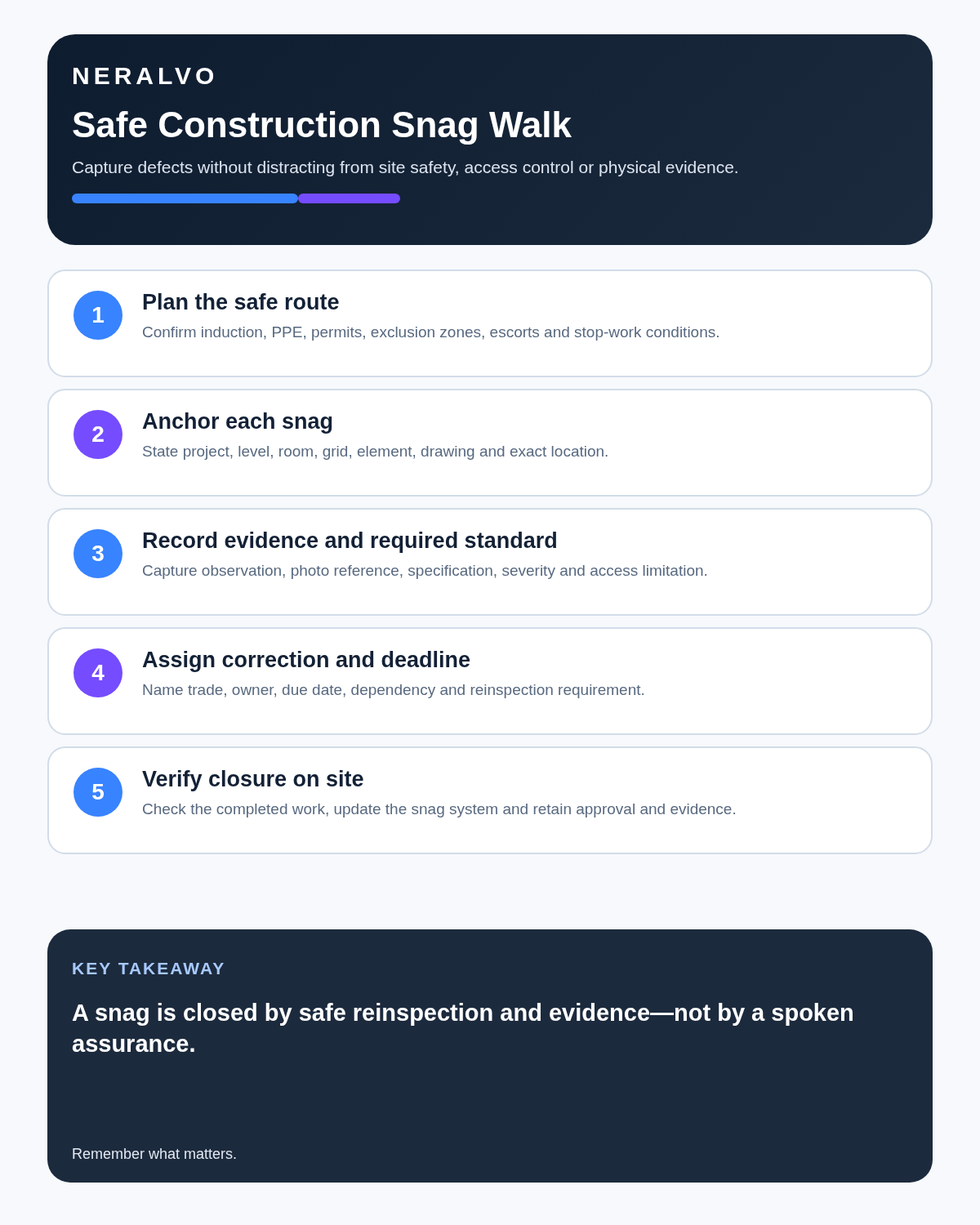
Use the eight-part snag sentence
- Location: block, level, grid, room or elevation.
- Trade: responsible package or subcontractor.
- Observation: what is incomplete, damaged or inconsistent.
- Required action: what must happen next.
- Priority: safety-critical, programme-critical or routine.
- Evidence reference: photograph, drawing, specification or RFI.
- Owner: person or organisation responsible.
- Deadline: agreed or required response date.
“Block B, level three, room 3.14. Drylining package. Fire-stopping above the door head is incomplete. Complete before ceiling inspection. Programme-critical. Photograph 27, drawing A-314. Site manager to confirm closure by Thursday.”
Separate evidence states
| Status | Meaning |
|---|---|
| Observed | Directly visible site condition |
| Measured | Value with method, unit and reference |
| Reported | Statement supplied by another person |
| Possible cause | Unverified explanation |
| Design conclusion | Outcome from the competent design route |
| Instruction | Authorised direction through the project process |
| Accepted | Verified closure by the required authority |
Route issues correctly
Use an RFI for missing or conflicting information, a non-conformance for work that does not meet a requirement, an inspection record for acceptance evidence and a formal instruction for authorised change. A general transcript should not blur these processes.
Control temporary conditions
Record the temporary arrangement, design or standard detail, loading, sequence, inspection status, permit or release, owner and removal trigger. Never infer that temporary works are approved because they were discussed during a walk.
Use a noise-control routine
Wind, radios, reverberation, PPE, vehicles and machinery can make a fluent transcript wrong. Move away from operating plant before speaking, face the microphone, use short sentences, state numbers digit by digit, spell unusual names and room codes, use verbal headings and review the transcript the same day.
No transcription system can recover speech that was never captured clearly.
Turn observations into controlled actions
Each action should state the exact location, required outcome, responsible owner, dependency, deadline, evidence needed and escalation route. “Site team to sort” is not adequate.
Site briefings and toolbox talks
A recording may help prepare or document an approved briefing summary, but it must not replace the actual presentation, site-specific information, attendance evidence or confirmation that workers understood the message. See the HSE’s current toolbox-talk resources.
Shift and manager handovers
Focus handovers on temporary conditions and incomplete controls:
- Restricted areas.
- Unfinished work.
- Temporary works or protection.
- Outstanding permits and isolations.
- Expected deliveries or lifting operations.
- Planned inspections and visitors.
- Issues requiring escalation.
Convert the reviewed transcript into the site’s normal handover record. Do not leave the next shift to search through audio.
Private end-of-day diary draft
From a safe office or welfare location, capture weather and material conditions, labour and key trades, work completed, deliveries and inspections, delays and reported causes, instructions or decisions received, unusual events and priority actions for tomorrow. Verify the transcript before creating the factual controlled site diary.
Verify closeout
- Correct location and element rechecked.
- Approved repair or correction completed.
- Inspection, test or photograph evidence linked.
- Drawings, quality records and as-built information updated.
- Temporary controls removed or formally retained.
- Authorised person accepted the outcome.
Protect site and personal information
Record only the minimum necessary detail. Security arrangements, access codes, personal performance matters, injuries and safeguarding concerns require restricted handling. Use approved accounts and retention rules.
A defined briefing or debrief is different from continuous audio monitoring. The ICO considers audio monitoring particularly intrusive; use targeted, announced capture and review the current worker-monitoring guidance.
How NERALVO Halo fits construction site management
NERALVO Halo includes NOTE mode, supported CALL mode, 64GB local storage, up to 35 hours of recording and Bluetooth sync with DOWAY. DOWAY can create transcripts, summaries, speaker-separated notes, templates, translations, mind maps and exports, with one year of DOWAY Max included from activation. These features support drafting only; competent people and controlled site systems determine safety, compliance and authority.
Cloud software, a dedicated recorder or manual notes?
For Construction Site Managers, the right answer changes with the setting. This matrix deliberately gives each method a situation where it can be the strongest choice.
| Situation | Best starting point | Reason |
|---|---|---|
| scheduled video briefings | Cloud meeting software | Native remote-meeting workflows can be more efficient here. |
| site visits, inspections or mobile calls | Dedicated recorder | A separate battery and recoverable local source improve resilience. |
| a restricted site or participant prevents recording | Manual notes or an approved alternative | Manual notes are the correct control when recording is unavailable. |
| office-to-site work | Governed hybrid | A hybrid can combine automation with reliable physical capture. |
Frequently asked questions
Can a site discussion become an instruction through an AI summary?
No. Use the authorised contractual and project process.
Can recording replace a snag photograph or measurement?
No. Link audio context to objective visual, measurement and document evidence.
Should urgent hazards wait for transcription?
No. Control the hazard and follow the emergency or site process immediately.
Final site-management checklist
- Recording made from a safe position.
- Location and current revision identified.
- Observation separated from diagnosis and instruction.
- Correct RFI, NCR, inspection or instruction route used.
- Temporary condition and authority clear.
- Actions specific, owned and dated.
- Closeout evidence verified.
- Site and as-built systems updated.
Bottom line: a construction voice note is useful only when it connects a safe, precise observation to the correct authority and verified site record.
Related guides
See the guides for civil engineers, building surveyors and project managers.
On this page
Related guides
See whether Halo fits this workflow
Review the NERALVO Halo specifications, included services, delivery information and current offer only after completing the guide.
Found an error or an out-of-date claim? Email support@neralvo.com with the article address and a supporting source.