The 60-second verdict
Quick answer: project managers can use an AI voice recorder to preserve decisions, assumptions, risks, issues, dependencies and actions, but the recording must be converted into the appropriate decision log, risk register, issue log, dependency log, change control and task system. Discussion is not the project record.
Best fit: Project Managers who need recoverable audio and human-verified notes in an authorised workflow. Use another method when: recording is prohibited, a participant declines or the approved process requires manual notes.
Evidence basis and limits
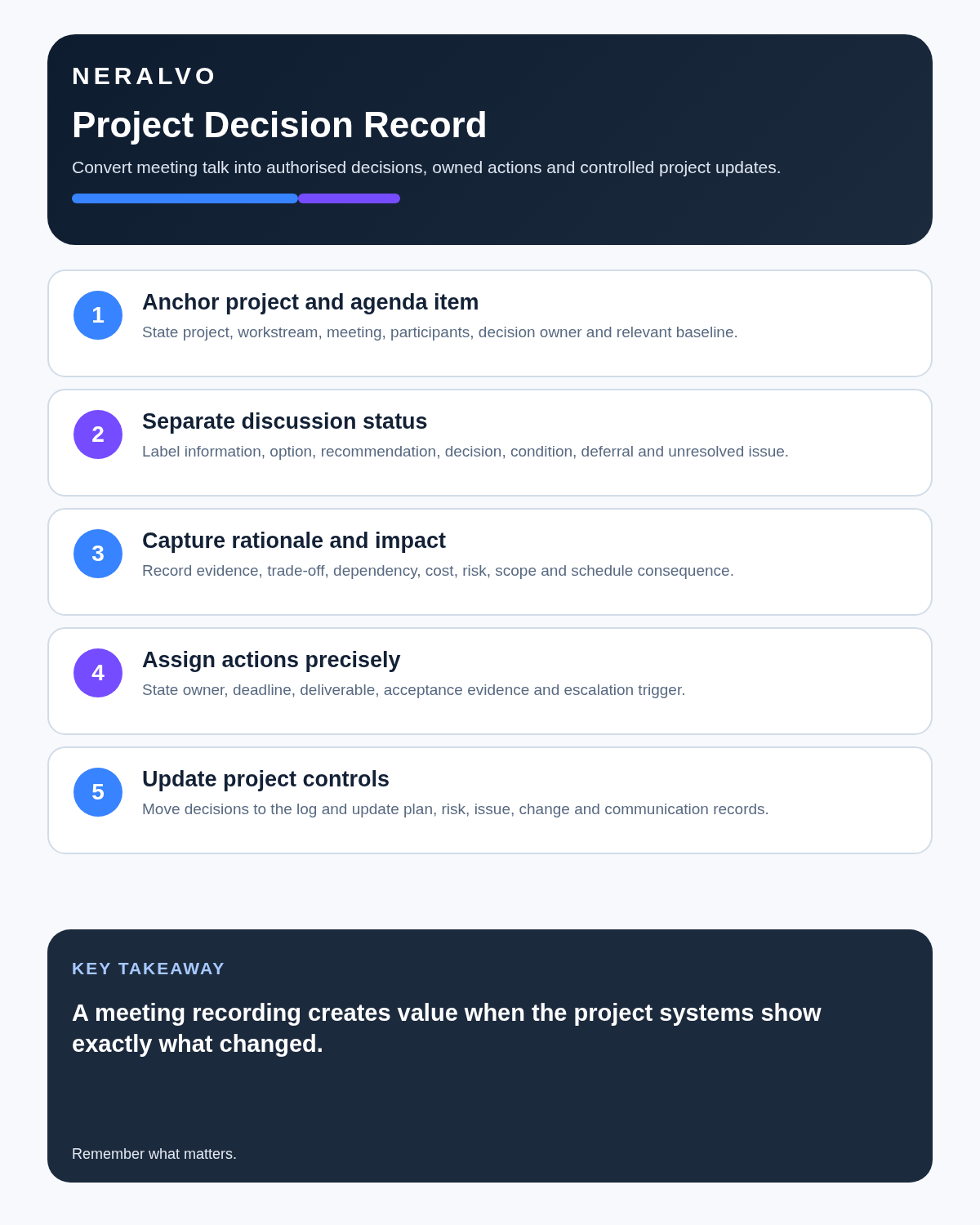
- Decision factors covered: Why meeting summaries create project ambiguity; Use the meeting-output router; The anchor → status → authority → rationale → impact → action → system workflow.
- Evidence rule: Claims are weighted by consequence: capture failure, changed meaning, access and recovery matter more than polished wording.
- Boundary: Examples and workflow recommendations must be tested with representative recordings, the intended users and the actual approval process before rollout.

Check whether NERALVO Halo fits project managers work can support approved meetings and private post-meeting capture. It cannot approve a change, accept risk or update the baseline automatically.
Why meeting summaries create project ambiguity
Projects contain recommendations, preferred options, decisions, unresolved questions and informal comments. An AI summary can flatten these into one list and make a tentative idea look approved.
Use the meeting-output router
| What was said | Correct destination | Question to verify |
|---|---|---|
| “This could delay testing.” | Risk register | What uncertain event, cause and impact exist? |
| “Testing is already blocked.” | Issue log | What has happened and who owns resolution? |
| “Move the pilot by two weeks.” | Change request | Was this proposed or formally approved? |
| “Priya will confirm on Thursday.” | Action log | What exactly will she deliver and by when? |
| “The sponsor approved option B.” | Decision log | Did the correct authority decide, and under what conditions? |
| “We need the supplier’s interface first.” | Dependency log | Who supplies it, when and what depends on it? |
| “We expect the data to be ready.” | Assumption log | What evidence and validation date are required? |
The anchor → status → authority → rationale → impact → action → system workflow
| Stage | Question | Output |
|---|---|---|
| Anchor | Which project, workstream, milestone and version? | Stable context |
| Status | Decision, assumption, risk, issue, change or question? | Correct category |
| Authority | Who can approve or accept? | Accountability |
| Rationale | What evidence and trade-off support the position? | Decision memory |
| Impact | What scope, time, cost, quality, benefits or risk changes? | Assessment |
| Action | Who does what by when? | Execution |
| System | Where is the authoritative record? | Controlled update |
Design the meeting before recording
A recorder cannot rescue a meeting with no purpose or authority. Confirm:
- The decision or outcome required.
- The chair and minute owner.
- Who has authority to approve changes or decisions.
- The controlled records that may need updating.
- Whether recording is permitted and proportionate.
- Where audio, transcript and approved minutes will be stored.
Use explicit spoken signposts
- “This is a new risk, not an issue yet.”
- “The decision is…”
- “This remains a proposal subject to approval.”
- “The action owner is…”
- “The due date is…”
- “This affects the approved baseline and needs change control.”
- “This is a planning assumption and must be verified by…”
The chair should read back material decisions and actions before moving to the next topic.
Use explicit project markers
- Decision.
- Recommendation.
- Assumption.
- Dependency.
- Risk.
- Issue.
- Change request.
- Action.
- Open question.
- Information only.
Use a worked routing example
“The supplier thinks the integration may be two weeks late. Priya will confirm the forecast by Thursday. If it slips, we might move the pilot, but the sponsor wants an impact assessment first.”
The correct routing is:
- Risk: supplier integration may arrive two weeks late, threatening the pilot.
- Action: Priya to confirm the supplier forecast by Thursday.
- Potential change: pilot-date movement requires impact assessment and sponsor decision.
- Not a decision: the pilot date has not changed.
An AI summary stating “Pilot delayed by two weeks” would create a false baseline.
Create a complete decision record
Capture the problem, options, evidence, assumptions, trade-offs, selected outcome, authority, conditions, affected baseline, implementation, verification and review trigger. This allows a future team to understand why the decision was made.
Distinguish risk, issue, assumption, dependency and change
| Type | Meaning | Minimum fields |
|---|---|---|
| Risk | Uncertain future event with possible effect | Cause, event, effect, owner, response and trigger |
| Issue | Event or condition already present | Current impact, owner, resolution and escalation |
| Assumption | Unverified condition used for planning | Source, evidence, validation date and fallback |
| Dependency | External input or condition required for progress | Provider, receiver, required date and consequence |
| Change | Proposed alteration to an approved baseline | Request, impact, evaluation, authority and outcome |
Write actions that can close
Replace “team to review” with the exact output, one accountable owner, contributors, dependency, deadline, destination and evidence required. Confirm that the named owner accepts the task.
Control changes formally
A meeting can identify a change, but the approved process should assess scope, schedule, cost, quality, benefits, resources, contracts, stakeholders and risk before approval, rejection or deferral. A sentence in the minutes does not amend the baseline.
Official source: the Association for Project Management describes change control as the process for capturing, evaluating and approving, rejecting or deferring requests to alter an approved baseline. Its guidance highlights effects on benefits, scope, quality, time, resources, cost, risk and stakeholders. See APM change-control guidance.
Preserve dissent and uncertainty
Record material objections, missing evidence and conditions. A unanimous-looking summary can hide a technical or commercial concern that remains unresolved.
Use a controlled post-meeting routing process
- Generate the transcript and draft summary.
- Correct speakers, dates, figures and technical terms.
- Highlight every apparent decision, action, risk, issue, assumption, change and dependency.
- Verify authority and status against the actual discussion.
- Enter each item into its controlled record.
- Circulate concise minutes with a correction deadline.
- Update affected baselines only after approved change control.
- Track action and decision implementation.
- Remove duplicate working copies under the retention policy.
What the minutes should contain
Minutes should not be a shorter transcript. They should record:
- Purpose and attendees.
- Confirmed decisions and authority.
- Actions with owners and dates.
- Material exceptions and unresolved points.
- New or changed risks and issues.
- Assumptions and dependencies requiring control.
- Change requests requiring separate assessment.
- The next governance step.
Government-project context
The UK Government Project Delivery Functional Standard, GovS 002, sets expectations for governance, roles, planning and control, risk and issue management, change control, reporting and information management across government projects. An AI recorder can support traceability, but it cannot create delegated authority or replace the approved management system.
See the current Project Delivery Functional Standard.
Protect project and meeting data
Project conversations may contain employee data, supplier information, security details, legal advice and commercial positions. Define:
- Which meetings may be recorded.
- How participants are informed.
- Who may access source audio and transcripts.
- Which approved system remains the source of truth.
- How long working files are retained.
- Which sections require pausing or exclusion.
How NERALVO Halo fits project managers
NERALVO Halo includes NOTE mode, supported CALL mode, 64GB local storage, up to 35 hours of recording and Bluetooth sync with DOWAY. DOWAY provides transcripts, summaries, speaker-separated notes, templates, translations, mind maps and exports, with one year of DOWAY Max included.
The project manager remains responsible for status, authority, routing and system updates. Halo is not a project, risk, issue, change or task-management system.
Cloud software, a dedicated recorder or manual notes?
For Project Managers, the right answer changes with the setting. This matrix deliberately gives each method a situation where it can be the strongest choice.
| Situation | Best starting point | Reason |
|---|---|---|
| scheduled remote client meetings | Cloud meeting software | Calendar automation and shared integrations are usually the strongest advantage. |
| in-person visits and travel | Dedicated recorder | Independent capture reduces reliance on an active phone or laptop. |
| a client declines or policy requires manual notes | Manual notes or an approved alternative | The boundary takes priority over convenience. |
| mixed CRM and field work | Governed hybrid | Use each method only in the setting it actually fits. |
Frequently asked questions
Can an AI summary become formal minutes?
Only after review, approval and transfer into the project’s authorised record.
Does a preferred option count as a decision?
No. Confirm authority, conditions and status.
Can AI assign actions reliably?
It can suggest them, but ownership, wording and deadlines must be confirmed.
Does a sentence in the minutes approve a baseline change?
No. The authorised change-control process determines the outcome.
Final project checklist
- Project, workstream and baseline anchored.
- Output router used consistently.
- Authority confirmed.
- Rationale, conditions and dissent preserved.
- Risks, issues, assumptions, dependencies and changes separated.
- Actions specific and accepted.
- Minutes contain controlled outcomes rather than a transcript summary.
- Changes assessed and authorised formally.
- Authoritative systems updated.
- Source access and retention controlled.
Bottom line: an AI recorder creates value only when verified discussion is routed into the correct controlled decision, risk, issue, assumption, dependency, change or action with accountable closure.
Related guides
See the guides for project kickoffs, programme managers and engineering managers.
On this page
Related guides
See whether Halo fits this workflow
Review the NERALVO Halo specifications, included services, delivery information and current offer only after completing the guide.
Found an error or an out-of-date claim? Email support@neralvo.com with the article address and a supporting source.