The 60-second verdict
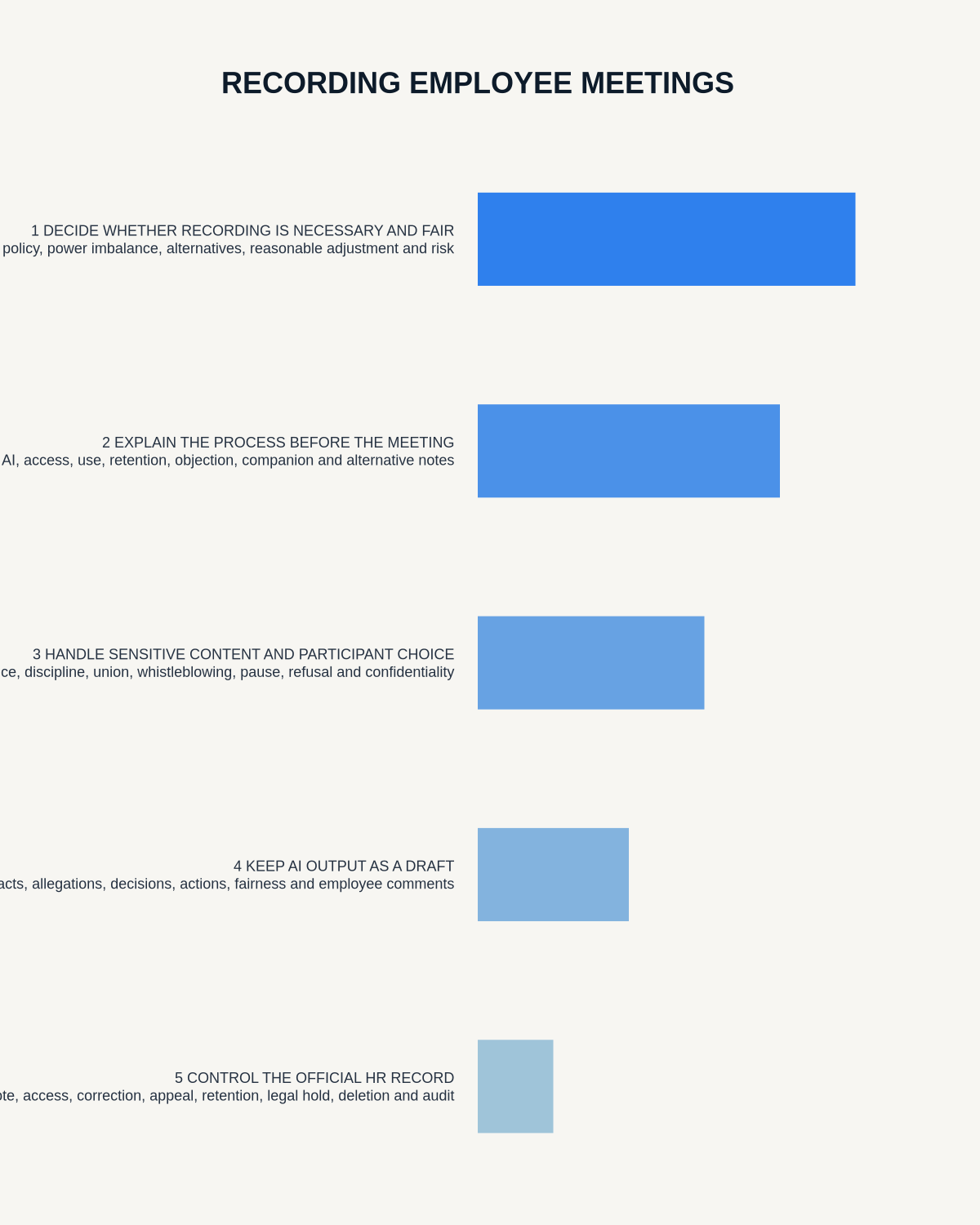
Quick answer: before recording an employee meeting, identify the HR process, prove necessity, check law and policy, provide clear advance information, preserve representation and procedural rights, protect sensitive data and create a reviewed HR record rather than relying on raw AI output.
Use this guide when: the recording purpose, authority, participants, access and retention can be defined. Pause when: any of those controls is unclear.
Evidence basis and limits
- Decision factors covered: Identify the meeting type first; Check policy and proportionality; Do not normalise covert recording.
- Evidence rule: Claims are weighted by consequence: capture failure, changed meaning, access and recovery matter more than polished wording.
- Boundary: This is practical information, not legal advice. Verify current ICO guidance, sector rules, contracts and organisational policy for the real use case.

Employee meetings can involve performance, conduct, health, pay, disability, grievances, allegations and personal circumstances. Recording may improve factual accuracy, but it can also feel intimidating, alter how openly people speak and create a larger, more sensitive HR record.
This guide explains the questions UK employers should address before recording workplace meetings. It is general information, not employment-law, HR or data-protection advice.
Identify the meeting type first
The correct process depends on whether the meeting is:
- An informal check-in.
- A performance review.
- An absence or wellbeing meeting.
- A reasonable-adjustment discussion.
- An investigation interview.
- A disciplinary hearing.
- A grievance meeting.
- A redundancy or consultation meeting.
- An exit interview.
- A union or employee-representative meeting.
Do not apply one generic recording script to every HR situation.
Check policy and proportionality
Ask why audio is necessary and whether contemporaneous notes, a second note-taker or an agreed written summary would achieve the purpose with less intrusion. The ICO’s worker-monitoring guidance treats transparency, necessity and proportionality as central.
See the official ICO guidance on monitoring workers.
Do not normalise covert recording
The ICO says workers should normally be informed about monitoring, apart from very exceptional circumstances. Acas states that, for investigation meetings, recording can take place if policy allows and the worker agrees, but it may be intimidating and should be agreed by all parties.
See Acas guidance on investigation meetings.
Give clear advance information
Tell participants:
- The exact purpose.
- Whether audio, video or both are captured.
- Whether AI transcription or summaries are used.
- Who can access the audio and text.
- Which document becomes the official HR record.
- How long each file is retained.
- Whether extracts may be shared.
- What happens if someone objects.
Repeat the key points at the start and inform late joiners.
Preserve employee rights and procedural fairness
Recording does not replace the right to be accompanied where it applies, reasonable adjustments, adequate preparation time, access to evidence, an opportunity to answer the case, impartial decision-making or appeal rights.
For grievance meetings, Acas advises employers to keep a confidential record, give the employee a copy of meeting records and notes, and ask them to confirm accuracy. See Acas grievance-meeting guidance.
Use a balanced note structure
- Meeting purpose and attendees.
- Evidence or concerns presented.
- Employee response in their own terms.
- Management questions.
- Documents referred to.
- Disputed facts and uncertainty.
- Agreed adjustments or support.
- Next steps and timescales.
- Decision-maker and appeal route where relevant.
Separate fact, allegation, opinion, explanation and decision.
Do not let AI assess credibility or emotion
Speech patterns, pauses, accent, disability, distress or nervousness should not become automated truthfulness, attitude or risk scores. AI may assist with a draft transcript, but humans must assess evidence and follow the correct procedure.
Protect special-category and criminal-offence data
Employee meetings may reveal health, disability, union membership, beliefs or allegations. Assess the Article 6 lawful basis, Article 9 condition and any additional requirements before processing. Restrict access to people with a defined HR need.
Separate raw, draft and final records
| Record | Status | Control |
|---|---|---|
| Audio | Verification source | Tight access and shortest justified retention |
| AI transcript | Unverified draft | Correct errors and label clearly |
| HR note | Approved record | Store in the authorised HR system |
Pause recording during private breaks
Stop during adjournments, companion consultations, legal advice, deliberations and unrelated personal conversation. State the pause and restart so the record remains understandable.
Verify material details
Check names, dates, quotations, allegations, actions, medical terms and negative statements. Give participants the appropriate opportunity to identify factual errors under the governing procedure.
Set purpose-based retention
Do not retain audio indefinitely because a grievance or performance issue might recur. Apply the HR schedule, legal holds and complaint requirements. Delete device, app, download and shared copies when the purpose ends.
Using NERALVO Halo in approved HR meetings
Review NERALVO Halo against these controls provides NOTE mode, supported CALL mode, 64GB local storage, up to 35 hours of recording and Bluetooth connection to DOWAY for transcripts, summaries, templates, translations, mind maps and exports. One year of DOWAY Max is included.
Employers should assess the complete Halo and DOWAY workflow before use. Managers should not introduce it independently or use its discreet size to conceal recording.
Workflow choice matrix for Recording Employee Meetings
Apply the strongest control before choosing a device. The table makes the non-hardware options explicit.
| Condition | Preferred route | Why |
|---|---|---|
| Repeatable remote work with approved integrations | Cloud software | Automation and central collaboration may outweigh device independence. |
| In-person, mobile or unreliable-connectivity work | Dedicated recorder | Independent capture and a recoverable local source are usually more resilient. |
| Recording is refused, prohibited or unnecessary | Manual notes / no recording | Respecting the boundary is the correct workflow, not a product failure. |
| High-risk or mixed work | Governed hybrid | Separate capture, review, approval and retention rather than trusting one tool. |
Frequently asked questions
Can a manager secretly record an employee?
Covert monitoring is exceptional and high risk. Obtain specialist legal and data-protection advice rather than improvising.
Can the AI summary be the disciplinary decision?
No. It may assist note preparation, but evidence, fairness and outcome require authorised human judgement.
Can an employee ask to record?
Yes, they may ask. The employer should respond under its policy, consider adjustments and seek agreement from participants.
Should the employee receive the transcript?
Follow the relevant procedure and data-access rules. A checked meeting record is often more suitable than raw AI text.
HR recording checklist
- Meeting category and procedure identified.
- Purpose and necessity documented.
- Policy and legal basis confirmed.
- Participants informed in advance.
- Agreement obtained where required.
- Companion and adjustment rights preserved.
- Private breaks excluded.
- AI credibility or emotion scoring prohibited.
- Transcript human-verified.
- Official HR record identified.
- Access and retention restricted.
- Complaint, access and correction process ready.
Bottom line: a responsible HR recording process preserves both perspectives, limits sensitive data and makes the official outcome clearer without weakening trust or employee rights.
Related guides
On this page
Related guides
Check permission, retention and access before choosing hardware
Once the policy requirements in this guide are satisfied, compare Halo’s specifications, local storage, included services and current offer against your approved workflow.
Found an error or an out-of-date claim? Email support@neralvo.com with the article address and a supporting source.