The 60-second verdict
Quick answer: an AI voice recorder can help furniture makers capture a customer brief, prototype findings, joinery decisions, finish trials, supplier questions and production changes. It should be used only after workshop hazards are controlled, and every dimension, material and approval must be transferred into the controlled drawing, cutting list or production record.
Best fit: Furniture Makers who need recoverable audio and human-verified notes in an authorised workflow. Use another method when: recording is prohibited, a participant declines or the approved process requires manual notes.
Evidence basis and limits
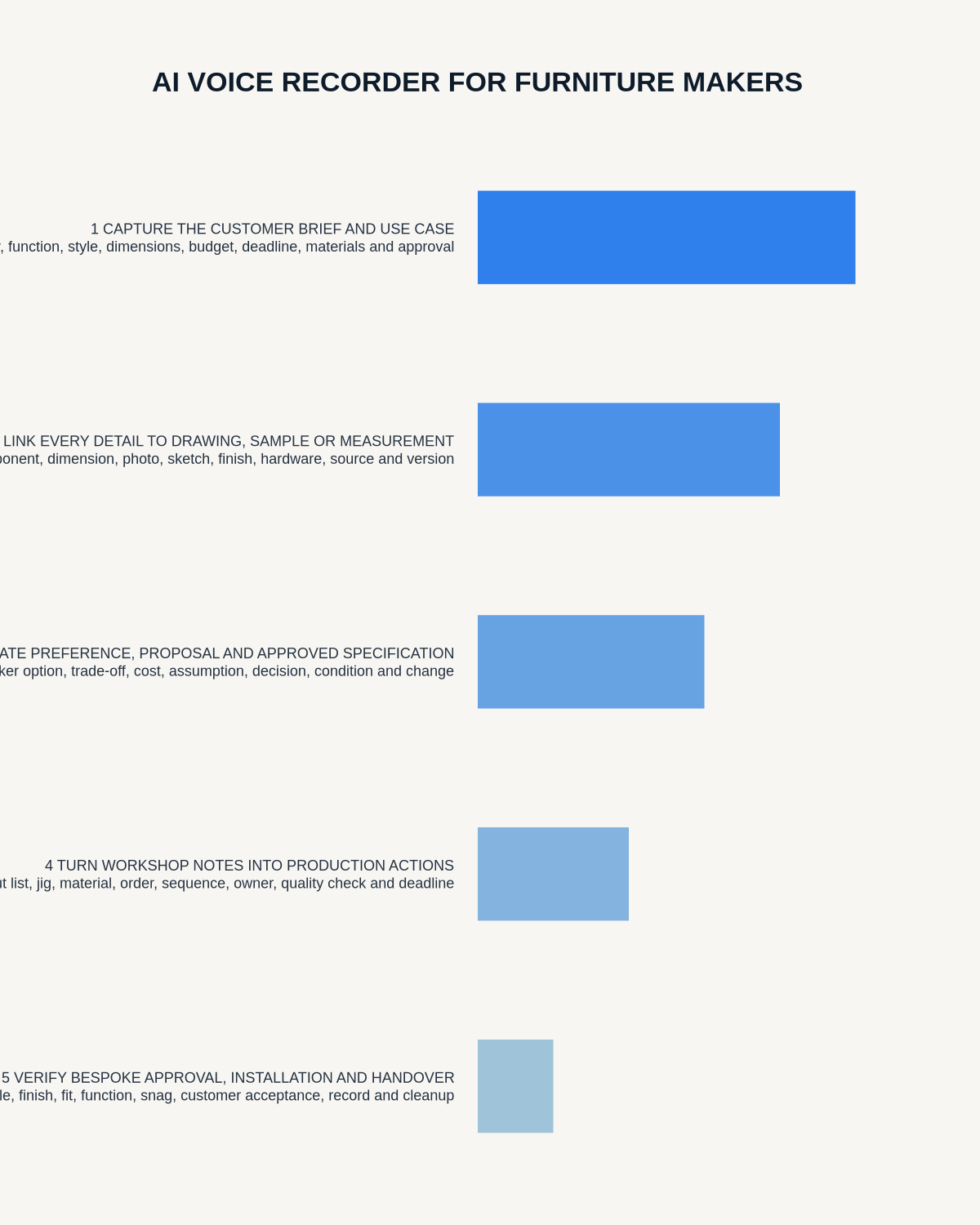
- Decision factors covered: Why bespoke furniture needs disciplined notes; The brief → test → approve → produce → verify workflow; Capture a customer brief that can guide design.
- Evidence rule: The decision is based on the complete capture-to-action workflow, not a single feature or marketing accuracy percentage.
- Boundary: Examples and workflow recommendations must be tested with representative recordings, the intended users and the actual approval process before rollout.

View Halo specifications for furniture makers use can make post-task capture faster, but it is not a measuring tool, CAD system, quality process or approval record.
Why bespoke furniture needs disciplined notes
A single piece may combine a customer’s subjective language, site dimensions, timber movement, hardware limitations, finish samples, ergonomic needs and delivery constraints. Without clear status labels, a comment such as “make the edge softer” can become an uncontrolled production change.
The brief → test → approve → produce → verify workflow
| Stage | Core question | Controlled output |
|---|---|---|
| Brief | Who will use the piece, for what purpose and under which constraints? | Agreed design criteria |
| Test | Which mock-up, joint, sample or prototype reduces uncertainty? | Evidence |
| Approve | Which option has the customer and maker accepted? | Signed-off selection |
| Produce | Which drawings, cutting lists, jigs and processes change? | Version-controlled instruction |
| Verify | Does the finished piece meet function, safety and finish requirements? | Quality closeout |
Capture a customer brief that can guide design
Record the intended user, room, function, capacity, dimensions, accessibility needs, style references, budget, programme, delivery route and maintenance expectations.
Translate subjective terms into criteria:
- “Minimal” might mean concealed fixings and reduced visual joints.
- “Family-proof” might mean rounded edges, repairable finish and stable construction.
- “Lightweight” should become a weight or handling requirement.
- “Timeless” should be tested through material, proportion and detail choices rather than treated as a specification.
Preserve the customer’s wording, then define what will prove that the design meets it.
Record only after machinery is safe
Do not operate the recorder while using saws, planers, routers, sanders, spray equipment, lifting systems or sharp hand tools. Isolate machinery, secure the component and move away from dust and noise before recording.
Connect every note to a component
Start with the project and component reference. State face, edge, joint or assembly. Include the drawing revision and current dimension.
“Reduce thickness” is unsafe. “Side rail SR-02, drawing Rev C, reduce finished thickness from the verified value to the proposed value, subject to joint and stiffness review” is traceable.
Use prototypes to answer one question at a time
A prototype or sample should have a defined purpose:
- Test joint fit and assembly sequence.
- Check proportion or ergonomics.
- Confirm movement clearance.
- Compare edge profiles.
- Assess hardware operation.
- Review finish colour, sheen or grain response.
Record the question, method, result, limitation and decision. A prototype that is not connected to a decision becomes workshop clutter rather than evidence.
Preserve design status
| Status | Meaning |
|---|---|
| Idea | Unreviewed concept |
| Prototype | Trial used for learning |
| Customer preference | Desired direction awaiting technical and cost review |
| Maker recommendation | Professional proposal awaiting approval |
| Approved design | Controlled version for production |
| Production change | Authorised amendment with revised records |
AI summaries often remove these distinctions. Reinstate them before the note is used.
Verify dimensions, tolerances and movement allowances
Check the datum, units, finished size, machining allowance, joint clearance, hardware clearance and expected material movement. Never manufacture from a transcribed value alone.
Where solid timber is involved, record grain orientation, moisture condition, board selection and how the design accommodates movement. The voice note should identify the issue; the controlled drawing and workshop judgement determine the solution.
Record material provenance and selection
Include species or product, grade, source or supplier, batch where relevant, thickness, veneer sequence, hardware and finish. Separate a natural variation from a defect and from a customer preference.
For replacement or matching work, link photographs and physical samples. A spoken colour description is not enough.
Build a finish-trial record
| Field | Required detail |
|---|---|
| Sample ID | Unique reference and substrate |
| Preparation | Sanding sequence, filler or conditioner |
| Coating | Product, mix, application and number of coats |
| Conditions | Drying time and environment |
| Result | Colour, sheen, texture and defects |
| Status | Proposed, approved or rejected |
The approved physical sample should remain the visual reference.
Control customer changes before production
For every change, record the exact request, technical impact, material impact, cost, programme, approval and documents affected. Update the drawing, cutting list, hardware schedule and quotation together.
Do not rely on a chat message or transcript as the only instruction to remake a component or change an approved finish.
Create a production handover
- Current drawing and revision.
- Component and quantity.
- Material, thickness and face selection.
- Critical dimensions and tolerances.
- Joint, hardware and jig references.
- Finish system and approved sample.
- Quality hold points.
- Outstanding decisions.
Use a final quality closeout
Verify dimensions, squareness, stability, joint fit, surface quality, edge treatment, hardware operation, finish match, safe use, delivery protection and customer approval. Record any limitation and aftercare instruction.
How NERALVO Halo fits furniture making
NERALVO Halo includes NOTE mode, supported CALL capture, 64GB local storage, up to 35 hours of recording and Bluetooth sync with DOWAY. DOWAY can create transcripts, summaries, speaker-separated notes, templates, translations, mind maps and exports. One year of DOWAY Max is included from activation.
It can reduce forgotten detail after a design review or workshop task. It does not replace safe working, measurement, testing, drawings or approval.
Cloud software, a dedicated recorder or manual notes?
For Furniture Makers, the right answer changes with the setting. This matrix deliberately gives each method a situation where it can be the strongest choice.
| Situation | Best starting point | Reason |
|---|---|---|
| scheduled remote meetings | Cloud meeting software | Native remote-meeting workflows can be more efficient here. |
| in-person or mobile work | Dedicated recorder | A separate battery and recoverable local source improve resilience. |
| recording is refused or prohibited | Manual notes or an approved alternative | Manual notes are the correct control when recording is unavailable. |
| mixed online and offline work | Governed hybrid | A hybrid can combine automation with reliable physical capture. |
Frequently asked questions
Can a client approve a finish through a transcript?
The transcript can record the discussion, but the approval should identify the exact physical or controlled digital sample and be entered into the project record.
Can AI create a cutting list from the discussion?
It may help organise a draft, but every component, dimension, quantity and allowance must be checked against the controlled design before production.
Should the whole workshop day be recorded?
No. Short post-task notes tied to a clear decision are more useful and less intrusive than continuous capture.
Final furniture-note checklist
- Machinery safely stopped.
- Project and component identified.
- Customer language translated into criteria.
- Prototype question and result recorded.
- Design status preserved.
- Dimensions and allowances verified.
- Material and finish references linked.
- Changes entered into controlled documents.
- Quality closeout completed.
Bottom line: a strong furniture-making voice note preserves why a decision changed, which evidence supported it and exactly where the approved instruction now lives.
Related guides
See the guides for carpenters and joiners, interior designers and kitchen designers.
On this page
Related guides
See whether Halo fits this workflow
Review the NERALVO Halo specifications, included services, delivery information and current offer only after completing the guide.
Found an error or an out-of-date claim? Email support@neralvo.com with the article address and a supporting source.