The 60-second verdict
Quick answer: journalists can use an AI voice recorder to preserve interviews and accelerate review, but every publishable quote must remain connected to the original audio, agreed interview terms, complete answer and surrounding context. A recording proves that words were spoken; it does not prove the underlying claim.
Best fit: Journalists who need recoverable audio and human-verified notes in an authorised workflow. Use another method when: recording is prohibited, a participant declines or the approved process requires manual notes.
Evidence basis and limits
- Decision factors covered: Use a three-layer interview record; Agree interview terms clearly; Capture useful interview markers.
- Evidence rule: Claims are weighted by consequence: capture failure, changed meaning, access and recovery matter more than polished wording.
- Boundary: Examples and workflow recommendations must be tested with representative recordings, the intended users and the actual approval process before rollout.

Check whether NERALVO Halo fits journalists work can support authorised interviews and field notes. It cannot determine truth, fairness, public interest or legal risk.
Use a three-layer interview record
| Layer | Purpose | Main risk |
|---|---|---|
| Original audio | Source evidence and complete context | Loss, unauthorised access or accidental alteration |
| Working transcript | Search, navigation and rough analysis | Misheard words, wrong speaker or false punctuation |
| Quote ledger | Checked wording approved for editorial use | Context removed or attribution misunderstood |
Do not overwrite the source audio after noise reduction, clipping or transcription. Create a working copy and preserve the original through the newsroom’s approved process.
Agree interview terms clearly
Labels such as on the record, background, not for attribution and off the record are used differently across organisations. Use the newsroom’s definitions and agree the meaning before sensitive information is shared.
- Can the source be named?
- Can their exact words be quoted?
- How may background information be attributed?
- Is any material embargoed?
- Which sections must not be recorded?
- Can the audio be processed through the proposed transcription service?
Where appropriate, repeat the agreed terms at the start of the recording and record any later change before it applies.
Capture useful interview markers
A reporter should still take brief notes. Mark the most important answer, documents shown, claims requiring independent verification, changes to attribution terms, visual or emotional context the audio cannot preserve and timestamps for possible quotations.
Ask the source to spell unfamiliar names and repeat critical figures or dates. Clear source audio reduces later uncertainty more than any AI feature.
Build the quote chain
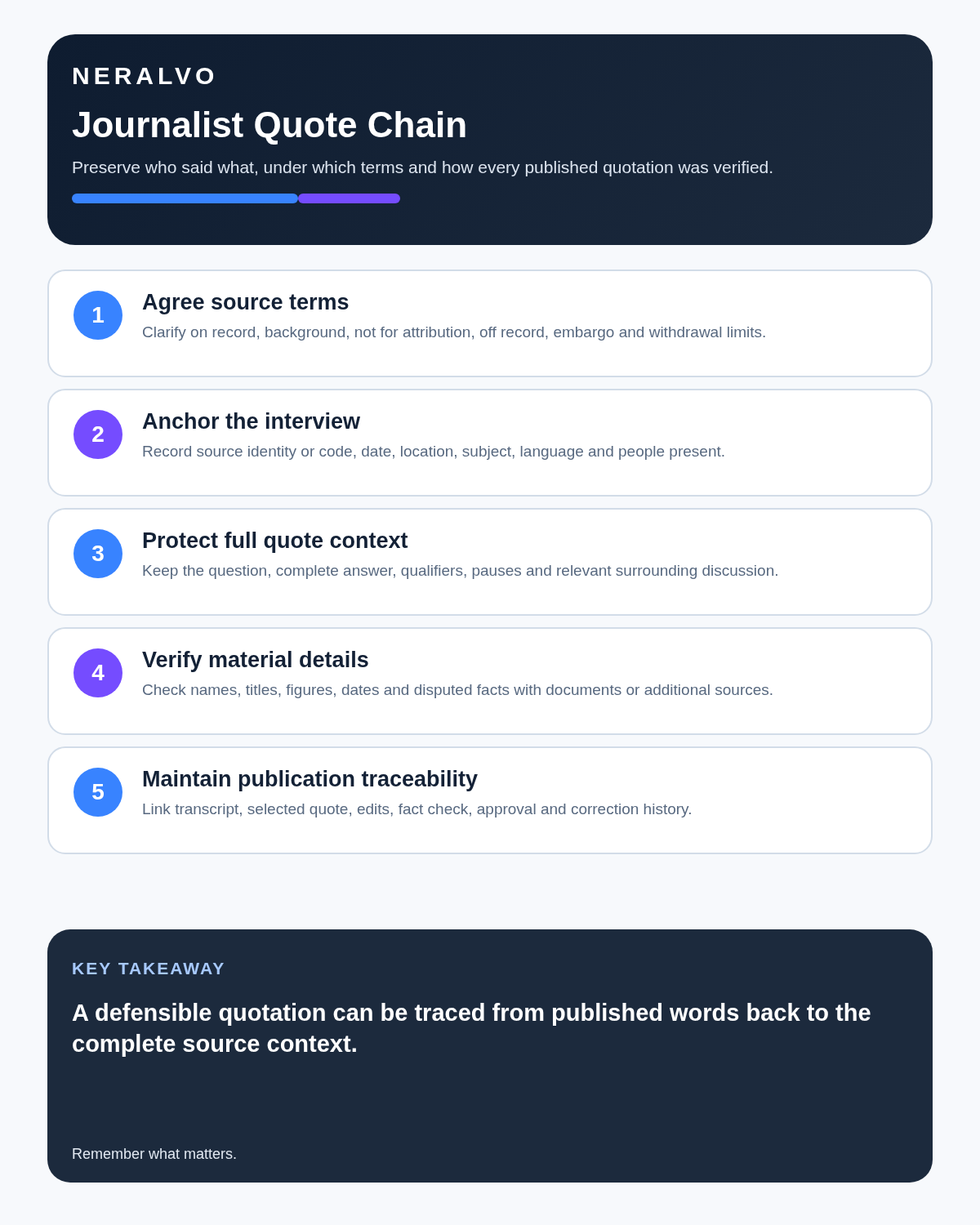
- Transfer the source file through the approved newsroom route.
- Generate a timestamped working transcript.
- Correct names, titles, organisations, places, units and technical terms.
- Mark inaudible or overlapping passages rather than guessing.
- Select the passage and review the full question and answer.
- Replay the exact section against the original audio.
- Record the agreed attribution status.
- Verify the underlying factual claim independently.
- Record editorial, legal, safety or source-protection risks.
Use a practical quote ledger
| Field | Record |
|---|---|
| Source reference | Named source or protected source code |
| Interview context | Date, time, location and reporter |
| Audio file | Approved newsroom reference |
| Timestamp | Start and end of the checked passage |
| Complete question | Prompt that produced the answer |
| Exact wording | Quotation verified against audio |
| Context | Relevant qualification and surrounding discussion |
| Attribution | Agreed publication description |
| Fact check | Documents or independent sources used |
| Editorial risk | Legal, safety, embargo or source-protection concern |
Verify quotations against the original audio
Listen before publication. Check omitted words, negatives, tense, grammar edits, interruptions, sarcasm and whether combined passages remain faithful. Do not edit grammar in a way that changes meaning or unfairly presents the source.
Separate quotation from claim verification
| Evidence | What it proves |
|---|---|
| Audio recording | The source said the words |
| Document | A record contains the stated information |
| Independent source | Additional account or evidence |
| Direct observation | The reporter witnessed a condition or event |
| Expert analysis | Qualified interpretation with stated limitations |
An accurate quotation can still contain a false, incomplete or interested claim. Identify what remains unverified.
Preserve fair response
For criticism or serious allegations, record the material claim, evidence basis, person or organisation affected, questions sent, deadline, response, non-response and how the final article represents that position.
AI must not invent a balancing response or make a non-response appear to confirm an allegation.
Protect confidential sources
A voice can identify a source through accent, background sound, location, metadata or the substance of the conversation. Before using cloud transcription, check processing locations, subprocessors, model-training terms, workspace access, sharing controls, export and deletion, and how long backups or working copies remain.
Use approved secure devices, accounts and transfer routes. Separate source-contact details from broadly accessible transcripts, minimise identifiers and follow the newsroom’s secure-source process. An ordinary consumer AI workflow may be unsuitable for a high-risk source.
See the NUJ’s source-protection guidance.
Handle trauma and vulnerable interviewees carefully
Explain the recording and intended use, avoid coercion, confirm boundaries and do not treat distress as proof of accuracy. Consider anonymity, present safety, future risk, children and whether publication may cause additional harm.
Covert recording is not an ordinary product feature
A small recorder can technically capture speech discreetly. That does not make secret recording ethically or legally routine. Hidden listening devices, interception, misrepresentation and subterfuge require the newsroom’s editorial and legal authorisation and a defensible public-interest basis under the standards that apply.
Do not improvise covert recording alone or treat device capability as permission. Review the current IPSO Editors’ Code of Practice.
Journalistic purpose is not a blanket data exemption
Data-protection rules recognise journalism and freedom of expression, but any applicable exemption is conditional rather than automatic. Security, accountability, necessity and the publication purpose remain important. Follow current newsroom legal guidance and the latest regulator material.
Use the latest newsroom legal guidance and the ICO’s current data-protection exemptions guide.
Use a field-recording routine
- Place the recorder close enough for clear speech without obstructing the source.
- Move away from traffic, machinery or strong wind where possible.
- Confirm the recording indicator before the first important question.
- Use written notes to identify speakers at press conferences.
- Capture a short test before a high-value interview.
- Use an approved backup where losing the interview would be serious.
- Record a separate private field memo for observations and unanswered questions.
Run the pre-publication check
- Every material fact is supported or clearly qualified.
- Quotations are exact and fair.
- Context and qualifications are preserved.
- The subject received an appropriate opportunity to respond.
- Privacy intrusion is justified and proportionate.
- Reporting restrictions and court rules were considered.
- Children and vulnerable people are protected.
- The headline matches the evidence.
- An editor or legal adviser reviewed significant risk.
How NERALVO Halo fits journalism
NERALVO Halo includes NOTE mode, supported CALL mode, 64GB local storage, up to 35 hours of recording and Bluetooth sync with DOWAY. CALL mode is not universal, so test the exact phone, case and route.
DOWAY provides transcripts, summaries, speaker-separated notes, templates, translations, mind maps and exports, with one year of DOWAY Max included. Critical interviews need a tested backup and a secure editorial workflow approved for the source and material involved.
Cloud software, a dedicated recorder or manual notes?
For Journalists, the right answer changes with the setting. This matrix deliberately gives each method a situation where it can be the strongest choice.
| Situation | Best starting point | Reason |
|---|---|---|
| scheduled remote meetings | Cloud meeting software | Calendar automation and shared integrations are usually the strongest advantage. |
| in-person or mobile work | Dedicated recorder | Independent capture reduces reliance on an active phone or laptop. |
| recording is refused or prohibited | Manual notes or an approved alternative | The boundary takes priority over convenience. |
| mixed online and offline work | Governed hybrid | Use each method only in the setting it actually fits. |
Frequently asked questions
Can a transcript be quoted without listening?
No. Verify publishable wording against the original source audio.
Does a recorded statement prove it is true?
No. Verify the underlying claim independently.
Can AI decide whether a source is credible?
No. Credibility requires editorial judgement, corroboration and context.
Can a consumer transcription service be used for a confidential source?
Only where the newsroom has assessed and approved the full data path for that level of risk.
Final journalism checklist
- Original audio preserved.
- Interview terms agreed and recorded.
- Source role and basis of knowledge clear.
- Quote ledger linked to timestamps.
- Quotes checked against audio.
- Context and qualification preserved.
- Claims independently verified.
- Fair response recorded.
- Source identity and material protected.
- Covert methods used only with proper authority.
- Final wording traceable to evidence.
Bottom line: trustworthy journalism protects the chain from source audio to checked quote to verified claim, with every edit answerable to the original evidence.
Related guides
See the guides for journalism students, researchers and content creators.
On this page
Related guides
See whether Halo fits this workflow
Review the NERALVO Halo specifications, included services, delivery information and current offer only after completing the guide.
Found an error or an out-of-date claim? Email support@neralvo.com with the article address and a supporting source.