The 60-second verdict
Quick answer: content creators can use an AI voice recorder to capture interviews, audience questions, hooks and production ideas, but every quotation, clip and commercial reuse must remain connected to its source, permission, fact-check status and context.
Best fit: Content Creators who need recoverable audio and human-verified notes in an authorised workflow. Use another method when: recording is prohibited, a participant declines or the approved process requires manual notes.
Evidence basis and limits
- Decision factors covered: Use an audience → problem → promise → proof workflow; Create a SPARK idea note; Separate content states.
- Evidence rule: Claims are weighted by consequence: capture failure, changed meaning, access and recovery matter more than polished wording.
- Boundary: Examples and workflow recommendations must be tested with representative recordings, the intended users and the actual approval process before rollout.
One interview can produce many assets, but technical ease does not create permission to republish, remix or advertise with another person’s words. The useful workflow maps the source before repurposing begins.
Build a source-permission map
| Field | Example |
|---|---|
| Timestamp | 00:18:24–00:19:10 |
| Topic | Why the original workflow failed |
| Speaker | Guest, customer or creator |
| Permission | Podcast and organic social; no paid advertising |
| Fact check | Statistic requires a primary source |
| Possible formats | Short clip, newsletter and FAQ |
| Context risk | Do not remove the qualification |
| Review date | Campaign or permission expiry |
Use an audience → problem → promise → proof workflow
- Audience: who the content is for.
- Problem: the specific question or tension.
- Promise: what the viewer or reader will gain.
- Proof: experience, demonstration, data or source.
- Format: article, video, short, email or podcast.
- Action: the next useful step for the audience.
Create a SPARK idea note
- S — Subject: audience and problem.
- P — Promise: value or reason to continue.
- A — Angle: distinctive perspective.
- R — Reason: evidence, story or example.
- K — Kick-off: format and next production action.
Separate content states
- raw idea;
- research question;
- source statement;
- draft claim;
- verified fact;
- sponsored requirement;
- approved final copy.
Do not publish a machine summary as though it has been fact-checked or approved.
Recording-to-content workflow
- Define the audience and purpose.
- Confirm recording, publication and commercial permissions.
- Capture the source interview or private idea.
- Correct transcript names, quotations and references.
- Build the source-permission map.
- Select a distinct angle for each format.
- Create a claim register for material statements.
- Check facts, copyright, sponsor and platform requirements.
- Edit in the creator’s own voice.
- Label advertising, affiliate and gifted relationships clearly.
- Complete editorial and brand approval.
- Publish approved assets and track outdated claims.
- Archive or delete source material under the project plan.
Permission is format-specific
Agreement to appear in a podcast does not automatically include paid advertising, future campaigns, quotation graphics, training datasets or remixes. Record:
- allowed channels and formats;
- commercial or non-commercial use;
- duration and territory;
- editing boundaries;
- attribution or anonymity requirements;
- withdrawal or expiry terms where applicable.
Build a claim register
For every material claim, record:
- exact wording;
- source and date;
- scope and limitation;
- verification status;
- whether a demonstration or disclaimer is required;
- approved final wording;
- review or expiry date.
Verify product details, statistics and quotations against authoritative sources before publication.
Adapt rather than duplicate
| Format | Best adaptation |
|---|---|
| Short video | One self-contained idea with immediate context |
| Carousel | Structured steps, contrasts or examples |
| Newsletter | Deeper context, source links and commentary |
| Article | Complete argument, evidence and limitations |
| FAQ | Direct answer to a recurring question |
| Paid ad | One substantiated promise matched to the landing page |
Publishing the same AI summary everywhere creates repetitive, low-value content and can spread an error across every channel.
Protect interviewees and private stories
Obtain the required permission for interviews, testimonials, private conversations and identifiable stories. Remove unnecessary personal data and preserve conditions that materially change the meaning.
A recording does not transfer copyright or ownership of another person’s story, performance, music, images or creative work.
Maintain advertising transparency
Keep sponsorship, affiliate, gifted-product and brand-message requirements visible during editing. A spoken brief should not hide the commercial relationship. The final content must include the disclosures required by the relevant platform and advertising rules.
How NERALVO Halo may fit content creation
Check whether NERALVO Halo fits content creators work can support private ideas, approved interviews and post-shoot notes through NOTE mode, supported CALL capture, 64GB local storage and DOWAY transcription tools. It is not a fact-checking, rights-management or publishing system.
Final content checklist
- Audience and purpose are precise.
- Every source passage has a permission status.
- Quotations retain context and attribution.
- Claims and product details are verified.
- Copyright and privacy are cleared.
- Commercial relationships are disclosed.
- The format has been adapted rather than copied.
- The final version has editorial approval.
- Source audio is restricted and retained deliberately.
Bottom line: AI makes long recordings easier to reuse. Quality and trust depend on mapping source, permission, evidence and context before each new asset is created.
Cloud software, a dedicated recorder or manual notes?
For Content Creators, the right answer changes with the setting. This matrix deliberately gives each method a situation where it can be the strongest choice.
| Situation | Best starting point | Reason |
|---|---|---|
| scheduled remote meetings | Cloud meeting software | Calendar automation and shared integrations are usually the strongest advantage. |
| in-person or mobile work | Dedicated recorder | Independent capture reduces reliance on an active phone or laptop. |
| recording is refused or prohibited | Manual notes or an approved alternative | The boundary takes priority over convenience. |
| mixed online and offline work | Governed hybrid | Use each method only in the setting it actually fits. |
Related guides
Profession workflow
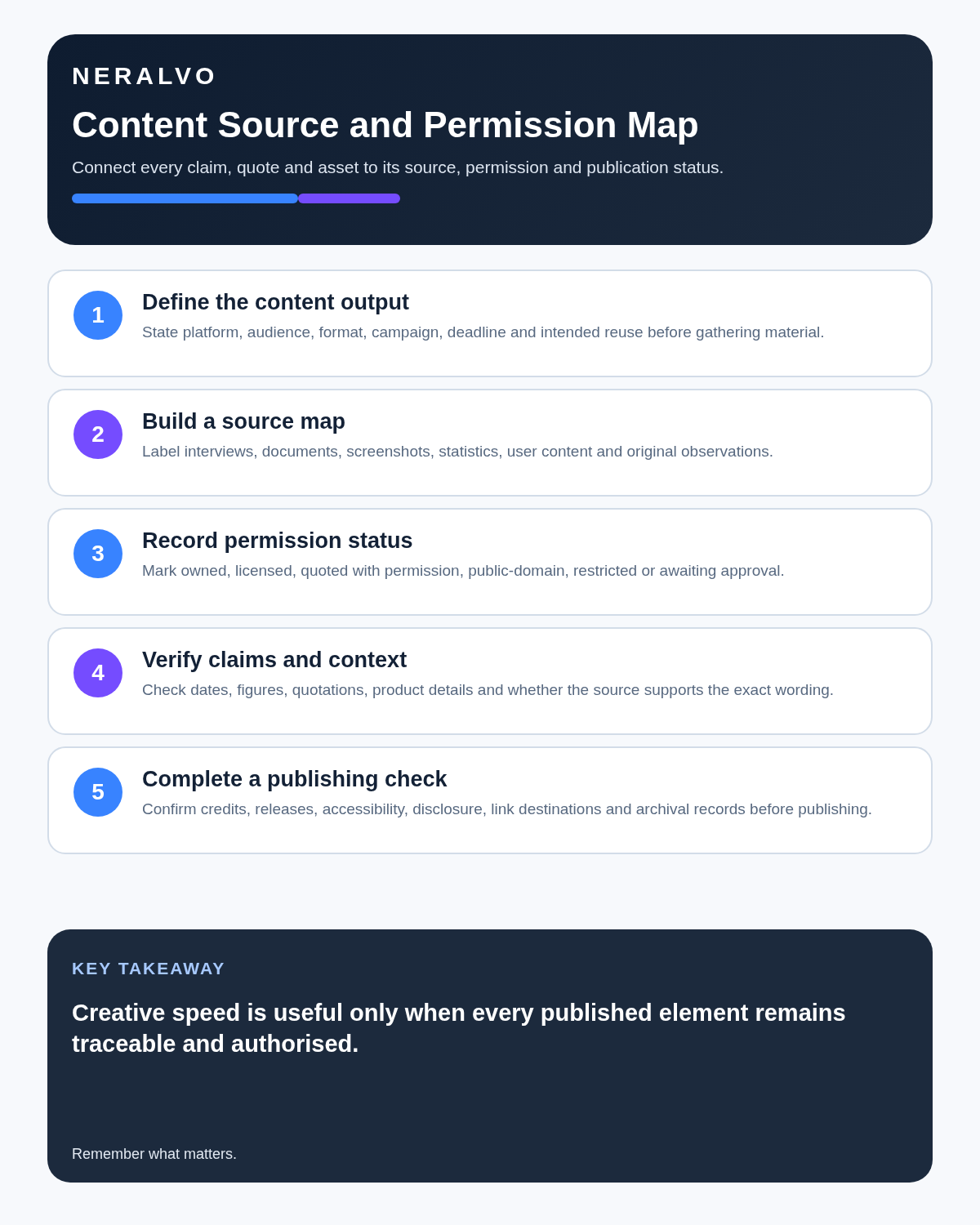
Visual map for AI Voice Recorder for Content Creators: Map Every Source and Permission
- Prepare the approved useDefine purpose, safe position, permission and the required formal record.
- Capture context firstState the case, asset, person, location or event identifier before detail.
- Human-verify evidenceCheck technical terms, units, names, dates, decisions and uncertainty.
- Complete the formal recordTransfer only verified information and apply access and retention controls.
On this page
Related guides
See whether Halo fits this workflow
Review the NERALVO Halo specifications, included services, delivery information and current offer only after completing the guide.
Found an error or an out-of-date claim? Email support@neralvo.com with the article address and a supporting source.