The 60-second verdict
Quick answer: use an AI voice recorder for market research by defining the research question, approving the participant and supplier workflow, capturing context as well as words, correcting the transcript and maintaining a traceable path from evidence to conclusion.
Best fit: Market Research who need recoverable audio and human-verified notes in an authorised workflow. Use another method when: recording is prohibited, a participant declines or the approved process requires manual notes.
Evidence basis and limits
- Decision factors covered: Choose the right method; Explain the complete workflow; Capture context.
- Evidence rule: The decision is based on the complete capture-to-action workflow, not a single feature or marketing accuracy percentage.
- Boundary: Examples and workflow recommendations must be tested with representative recordings, the intended users and the actual approval process before rollout.
Market research may involve interviews, focus groups, field observations and diary studies. A recorder such as View Halo specifications for market research use can preserve detail, but AI-generated themes do not replace a documented research method.
Choose the right method
- One-to-one interviews: individual experiences and decision processes.
- Focus groups: interaction, shared language and disagreement.
- Contextual observation: behaviour in the real setting.
- Telephone interviews: reach and convenience.
- Diary or voice-note studies: experiences over time.
Define the research question
State what the study needs to understand and which decisions it will inform. Avoid collecting broad recordings with no planned analysis.
Explain the complete workflow
Participants should understand why audio is needed, whether AI transcription is used, who can access source and text, quotation plans, retention, withdrawal limits and any confidentiality limits in a group setting.
Capture context
- Date and location
- Participant code
- Relevant environment
- Stimulus or question used
- Interruptions and technical problems
- Researcher observations kept separate from participant speech
Correct before analysis
Verify speakers, names, brands, figures and quotations. Mark overlap and inaudible sections honestly. Remove unnecessary identifiers and keep a record of material corrections where the study requires it.
Analyse through a documented method
Define the unit of analysis, coding approach, codebook changes, treatment of contradictory evidence and how AI-suggested themes are accepted or rejected. Frequency alone does not prove importance.
Link claims to evidence
Every major conclusion should be traceable to checked excerpts, field notes or other data. Preserve segment differences and negative cases rather than flattening them into one convenient story.
Cloud software, a dedicated recorder or manual notes?
For Market Research, the right answer changes with the setting. This matrix deliberately gives each method a situation where it can be the strongest choice.
| Situation | Best starting point | Reason |
|---|---|---|
| scheduled remote meetings | Cloud meeting software | Native remote-meeting workflows can be more efficient here. |
| in-person or mobile work | Dedicated recorder | A separate battery and recoverable local source improve resilience. |
| recording is refused or prohibited | Manual notes or an approved alternative | Manual notes are the correct control when recording is unavailable. |
| mixed online and offline work | Governed hybrid | A hybrid can combine automation with reliable physical capture. |
Frequently asked questions
Can AI perform the qualitative analysis?
It can support organisation and coding suggestions, but accountable researchers must apply and document the method.
Should every participant be quoted?
No. Use quotations that support the analysis and comply with the participant information and identification controls.
Can recordings be reused for another study?
Only where the original information, permissions and governance support the new purpose.
Useful resources
- Market Research Society Code of Conduct
- ICO research provisions guidance
- View Halo specifications for market research use
Market-research checklist
- Question and decision use defined
- Method justified
- Participant information accurate
- Context captured
- Transcript corrected
- Analysis method documented
- Claims traceable to evidence
- Access and retention controlled
Market-research decision and audit toolkit
Strengthen the study by connecting each research activity to a decision, sample rationale, evidence standard and limitation. This prevents a large transcript archive from being mistaken for a defensible research programme.
Research decision canvas
| Field | Question |
|---|---|
| Decision | What will the organisation decide differently because of this study? |
| Population | Which people, buyers, users or stakeholders are relevant? |
| Evidence need | Behaviour, language, prevalence, process, motivation or reaction? |
| Method | Why is an interview, group, observation, diary or survey suitable? |
| Disconfirming evidence | What finding would weaken the current assumption? |
| Decision deadline | When must findings be ready and who owns the decision? |
Build deliberate sample variation
Recruit across the dimensions that could change the answer: role, authority, organisation size, frequency of the problem, current workaround, previous rejection, accessibility need, language, geography and purchase stage. Record who was excluded and why. A narrow convenience sample can still produce valuable learning, but its limits must be explicit.
Use a field-capture bundle
- Participant code and session metadata.
- Corrected audio transcript.
- Time-linked observation notes.
- Stimulus, task or discussion guide version.
- Photograph, artefact or screen reference where permitted.
- Researcher reflection kept separate from participant evidence.
- Technical or environmental limitations.
Focus-group dominance check
For each topic, note who introduced it, who agreed, who disagreed, who did not contribute and whether the moderator prompted the response. Count participants only where counting is analytically appropriate; repeated statements from one dominant speaker are not multiple independent observations.
Evidence-to-finding audit trail
| Finding component | Required support |
|---|---|
| Claim | Plain-language conclusion with defined segment and context |
| Evidence | Checked excerpts, observations, artefacts or quantitative source |
| Variation | Who experienced it differently and why |
| Contradiction | Negative case or evidence that weakens the claim |
| Confidence | Effect of sample, method, data quality and researcher judgement |
| Implication | Decision or next test, clearly separated from the finding |
Research quality metrics
Track sessions with unusable audio, transcript corrections affecting meaning, missing participant records, findings without traceable evidence, sample gaps, unresolved contradictions and source files retained beyond plan. These metrics reveal process quality more reliably than the number of interviews completed.
Practical NERALVO Halo setup
Test the exact room or call route, confirm participant information before capture, use participant codes in filenames, state topic transitions aloud and record private researcher reflections separately. Correct the transcript before coding and use DOWAY summaries only as navigational drafts. The study repository—not the recorder or app—should remain the authoritative research environment.
Decision-release questions
- Does the finding answer the original decision question?
- Is the relevant segment clear?
- Can every material claim be traced to checked evidence?
- Were contradictory cases considered?
- Are limitations visible beside the conclusion?
- Is the recommendation presented as a choice rather than a fact?
Related AI voice recorder guides
Profession workflow
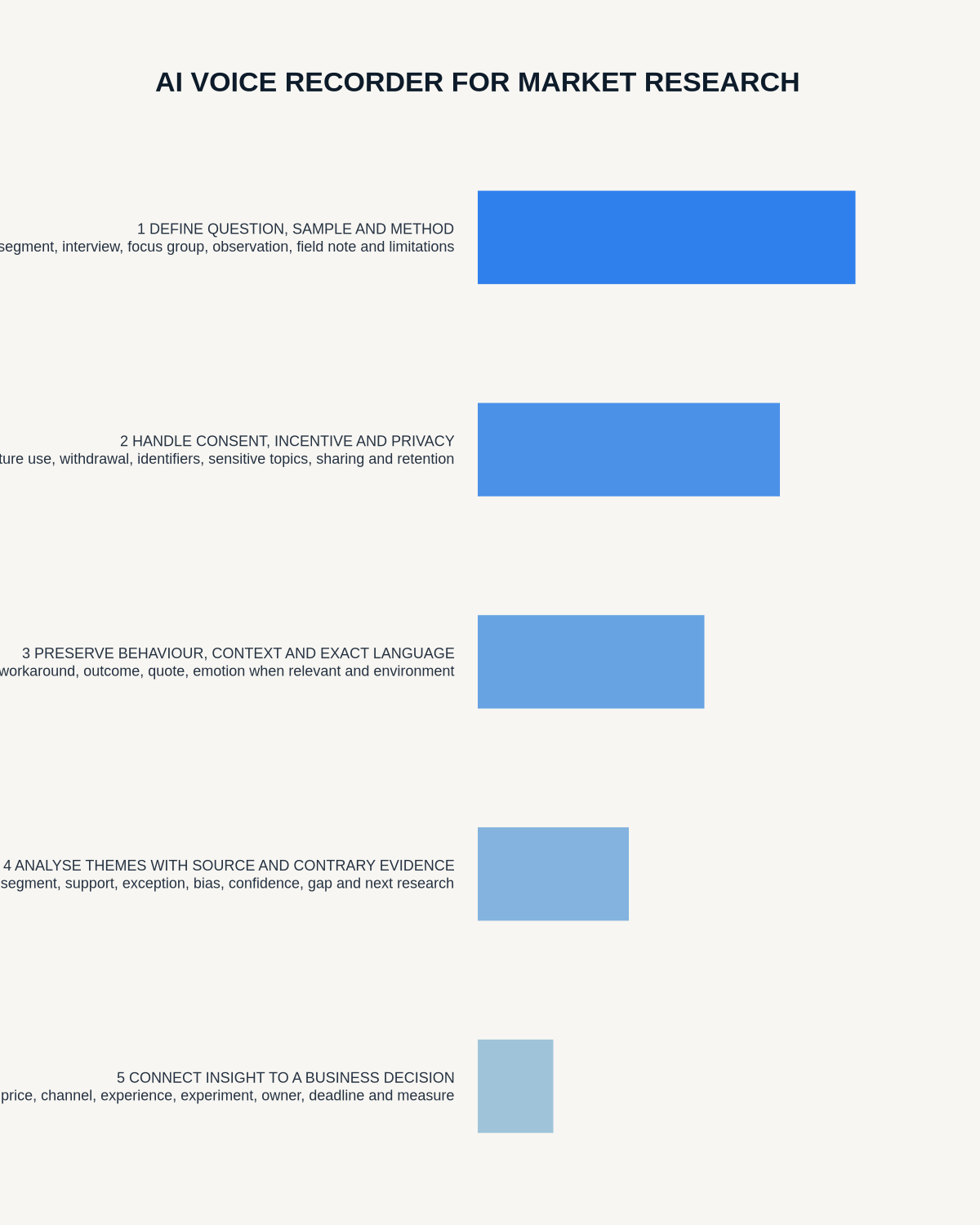
Visual map for AI Voice Recorder for Market Research: Interviews, Focus Groups and Field Notes
- Prepare the approved useDefine purpose, safe position, permission and the required formal record.
- Capture context firstState the case, asset, person, location or event identifier before detail.
- Human-verify evidenceCheck technical terms, units, names, dates, decisions and uncertainty.
- Complete the formal recordTransfer only verified information and apply access and retention controls.
On this page
Related guides
See whether Halo fits this workflow
Review the NERALVO Halo specifications, included services, delivery information and current offer only after completing the guide.
Found an error or an out-of-date claim? Email support@neralvo.com with the article address and a supporting source.