The 60-second verdict
Quick answer: create an auditable research transcript by preserving the original audio, defining the transcription standard, documenting every material correction, protecting participant identity and keeping a traceable link from source file to transcript, coding and final research claim.
Decision focus: use the method below only where it produces a recoverable source, a verifiable output and a clear next action. If one of those fails, change the workflow rather than trusting a polished summary.
Evidence basis and limits
- Decision factors covered: Start with the research protocol and data-management plan; Define the required transcription standard; Create a provenance record.
- Evidence rule: A claim earns weight only when the source, date, configuration and limitation are clear enough for a reader to check.
- Boundary: Examples and workflow recommendations must be tested with representative recordings, the intended users and the actual approval process before rollout.

Research transcription is evidence preparation, not simple text conversion. An AI recorder such as Apply this guide before assessing NERALVO Halo can support approved interviews, but the device, transcription service and review process must fit the protocol, ethics approval and data-management plan.
Start with the research protocol and data-management plan
Before recording, define:
- The research question and method.
- The participant-information and consent process.
- Which audio, notes, documents and contextual material will be collected.
- The transcript type and notation convention.
- Who may access identifiable and de-identified data.
- Which device, app, processor and storage locations are approved.
- How pseudonyms and identity keys will be managed.
- How participant requests and withdrawal terms will be handled.
- How long each file type will be retained.
- What will be archived, shared or deleted at project close.
Do not choose the transcription tool first and attempt to make the ethics and data plan fit it afterwards.
Define the required transcription standard
- Verbatim: preserves speech features under a defined convention.
- Intelligent verbatim: removes limited verbal clutter without changing meaning.
- Conversation analysis: records timing, overlap and interaction in more detail.
- Translated transcript: keeps the source language and translation as separate layers.
- Summary record: suitable only when the approved methodology does not require a full transcript.
Document the convention and apply it consistently across the dataset. Changing it during the project can weaken comparison and auditability.
Create a provenance record
For each file, retain the source identifier, participant code, date, interviewer, device, processing service, transcript version, reviewer, correction date and de-identification status.
Preserve the original source
Store the original audio under restricted access and do not overwrite it. Label machine output clearly as an unverified draft. Use checksums or other integrity controls where the research plan requires them.
Secure the source immediately after capture
- Confirm that the correct file was captured.
- Transfer it through the approved route.
- Store it in the authorised repository.
- Check that access permissions are correct.
- Remove unnecessary copies from personal devices.
- Record the transfer and file status.
- Do not begin AI processing through an unapproved account.
Create a participant and file-reference system
Use project identifiers rather than names in working filenames where practical. A useful pattern is:
PROJECT-ROUND-PARTICIPANT-DATE-FILETYPE-VERSION
Keep the identity key separately, restrict it more tightly and record who may reconnect participant codes to identities.
Use consistent transcript conventions
Define markers for inaudible speech, overlap, pauses, uncertain speakers, translation, researcher notes and removed identifiers. Apply the same conventions across the dataset.
Correct material detail systematically
Verify names, specialist terms, numbers, dates, units, sequences, speaker labels and quotations against the audio. Preserve negation, modality, conditional language, uncertainty and dialect where they matter to the analysis. Do not silently rewrite the participant into a more polished or certain speaker.
Where the method requires it, also preserve overlap, pauses, non-verbal features and contextual detail. Mark unclear passages honestly rather than guessing.
Maintain a correction log
The level of detail should match the project risk, but an auditable process should show:
- Which software or service created the first transcript.
- Who checked it and when.
- The transcript convention used.
- Whether the entire file or a defined sample was checked.
- Known audio limitations.
- How inaudible sections were marked.
- How names and technical terms were verified.
- Which version was approved for analysis.
Separate transcript, coding and interpretation
The transcript represents the source. Coding and interpretation are later analytical layers. Record codebook versions, changes to categories and whether AI suggestions were accepted, rejected or modified by the researcher.
Keep participant evidence, researcher memos, machine-generated themes and formal findings visibly separate. A fluent AI summary or mind map is another transformation—not a research conclusion.
Use AI-generated themes as prompts, not findings
AI may group similar language while missing irony, power, context, minority evidence or a negative case. Compare suggested themes with the full transcripts, stated method, codebook and disconfirming material. Record the human reasoning that developed the final analysis.
Protect participant identity
Use participant codes, store any re-identification key separately and assess whether rare events, places, roles or quotations could still identify someone. Pseudonymisation is not the same as anonymity.
Review direct and indirect identifiers, including names, contact details, employers, precise roles, small locations, rare events, family or health detail, third parties, searchable quotations, filenames and metadata.
Document de-identification decisions
| Detail | Possible action | Reason |
|---|---|---|
| Exact employer | Replace with a sector category | Reduce identification risk while preserving analytic relevance |
| Rare event | Generalise or restrict access | High indirect-identification risk |
| Third-party name | Replace with a role | Protect someone outside the study |
| Town and workplace | Use a broad region | The combination may identify the participant |
| Distinctive quotation | Restrict, shorten or paraphrase only where the method permits | Searchable wording may reveal the speaker |
Record whether each detail was removed, generalised, replaced, restricted or retained because it was analytically necessary.
Handle multilingual transcription and translation
Preserve the source-language audio and, where feasible, a checked source transcript. Document who translated the material, the translation approach, how dialect and cultural references were handled, which quotations were back-checked and where meaning remained uncertain.
A smooth translated transcript can still misrepresent the participant’s certainty, emphasis or intended meaning.
Control access by research role
| Role | Possible access |
|---|---|
| Principal investigator | Approved identifiable source and project records |
| Transcriber | Only the files required under the approved agreement |
| Analysis team | De-identified transcript where possible |
| External collaborator | Minimum dataset defined by agreement |
| Archive or public user | Only material cleared for sharing |
Access should follow the protocol and data plan rather than convenience.
Use a complete audio-to-dataset workflow
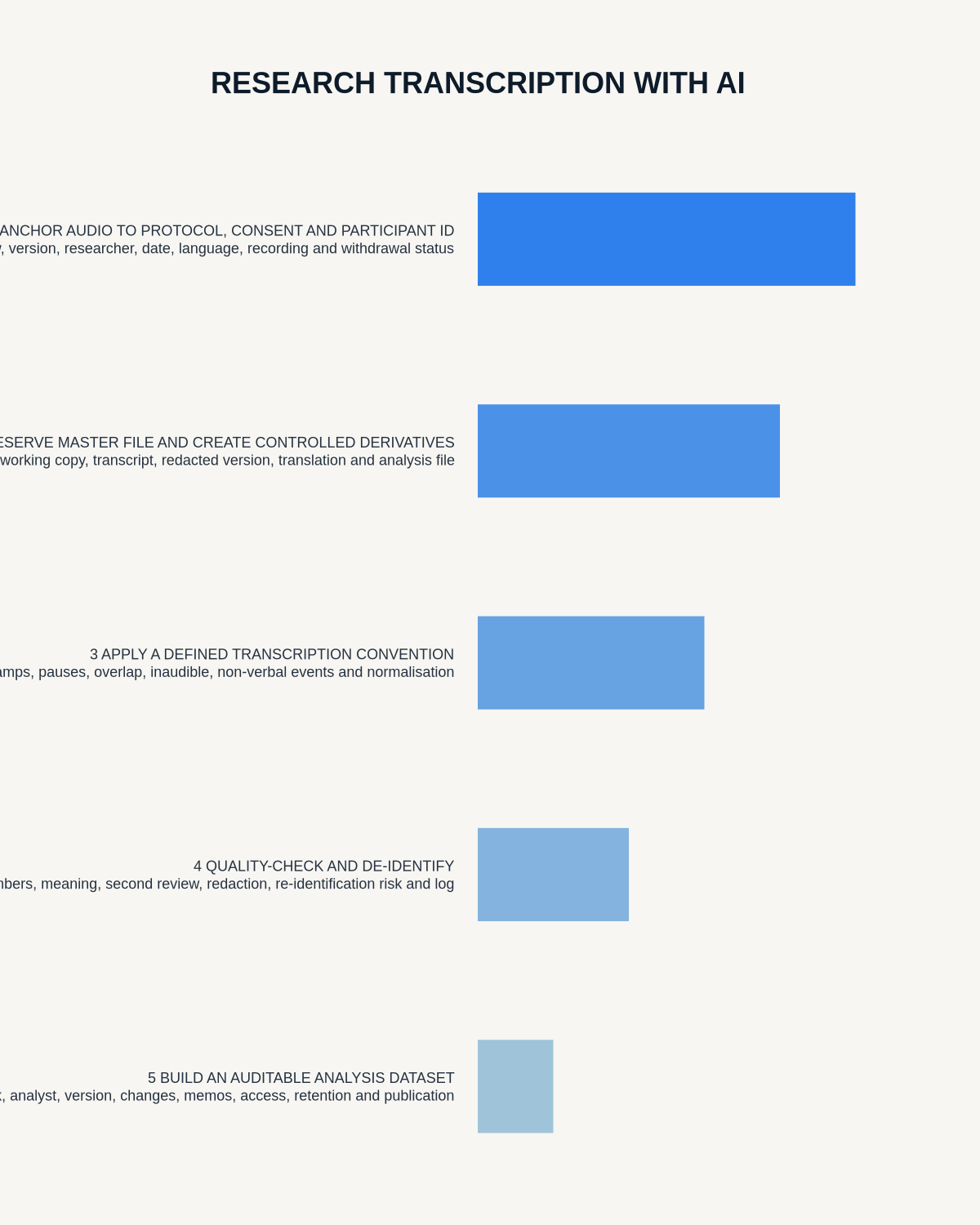
- Confirm participant information and the approved recording process.
- Capture the interview with a tested setup and backup notes.
- Transfer and secure the original audio.
- Create the raw machine transcript in the approved environment.
- Correct it using the documented convention.
- Record reviewer, date, limitations and version.
- Create the de-identified analytic copy.
- Quality-check identifiers, quotations and uncertain passages.
- Import the approved version into the authorised analysis repository.
- Apply the stated coding or analytical method.
- Keep findings traceable to evidence and analytic memos.
- Apply participant requests, retention, archiving and deletion rules.
Apply proportionate quality assurance
Depending on risk and method, use full listening, double-checking, independent review of high-consequence extracts or documented sampling across interviewers, languages, accents and recording conditions. Give full review to quotations, disputed passages, poor audio and information that materially affects the analysis.
Report what was checked and the known limitations rather than claiming perfect transcription accuracy.
Workflow choice matrix for Research Transcription with AI
Choose the method that protects the source and reduces downstream correction. The table makes the non-hardware options explicit.
| Condition | Preferred route | Why |
|---|---|---|
| Repeatable remote work with approved integrations | Cloud software | Automation and central collaboration may outweigh device independence. |
| In-person, mobile or unreliable-connectivity work | Dedicated recorder | Independent capture and a recoverable local source are usually more resilient. |
| Recording is refused, prohibited or unnecessary | Manual notes / no recording | Respecting the boundary is the correct workflow, not a product failure. |
| High-risk or mixed work | Governed hybrid | Separate capture, review, approval and retention rather than trusting one tool. |
Frequently asked questions
Can AI transcription be used without human review?
Not where accuracy affects analysis. The review depth should match the research question and risk.
Should every correction be logged?
Material corrections and version changes should be documented according to the project’s audit requirements.
Can the same transcript be used in a new study?
Only where the original participant information, permissions, ethics and governance permit the new use.
Can AI themes be reported as findings?
Not by themselves. Findings require a defensible method, contextual interpretation and researcher review.
Does replacing names make data anonymous?
Not necessarily. Indirect identifiers, metadata and searchable quotations may still reveal identity.
Useful resources
- UKRI research-data guidance
- ICO research provisions guidance
- Podcast Transcription with AI
- Offline AI Voice Recording
- Apply this guide before assessing NERALVO Halo
Audit checklist
- Protocol, consent and data plan defined.
- Transcription standard documented.
- Original source preserved and secured.
- Machine draft labelled.
- Corrections, limitations and versions documented.
- Uncertainty marked consistently.
- Participant identity protected.
- Coding separated from source text.
- Quality assurance documented.
- Claims traceable to checked evidence.
Research data-lineage and quality-assurance toolkit
Create an explicit chain from the participant and source file to every analytical output. This makes corrections, access decisions and published quotations auditable.
| Layer | Required metadata | Access rule |
|---|---|---|
| Original audio | Participant code, date, device, interviewer and checksum where required | Most restricted source group |
| Machine transcript | Processor, model or service, run date and settings | Label as unverified |
| Corrected transcript | Reviewer, convention, completion date and known limitations | Approved research team |
| De-identified copy | Redaction decisions and identity-risk review | Analysis team |
| Coded dataset | Codebook version, coder and adjudication status | Method-defined access |
| Quotation or publication file | Source ID, timestamp, approval and wording check | Publication-cleared only |
Quality-assurance sampling plan
Define whether every transcript receives full audio review or whether a documented sample is appropriate. Sample across interviewers, languages, accents, recording environments and participant groups. Give full review to material quotations, safety-critical data, disputed passages and transcripts with poor audio.
Weighted error categories
- Critical: reversed meaning, wrong speaker, false quotation or identity disclosure.
- High: wrong name, date, figure, technical term or omitted condition.
- Medium: punctuation or paragraphing that affects interpretation.
- Low: cosmetic differences with no analytical effect.
Report the checking method and limitations rather than claiming perfect accuracy.
De-identification risk review
Check direct identifiers, rare roles, exact locations, family relationships, distinctive events, searchable quotations, filenames and metadata. Record whether the detail was removed, generalised, replaced, restricted or retained because it is analytically necessary.
Version naming example
PROJECT-R03-P014-2026-08-03-TRANSCRIPT-CORRECTED-v02
Do not overwrite earlier states. Mark one version as approved for analysis and prevent teams from coding an outdated machine draft.
NERALVO Halo workflow
Use Halo only when the ethics and data-management process approves the complete route. Capture with participant codes, transfer promptly, confirm the file, restrict the original and generate transcripts only through the approved account. DOWAY outputs can assist navigation, but the corrected transcript and controlled research repository remain authoritative.
Audit release questions
- Can every analytic extract be traced to a source and timestamp?
- Is the transcript convention documented?
- Are corrections and limitations visible?
- Is the identity key stored separately?
- Are AI-generated themes separated from formal analysis?
- Do retention and participant-request rules cover every derivative copy?
On this page
Related guides
See whether Halo fits this workflow
Review the NERALVO Halo specifications, included services, delivery information and current offer only after completing the guide.
Found an error or an out-of-date claim? Email support@neralvo.com with the article address and a supporting source.