The 60-second verdict
Music students often leave a lesson remembering the general message but not the exact bar, tempo, fingering, bowing or practice method. A short, well-designed recording can preserve the right detail without turning every lesson into a permanent performance archive.
Best fit: Music Teachers who need recoverable audio and human-verified notes in an authorised workflow. Use another method when: recording is prohibited, a participant declines or the approved process requires manual notes.
Evidence basis and limits
- Decision factors covered: The hear → mark → practise → compare cycle; Stage 1: Hear one purposeful sample; Stage 2: Mark the exact musical location.
- Evidence rule: The decision is based on the complete capture-to-action workflow, not a single feature or marketing accuracy percentage.
- Boundary: Examples and workflow recommendations must be tested with representative recordings, the intended users and the actual approval process before rollout.
An AI voice recorder for music teachers can support permitted short examples, spoken practice instructions and private progress notes. It cannot assess musical quality independently, create reliable notation from ordinary speech capture, predict an exam grade or replace direct demonstration and teacher judgement.
The hear → mark → practise → compare cycle
| Stage | Teaching question | Output |
|---|---|---|
| Hear | What is audible in this short passage? | Specific evidence |
| Mark | Where in the score or structure does it occur? | Exact reference |
| Practise | Which method will target it? | Clear home action |
| Compare | What changed under similar conditions? | Progress evidence |
This cycle keeps the recording connected to a teachable musical decision rather than a vague instruction to “make it better.”
Stage 1: Hear one purposeful sample
Choose a short passage that answers a clear question, such as:
- Is the pulse maintained through the diminuendo?
- Does the articulation remain consistent across the phrase?
- Is the accompaniment covering the melodic line?
- Does the breath plan support the final bars?
- Can the learner sustain the intended character at the current tempo?
Explain what will be recorded, how it will be used and when it will be deleted. A short before-and-after passage is normally more useful than automatic full-lesson recording.
Stage 2: Mark the exact musical location
Connect feedback to the score or piece structure. Verify:
- Piece, movement or song.
- Bar, rehearsal mark or section.
- Beat or phrase.
- Tempo and unit.
- Fingering, sticking, bowing or position.
- Articulation, dynamic and expression marking.
Speech recognition can confuse numbers, note names and foreign musical terms. Check every instruction against the score and the teacher’s actual decision before sharing it.
Stage 3: Design the practice method
A useful instruction states not only what to improve, but how to work on it. Examples include:
- Separate hands at the stated tempo.
- Rhythm variation across the difficult group.
- Slow bow or breath planning over the phrase.
- Silent fingering before adding sound.
- Reduced range before restoring the full passage.
- Looping two bars with a defined rest.
- Recording one final attempt after successful repetitions.
Match the method to the learner’s age, instrument, available time and current technique. AI should not create a large generic schedule that competes with the teacher’s priorities.
Stage 4: Compare under suitable conditions
Progress recordings are useful only when the comparison is fair. Room acoustics, instrument, tuning, microphone distance, accompaniment and repertoire difficulty can change the result.
Ask:
- Was the passage and tempo comparable?
- Was the recording position similar?
- Did the learner use the agreed method?
- Is the improvement audible in the target feature?
- What still requires direct observation?
Preserve the learner’s own reflection. A louder or cleaner recording is not automatically a better performance.
Separate musical layers in the feedback
| Layer | Examples |
|---|---|
| Accuracy | Pitch, rhythm, entries and text |
| Technique | Posture, coordination, breath, touch or bow control |
| Sound | Tone, balance, projection and consistency |
| Interpretation | Phrasing, character, shape and style |
| Performance | Continuity, recovery, communication and presence |
Choose a limited number of priorities. “More musical” is not a practice plan; a precise musical layer and location is.
Understand the recorder’s audio limits
NERALVO Halo is primarily a portable voice-capture and AI-notes device. Instrument volume, distance, frequency range and room acoustics may affect a sample. Do not use it as a substitute for specialist stereo, multitrack or studio equipment where critical tone, balance or production decisions depend on high-fidelity capture.
General speech transcription is also not reliable musical notation. Use appropriate notation software or teacher-written examples when pitches and rhythms must be exact.
Protect children and remote learners
Schools and colleges should use the version of Keeping Children Safe in Education currently in force. Private and out-of-school teachers should maintain suitable safeguarding, communication, parental or carer and reporting arrangements.
Do not record changing areas, bedrooms, unrelated conversations or private disclosures. Remote lessons may capture the learner’s home and family. Use secure accounts, appropriate backgrounds and a clear recording purpose. Move any safeguarding concern immediately into the authorised process rather than leaving it in a lesson recording.
Keep performance sharing separate from teaching use
A private lesson reference is different from publishing a learner’s performance, placing it in advertising or distributing it to a group. UK copyright can protect musical works and sound recordings, and performers may have separate rights in their performances.
See GOV.UK guidance on copyright protection and performers’ rights. Consider permission, safeguarding, copyright, performer rights and the original recording purpose before wider use.
Keep exam readiness accountable
An AI-generated note cannot predict a grade. Exam readiness requires the correct syllabus, repertoire, supporting tests, performance conditions and teacher assessment.
Verify the current examination-board requirements and record:
- What is securely prepared.
- What remains inconsistent.
- Which requirement still needs evidence.
- The realistic preparation timeline.
- The learner’s view and confidence.
A concise post-lesson voice-note script
- Piece: identify movement, section and bar range.
- Success: state one musical or technical strength.
- Evidence: describe the audible issue precisely.
- Method: state the practice process and starting tempo.
- Progression: define the condition for increasing difficulty.
- Review: state what the learner will bring or demonstrate next time.
Correct bar numbers, tempos, fingerings and terminology before updating the learner’s practice record.
How NERALVO Halo can support music teaching
View Halo specifications for music teachers use can support permitted short examples, progress discussions and spoken practice notes. It includes NOTE mode, supported CALL capture, 64GB local storage, up to 35 hours of recording and Bluetooth sync with DOWAY. DOWAY can create transcripts, summaries, speaker-separated notes, templates, translations, mind maps and exportable files, with one year of DOWAY Max included from activation.
Halo is not specialist music-recording equipment, notation software, an examiner or a safeguarding system.
Music-note quality check
- Did the recording have a specific teaching purpose?
- Was only a proportionate passage captured?
- Are piece, bars, tempo and musical terms verified?
- Does the feedback identify a musical layer and exact location?
- Is the practice method clear and realistic?
- Were comparisons made under reasonably similar conditions?
- Are children, remote learners and private disclosures protected?
- Was wider performance use considered separately from lesson use?
- Is exam readiness based on teacher evidence?
A strong music-teaching record lets the learner hear the right detail, locate it, practise it deliberately and return with comparable evidence.
Cloud software, a dedicated recorder or manual notes?
For Music Teachers, the right answer changes with the setting. This matrix deliberately gives each method a situation where it can be the strongest choice.
| Situation | Best starting point | Reason |
|---|---|---|
| scheduled online lessons or staff meetings | Cloud meeting software | Native remote-meeting workflows can be more efficient here. |
| classroom, lecture or campus discussions | Dedicated recorder | A separate battery and recoverable local source improve resilience. |
| recording is not permitted or a learner objects | Manual notes or an approved alternative | Manual notes are the correct control when recording is unavailable. |
| mixed teaching and administrative work | Governed hybrid | A hybrid can combine automation with reliable physical capture. |
Related AI voice recorder guides
See the guides for language tutors, private tutors and musicians.
Related guides
Profession workflow
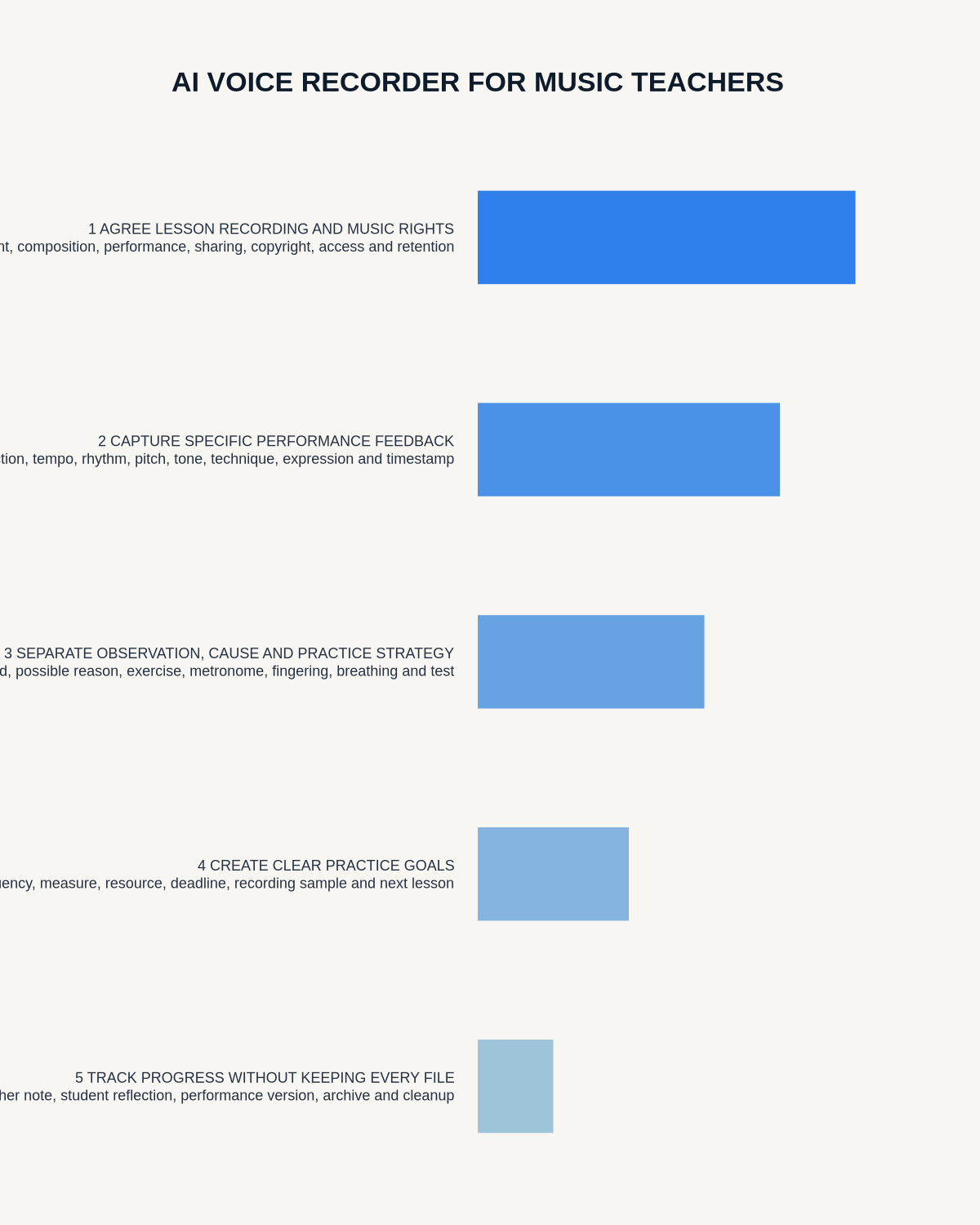
Visual map for AI Voice Recorder for Music Teachers: Lesson Feedback, Practice Goals and Progress Notes
- Prepare the approved useDefine purpose, safe position, permission and the required formal record.
- Capture context firstState the case, asset, person, location or event identifier before detail.
- Human-verify evidenceCheck technical terms, units, names, dates, decisions and uncertainty.
- Complete the formal recordTransfer only verified information and apply access and retention controls.
On this page
Related guides
See whether Halo fits this workflow
Review the NERALVO Halo specifications, included services, delivery information and current offer only after completing the guide.
Found an error or an out-of-date claim? Email support@neralvo.com with the article address and a supporting source.